


[Seagull Books, 2025]
Tr. from the Slovak by Julia Sherwood and Peter Sherwood
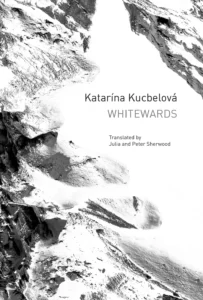
Reading Katarína Kucbelová’s book-length poem whitewards is much like going on a pilgrimage, initially seeking narrative threads but eventually giving over to the work’s metaphysical and spiritual questing. Like the book’s opening characters, three climbers attempting to ascend a mountain, readers must journey through this collection not only with a sense of being lost but also with strong desire to be found. whitewards is replete with questions that, much like the poems on the page, are starkly set against a white backdrop, whether snow, or light, or other luminous objects. Answers are less forthcoming, however, as Kucbelová strives in each section to keep her ideas on the how and why and what of departures and arrivals undefined and open.
whitewards’ set of intriguing, if enigmatic, recurring characters are the bones holding this ethereal narrative together. Central to the collection is an unnamed “she” who looks down upon much of the action from an indeterminate peak. Part hermit and wise woman, “she” is sought after as much as she seeks. Part oracle and angel, “she” is reputed and reborn, a Lazarus or Persephone cycling through awareness and hibernation. Equally central is a collective “we” that may, or may not, be in close connection to the initial three climbers depending on vantage point. Take the contrast between the opening of section 4, “three figures climbing a hill / or is it two?” and the opening of section 5, “we have climbed the hill / and sat on a rock // sheltering from the wind.” Throughout whitewards, readers must ask section to section, and sometimes stanza to stanza, who is seeing, who is speaking? This is especially true later in section 5, when viewpoint shifts into direct address: “may you find success / may you find peace / may you find love / may you find joy,” seemingly from an all-knowing “I” that proclaims:
I am your home
your ecosystem
your motherland
your polis
your soil
your abode
Is the “I” the same as the “she”—mother, earth, goddess? Or is some different being, spirit, or force omnipresent?
By letting these voices weave together and come apart, Kucbelová allows us to step into this unformed narrative in any role of this book-length poem. Likewise, each of its 43 sections seems to be a string being expertly knit into a larger whole. This structure creates an intimacy that would be difficult to maintain had Kucbelová opted to individually title each section as its own poem. Repetitions of character and image become seams in this poem, with sections benefiting from their individual stitch points and the space between the many sections’ open loops. This collected looseness mirrors our own malleability as character-readers and seems designed to move the poem and us from who am I to what am I to what will I be at the end to is this just a beginning.
Other objects have their own character roles in whitewards as well. Time is plentiful, wasted, bound to others’ ideas. It is also malleable, as seen in section 12, so that people can “go back in time and explore” or “spend their time discussing more apt / definitions” that help explain life. Snow is present even when absent, and its abundance and ability to shapeshift and be something other than what it is adds layers to many sections, including in the pivotal section 12:
sometimes we ask, is this really winter?
is this how snowflakes are meant to look?
piling up in the fold of a sleeve like
frogspawn
they are hard to capture on camera and sting
the face
And, of course, winter snow is white. Frost is white. Ice and dry grasses can be white, as can light, and paint, and champagne bubbling over in glasses. The suffix “-ward” is defined as being “in the direction of” or “toward” a location, and Kucbelová comes to the state of white through multiple directions and variants. The trajectory of whitewards carries itself like “the melted snow / which froze, then started to melt again,” and while its ultimate destination is unclear, characters and readers alike “don’t want to end up like snowflakes / on water” (section 10). Who wants to simply disappear, no longer an individual but only an undefined part of some larger, homogenous body?
To Kucbelová, stories might offer one way for us to avoid such dispersion and subsumption. In section 8, “she” is “revived” as “a person / of last resort” by those who have brought her back to life, seemingly to listen to stories they cannot share with others. “[S]ome stories had to be told / to someone,” and her capability to digest the otherwise unmentionable engenders both fear (Kucbelová notes those talking “were afraid of her” three times in this section) and need. Parents, “the old and disabled,” lonely mothers, and heads of corporations:
…kept coming to see her
often telling her the same thing over and
overslowly she learned
that sometimes a story needs to be told
again and again
before it leaves a person
and lets them live
or die
Later, in section 26, Kucbelová affirms that although “she didn’t write their stories down / or tell them to anyone else,” and only rarely gave a direct answer—“I don’t know”—to questions people asked, “they kept coming.” Such is the human need to share our lives, to seek knowledge, and to not be forgotten.
What to make, then, of sections 14, 16, 18, and 20, which are among the most physical sections within whitewards? In the first, “her” body is a heavy burden to escape from, “leaving all her weight inside,” while the next opens with an overpowering male presence that holds a female body from behind, “choking her throat…her hands behind her back, tied / to her torso.” Can we believe that the story being told in this section is of a female singer’s performance, “her choking, tearful voice her only way of / fighting / but fighting whom?” Section 18 opens with two people (a “you” and “I”) discussing what seems to be the appearance of this singer at her concert, notable in their disagreement over the color of the woman’s dress—white or an unexpected burst of the color red. The discussion continues in section 20, where the man is now holding the woman on the ground as she tries to free herself, and where the two talking cannot remember if “a single / high-heeled shoe” remained after the performers left the stage. Sections 13 and 19, each only two lines, structurally and emotionally heighten the questionable performance we are shown:
13.
but that is not what happened!
why are you telling lies19.
how did we manage to survive this?
have we survived it?
Placed near the center of the poem, these sections teem with sexual tension and border on a violence that is performative and voyeuristic. What does it mean that the two concert goers are more concerned about the color of a dress than a woman in distress? What does it mean that we, as readers, also cannot avert our gaze or intervene? Kucbelová, here and throughout whitewards, leaves her pronouns oblique and her storyline obscure, surrounded by plenty of white space that allows us to fill in our own thoughts, interpretations, and narratives. Even so, no matter how much we might wish for greater clarity, much like this subsection’s two conversationalists, we “will never learn / what really happened” (section 20).
As whitewards moves toward its conclusion, Kucbelová circles again, unbound “by our notions of time.” While section 23 announces spring, petals turn out to be just snow, people swim in a frozen lake, and we’re reminded “most suicides occur in May / (hanging oneself from a cherry tree).” The three climbers return in section 27, having seemingly come no closer to our observant “she”, who “wanted to go down to meet them // down to earth.” Things are warming up in section 30, with a first-person character piling once-red-petalled stalks atop fresh soil:
adding flowers as if stoking a hearth
I’ll give it a good stir
and wait until it gives off a fresh stench
of almost total decomposition
Things are also increasingly perilous, with those attempting to create ceruse dying of lead poisoning in section 31 and grey snow turning “into black water / as it lands” in section 34. After shockingly little color, whitewards takes on a few splashes of red, black, grey and blossom pink while marching, in section 39, toward:
…a shade of white
that reflects almost all light
absorbing less than two per cent
if you walk past
this almost perfect whiteness
you won’t see it and you’ll be suffused by a
dazzling chill
Far from comforting, these colors seem to reflect an undiagnosed, unhealed wound. In increasingly shorter sections, Kucbelová’s light serves as guidepost between worlds, between consciousness and the void. Our characters are also transfused, with “she” and “I,” “you” and “we,” permeating into each other. Is Kucbelová reaching for “the path to enlightenment and to freeing / oneself” (section 31), or is she in search of physical resurrection or rebirth? Does she speak of and to herself, the earth, humanity, its soul, the divine? By now, readers should expect no answer, though “in the end you yield to / temptation / and enter” (section 39).
In crafting a collection aloof and cold, analytical more than emotional, Kucbelová grants us an audience to her sage on a peak, while we identify more with the three travelers making little progress up her wintery mountain. The scents, sights, and sounds of this journey are repetitive, and the senses at times seem to exist only to be questioned. Questions themselves play a central role, with certain sections, like section 11, consisting entirely of questions, and others, like section 35, asking more questions than they supply answers. Most importantly, Kucbelová stacks her poems in ways that are not at first apparent as referential. The obvious recurrence of three travelers or of snowfall can, with careful reading, lead to individual lines and nearly identical images that repeat and create echoes, such as in sections 1 and 14 where weight first leaves the body but recurs as the body leaving its weight. Kucbelová is entirely correct in section 37 when she says “what people remember most are beginnings / and ends / everyone in a different way”—whitewards provides a journey that some readers may be content to take one time. Others will certainly revel, as I did, in a complex collection that opens new thresholds to cross with each reading, which is exactly how I imagine Kucbelová meant it to be.
Lisa Higgs is associate editor of RockPaperPoem. She has published three chapbooks, most recently Earthen Bound (Red Bird). A recipient of a 2022 Minnesota State Arts Board grant, her reviews and interviews can be found online at the Poetry Foundation, Kenyon Review, Adroit Journal, Full Stop, and Colorado Review.
This post may contain affiliate links.