


Think about the speech patterns of someone dear to you, Rachelle Toarmino told us, at a November workshop with Brooklyn Poets. Think about something annoying they’ve recently said or done. Think about a verbal quirk of theirs that, against all odds, you find endearing. By focusing on how this person speaks, writers can more faithfully bring them into the poem. Voice is, after all, everything a poet has to play with on the page.
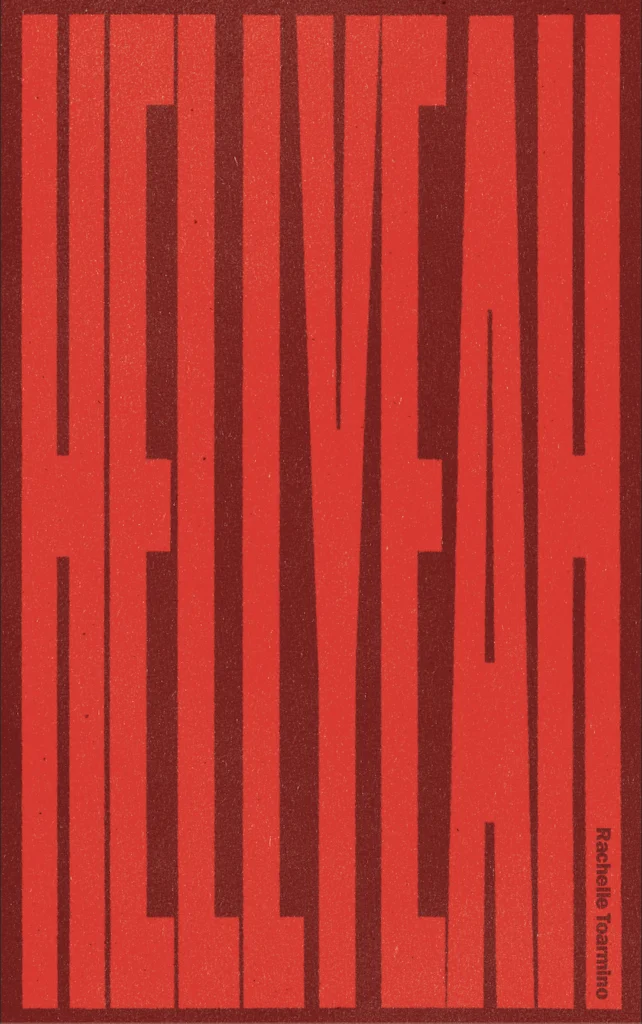
Toarmino is all about voice, and her meticulous ear for humor, polysemy, and rhythm is on full display in HELL YEAH, her second full-length collection. There is, in Toarmino’s poems, what Robert Frost described as “the sound of sense … the abstract vitality of our speech.” Her speakers exude charm, playfulness, and presence, as if they are the only person in the world who dares to say, “Hell yeah.” In case it isn’t clear, I can’t get enough of Toarmino’s various voices. Over Google Docs, I asked about her process, poetic influences, the project’s structural underpinnings, and recent language she has overheard in the wild.
Terry Nguyen: I was surprised to learn that the collection’s title, Hell Yeah, initially occurred to you as a joke. To me, it perfectly encapsulates your poetics. On the surface, ”hell yeah” is just slang—something that can be said a hundred different ways by a hundred different people. And every speaker brings a slightly different intonation to those two words, which can make a world of difference. To bring it back to your poetics, the way your speakers invoke—and subvert—common sayings, like
“You put your money where my mouth is
making it personal”
or
“[…] Well
there I go again taking
what I can get and giving
it all I’ve got. What I’ve got
is my voice and heat breaking
against it.”
feels revelatory, ecstatic, refreshing, and estranging—as if they’re the only person in the world who dares to say, Hell yeah. What draws you to “mundane,” even meme-ified speech? I’m thinking of the “I tried the whisper network” part of your poem “Comeback,” as well as “You up?”, from your debut collection That Ex. How do you find the generative in language that’s been said or written so many times before?
Rachelle Toarmino: I really appreciate this observation, because I totally agree with you. While writing the jacket copy for Hell Yeah, I kept thinking that I was articulating a poetics, rather than describing an individual project. I’m interested in language because it hides—and therefore can reveal—everything we know, feel, and believe: values, biases, and all other attitudes and dynamics between subjects and objects. It works both as a knowledge system, preserving these ideas as vocabulary and syntax, and as a tool for communication and connection.
I’m interested in poetry because of its ability to destabilize and defamiliarize this most intimate thing we have—our language—to renew our attention and reach new ideas, relationships, and meanings. I find working with common speech incredibly generative because it is the most immediate: it’s what makes up our most private thoughts, our most charged utterances, our most memorable conversations—and, significantly, our most forgettable ones, the ones that connect us to ourselves and each other every day. The how is a tougher one to answer briefly, as it’s a process that involves a lot of experiment and play: learning new languages, working with procedures, and training myself to pay close attention to the ways people speak, especially when they speak “incorrectly”—myself included, whether in conversation, thought, or dream.
TN: Do any immediate examples come to mind of incorrect speech you’ve noticed or even said yourself?
RT: It’s a family custom to fuck up idioms. “If the shoe fits,” my dad once said, “you gotta walk a mile in it.”
TN: I got a sense of your poetic influences through the two poets in the epigraph: Bernadette Mayer and Emily Dickinson. I’m curious about your relationship to lyric poetry—in “Real Romantic,” you write, “The impulse toward the lyric / is a private thing / and I’m a real insider // The sentence pulled back by its hair / settles into a miraculous / decoy for sense.””. Do you feel like you’re writing in or after the lyric tradition?
RT: I chose these two epigraphs not for their forms but because both Mayer and Dickinson are epistemological poets: they’re interested in what and how we know. Dickinson worked in a lyric mode—one that she bent, broke, and made her own—while Mayer worked more variously—the epigraph, for example, comes from Midwinter Day, a work she described as an epic. My experience of writing Hell Yeah was one of writing individual poems, most of which I wrote organically as lyrics and without an upfront awareness or conceit regarding form. But in some, I intentionally engaged with the tradition—the sonnets of the third section “Meat,” for example—to frustrate it, force it to fit my voice (and not the other way around), and leave the lyric a little more open than how I found it. I don’t think my interests in general are limited to the lyric, but when I took a step back from an early draft of this manuscript, I could see that the project as a whole was drawing on the form as mode and means for discovery.
TN: The collection is split into three sections: Music, Flowers, and Meat. The poems in “MUSIC” are kind of like condensed riffs on an idea. They seem more traditionally lyric to me, whereas “Flowers” is looser and more disparate, like we’re being strung along a daisy-chain of thoughts and feelings. “Meat,” the third and last section, consists of three poems in various forms, including a sonnet. How did you arrive at this structure?
RT: By the time I reached the arrangement stage, I discovered that the book as a whole is interested in what’s knowable and the inherited systems—in this case, common speech—that make knowledge possible. For that reason, I borrowed from traditional logic structures, which are often three parts—if-if-therefore; thesis-antithesis-synthesis; point-evidence-interpretation—to group the poems into three sections and present each section as a step in the reasoning process. “Music,” as you’ve observed, sets up a variety of lyric situations; “Flowers” becomes aware of this speaking and bends its lyric sensibility back on itself; and “Meat,” with its discoveries and renewed understandings, gets at the heart of it all to push back, double down, and arrive at something like a conclusion.
But because speech is not just for reasoning but unreasoning—delight, grief—too, or because speech becomes song when prosaic modes of thinking hit a wall, I also borrowed from the fundamentals of music theory to help the book quite literally find its groove—in this case, polyrhythm, the simultaneity of multiple independent rhythms. One traditional explanation for humans’ ability to hear polyrhythms is that the heart beats in 3/4 time while the lungs breathe in 2/4 time. In other words, the ability to break down the exact same stretch of time into multiple overlapping patterns is fundamental to us, part of our most essential experience of being alive. I followed this principle to make the sections divisible, in their own ways, by both two and three: “Music” is eighteen poems; “Flowers” is a ten-part series in triptychs; and “Meat” is three poems, with the second being a ten-part sonnet cycle in prose. This was my way of bringing together the formal reasoning of philosophy and math with the felt logic of music—which together, for me, mean and make poetry.
TN: I’m interested in this New York School-esque concept of community that’s reflected in your work—how other people’s speech and poetics naturally influence and inflect your own. Several poems in your book borrow forms and language from other poets, including Frank O’Hara, Sommer Browning, and Molly Brodak. You’re also the founding editor-in-chief of Peach Mag, and teaching poetry and organizing events through Beauty School. How has being in community with other writers informed your work?
RT: Many of my poems begin as riffs or responses to someone else’s use of language. In this book, I’m very intentionally trying to uncover how others’ ways of speaking—whether my father’s, as in “All My Life, Oh Lord,” or Frank O’Hara’s, as in “Selected Poem of Frank O’Hara”—prompt and make possible my own. In a big way, my community practices are an extension of this interest: I want to know how other people are using and trying to change the language. And at the very least, surrounding myself with other writers makes writing more fun. I’m a pack animal in these capacities. There’s a momentum and accountability to it.
TN: In the workshop you hosted at Brooklyn Poets, you read the poem “Announcement.” It’s an Italian sonnet that’s also a parodic riff on the cheesy language poets resort to when sharing their work online, but you (as the speaker) is also implicated in the poem. Now that you’re on Hell Yeah: The Tour, have you noticed any interesting speech patterns/habits that’ve come up at your book events? I’m curious whether this will manifest in your future projects.
RT: This is such a great question. A common one is being called “a poet in her own right,” usually from people who primarily know me as a publisher. Another one that interests me is “unapologetic.” For what exactly should I be apologizing?
Terry Nguyen is a poet, essayist, and critic from Garden Grove, CA. She is a first-year MFA candidate in Poetry at Columbia University.
This post may contain affiliate links.