


[Tin House; 2025]
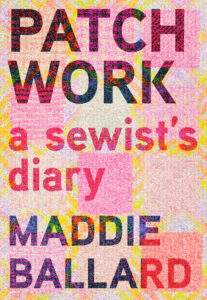
Any artistic endeavor can be an act of self-preservation and, of all art forms, clothing is particularly close to the self. In Patchwork: A Sewist’s Diary, Maddie Ballard explores sewing as “a kind of productive daydreaming: Maybe I could feel this way, if I made this garment for my body. Maybe I could be this kind of person.” Sewing is an investment, she thinks, “in what sort of person your future self will be, and how she will feel about her body, and what she will want to wear.” If you make a garment for a future version of yourself that you have yet to become, you make it under the assumption that you will exist long enough to become that person.
It’s a common enough idea that fashion is a language, a way to tell people something about yourself or, in the case of a gift, your relationship to someone else, without speaking words. But many people ignore the additional freedom of expression that making that clothing allows. It is designed specifically for you, not limited to what has already been conceptualized by other designers. Unlike simply dressing oneself, Ballard writes, “Sewing is imagining, not just assembling, a self into being.” The difference between dressing and sewing your own clothing could be seen as the difference between learning a language’s basic vocabulary and having every synonymic gradation at your disposal.
Learning this language, of course, takes time. Ballard’s first sewing projects involve as much anger and seam ripping as they do successful self-conception. My own sewing experiences are more failures than successes by a margin too horrifying to publish. My first sewing project—a cropped denim jacket that I made the night before I took the SAT—had such small arm holes that my right arm went numb by the end of the test the next day. The first pair of jeans I tried to make did not have a fly because I forgot they needed one. The second involved such heavy denim they could have stood up by themselves, sculptural. The third were so tight they incited immediate rage. The fourth I cut the pieces for nine months ago but abandoned out of some combination of depression and fear of another failure. My sewing projects, like Ballard’s, almost always begin as daydreams but, unlike Ballard’s, have almost never lived up to my visions of them and even more rarely have made me feel like the person I imagined I would become upon wearing them. When I began reading this book, I had taken a hiatus from sewing.
Ballard reminds me that to create a future self in this way cannot always be a comfortable experience. “I choose this grey plaid and cut it to my size thinking unashamedly of myself and how I want to feel, which is not how I feel now.” If she is not perfectly happy with herself as she is, choosing and adjusting patterns asks her to determine the specifics of that unhappiness, and each time she chooses to finish a garment in a more time-consuming but more secure way, it ensures her clothing will last long enough for that personal growth to take place. Every time Ballard mentioned folding a French seam, I felt vicarious safety. For anyone whose identity is largely constructed and communicated through styling, which to some extent is all of us, clothing becomes a part of you. It is easy to believe, then, that you are only as resilient and deserving of care as the cover you have given yourself. If I turn a jacket inside out and find those stiff, folded seams inside, I want to put it on. Even if no one else sees the jacket’s innards, I imagine the way I present myself in such a jacket is different from if I knew the seams against my back were merely serged together.
In trying to understand herself through sewing, Ballard wrestles with her Chinese heritage. She searches for a cheongsam that she is comfortable in but that doesn’t feel completely divorced from the culture it came from. An early attempt “looks—the words I am thinking are too Chinese. I prickle with shame. Somehow I look like I’m performing myself, like I don’t quite have a right to this outfit.” If the power of clothing is the ability to construct a somewhat idealized future self, a container for the person you wish to grow into, the challenge is to make sure this container can also hold your present self without making you feel brutally uncomfortable or like an imposter, and Ballard’s reckoning with this provides a unifying tension in the book.
In all but my most recent attempt at jeans, I did not use my own measurements to make patterns. I used the measurements I wished to be and built myself a container, thinking I deserved any creases in my skin they caused for my failure to fit the shape I desired for myself. I don’t think it’s a coincidence that the time when I was buying an ungodly amount of dying-on-arrival fast fashion was also a time in my life when I was taking the worst care of myself, when I had hardly a single fantasy of the future. When I thought about the person clothing could turn me into or my relationship to it, I was not inventing a better future self or giving her room to grow; clothing was a means to hide shame or cause pain or pretend through fraying microplastics that I was someone worthy of care I refused to give myself.
Ballard corrects what I believed it meant to make clothing for your future self. Each chapter of Patchwork centers a different sewing project, accompanied by an illustration, and these garments are ordered chronologically, suggesting the progression of Ballard’s life and sewing abilities. While she begins the book with a dress bearing “crooked, flimsy pockets and a poorly topstitched waist,” by midway through, she knows intuitively which alterations to make to a pants pattern so it will flatter her. The book reads like the quilt its title suggests. The association between the chapters is simply thread—literally, the author’s sewing practice. Sewing has wedged itself into many unrelated corners of her life, and each rectangle, each chapter, is small and different in subject, scope, time, sometimes place. Like in a real diary, we stitch in and out of stories with no idea where we’ll end up next, just knowing it will be related, somehow, to this practice.
Then again, this structure doesn’t afford as close a connection to Ballard as memoirist, which lessens the emotional attachment one can feel toward her sewing-related revelations. She writes often as if still in awe of sewing, which lets the reader appreciate it with her, and some of her discoveries are deserving of this poetic wonder: one dress “makes me conscious of my body as sensation rather than visual object. My body feels like its mine…The dress gives me back to myself.” Other lines that are meant to sound revolutionary come off as cliche or overstated, ideas that are already commonly tossed around in discussions of dressing: “who knew you had so much self to express? You always knew.” Because she makes many of these more generalized observations seemingly for the reader’s benefit, rather than showing us how she herself came to realize them, there is no personal victory to help them hit home. She reminds us that “you make the clothes to fit you, rather than the other way around.” It’s an important realization but one I’ve seen countless times already: find or make clothes that fit you, don’t change yourself to fit certain clothes. “Every garment is bespoke by default,” Ballard writes, “and your figure, not some ‘ideal’ figure, is the centre.” She makes many of these points more subtly and gracefully—for example, when she describes making a pair of pants and learning, over several attempts, exactly which parts of a typical pants pattern she must change in which ways in order to make them fit her particular waist and hips. Spelling them out again feels almost condescending, bespeaking a lack of trust between author and reader.
The episodic nature of the book also makes it difficult to fully explore the larger discussions Ballard cares about. The discussion of sewing as a means of conceptualizing a future is undercut by Ballard’s uncertainty about her own ability to meaningfully change the future outside of herself. She opens up many relevant discussions: clothing has inherent cultural, personal, artistic, political, and environmental implications. Ballard tells her partner in the first chapter, “This is the amount of labour that goes into every $10 dress on the H&M sale rack!” She considers that “It is a privilege not to have to—not to be able to—rush.” In another chapter, the neck and leg pain from sitting at a sewing machine for hours makes her think of “the women in the hot rooms in Shenzhen and Dhaka, sewing the next season’s $20 jeans for a pittance.” She recognizes that “I came to this labour by choice, that I’m sewing for myself in a bedroom in an affluent suburb of Auckland, using fabric I could easily afford.” On the other hand, she remembers that she “used to buy those $20 jeans and that there was a time when I couldn’t afford anything else.” She is scratching the surface of a massive debate over ethical consumption of clothing, but rather than place herself in a meaningful position in this debate, she ends the chapter, “It’s all so complicated and everybody is complicit. I can’t solve any of it. But I can try to make with care.” It’s true that her own sewing practice is something, but this conclusion offers little to a reader hoping for some meaningful or novel take on these issues.
Patchwork’s shortcomings are born mostly from the inherent difficulties of its format: short, differently angled vignettes aren’t necessarily conducive to addressing multiple complex themes. The truly powerful—and most interesting—idea she brings to fashion discourse is her initial insistence on clothing as a promise for a particular, sometimes distant, future. This is a creative way of challenging the fleeting trend cycles and flimsy garments that rule much of the ready-to-wear fashion landscape today, one I have not seen given so much thought before. Besides this new way of appreciating sewing, much of the book’s emotional impact, for me, came from relating to Ballard’s experiences as someone who also sews. As an amateur clothing designer often brought to a state of despair by mistake-riddled garments, I was inspired not to give up on successfully making or adjusting a pattern. Perhaps the most valuable thought this book can sow in a reader’s mind is that, no matter how much you insist you don’t care about fashion, no one can escape having a relationship to clothes. We can cultivate an estranged, uncomfortable, confused relationship, or we can develop something intimate, a relationship that helps us to understand and enjoy existing as ourselves a bit more.
Erin Evans is a writer from Michigan, now living in New York. She studied Creative Writing and Literature at the University of Michigan, where she also worked as an arts writer and editor for The Michigan Daily. Her essays and criticism have appeared there and in Vestoj.
This post may contain affiliate links.