


I came upon Rebecca van Laer’s work in the form of a care package sent to me by Long Day Press’s very own Joshua Bohnsack, along with a note saying he was sure van Laer’s How to Adjust to the Dark was up my alley. It was, in fact, as was made clear by my reading it in a day, unable to put it down. Laer is now back with Cat, out via Bloomsbury as part of their “Object Lessons” series, a beautiful meditation on companionship, grief, what defines the notion of “home,” and much more. Even if you aren’t a self-proclaimed “cat person” (I admit in our correspondence below that for a long time I wasn’t), there is much wisdom to be absorbed in the pages of this book.
Rebecca,
I think I should start this exchange about your new book Cat by admitting: I am one of those people who used to proclaim a hatred of cats.
When I was a kid, I was proven to be violently allergic, and when that’s told to you so young, you’re sort of conditioned to believe in your allergy as an enemy. This was all until I was faced with the problem you mention in your book: I fell in love with someone who had a cat. Our romance unfolded in brief, intoxicating visits to my city, culminating in a weekend I spent visiting him in his small town, which also meant a stay with a furry gray bedfellow. I packed every form of antihistamine I had, prepared to be all nose-runny and puffy and ugly, but isn’t that a sign of love? To be your entire self in front of someone?
When I first got to the apartment, the cat eyed me suspiciously, as if aware of my fear of him. But within a minute, he was nestled into my lap, wiping his upper lip along my knuckles. “You’re petting him like he’s a dog,” the guy I was seeing said, and showed me the cat’s favorite spots. Although we tried to get him to sleep in the living room, he refused, preferring the curve of my abdomen. For a long weekend, we became inseparable. And the craziest thing was: I wasn’t even that allergic. I’m starting to wonder if I ever was as deathly allergic as I was told I was.
You mention in your book that it’s way more common for people to claim a hatred of cats v. dogs. Why do you think this is? Is there a historical explanation? Is it behavioral/psychological? Is it image related?
Best,
Sofia
—
Sofia,
I have been on the other end of such a romance—my senior year of college, my boyfriend would only spend a few minutes at my apartment. When I graduated and moved back in with my parents, we made an elaborate attempt to make it comfortable for him to sleep outside in a screened-in room on their deck. But it was too buggy; it turned out that the cat allergy was less threatening than the fluttering, biting insects. After the night inside, he was fine.
Allergies are weird. Some come and go over time. Some improve with exposure therapy, where some only get worse. In writing my book, I found that people with cat allergies were more likely to avoid cats altogether than people with dog allergies were to avoid dogs. And I do think this is related to a long (Western) tradition of cat hatred. Cats have been seen as sneaky, duplicitous, and even devilish. There’s a history of cat murder alongside witch hunts, and a more general association between misogyny and dislike of cats, since cats are often (negatively) feminized in the cultural imagination. Even if we’re totally unaware of this history on a conscious level, it shapes our attitudes. I’m thinking of the woman yelling at a cat meme—it’s become a template for so many jokes, but in all of them, the cat is hostile to Taylor Armstrong’s tears.
On another level, it’s sometimes pleasurable to hate things, and it’s culturally acceptable to hate cats. I always saw that boyfriend’s total rejection of my cat as, on a deeper level, related to his rejection of me. Although I know cat allergies are real, I was convinced my cat represented the things about me he couldn’t tolerate and wanted to protect himself from. When he spent that night in my parents’ house without incident, it became a little bit clearer that this was true. He could stand some exposure to the things that made him uncomfortable; he’d just prefer not to. Needless to say, we broke up.
Now, I’m allergic to honey bee venom. My dad has over thirty bee hives. I still visit him at his house, my epi pen in hand.
Did that love change your relationship to cats forever? Or was that long weekend an isolated event?
Rebecca
—
Rebecca,
There’s something very poetic about you still visiting your dad despite: 1) your allergy and 2) the concentrated potential of reaction present. Do you think writing memoir is a bit like that? There’s something that feels borderline-dangerous about having to mine our own memories, to face what might be long suppressed.
That weekend definitely changed my relationship to cats. I am not as afraid of them anymore. It’s still going to take some time, considering I have a whole 25+ years of fear to deal with. But it does make me curious about how much of our fear/hatred comes from external forces when we are children, before we have enough sense of self to develop and codify our own opinion of things.
As a fellow writer, I am curious to hear about where this book started for you. Do you remember the first pages you wrote for it? At what point did it take the shape of a longer project? Is it what you envisioned from the beginning when you chose a project about cats, or has it materialized into something unexpected?
Best,
Sofia
—
Sofia,
I underwent venom therapy as soon as I found out about the allergy so that I’d feel safer in the world in general. That’s how a venom allergy works—you can lessen the chance of a response by having small amounts injected over time until your tolerance builds up. I fear that this is, in many ways, a metaphor for writing, or at least the way I use writing to metabolize the material of my life. Writing to make sense of things feels both prophylactic (I will process an event, a thought in a safe space) and at times a little dangerous (Is it safe? what will happen as I bore further and further down?).
Writing this book took an unexpected shape with unexpected revelations along the way. It started as something fun, a little whimsical in 2021—I called it a short story, even though I was already trying to sort out what Toby and Gus mean to my partner Steven and myself, even though I was calling it fiction. I felt I wanted to expand it into a book, but I really didn’t know what that book was until Toby died in January 2022 and I started frantically recording everything that happened more-or-less in real time, taking notes at the kitchen table in the early winter light just after he’d been euthanized at the emergency vet. I thought I would want to have the raw emotion later, and I was right. I wrote a (nonfiction) book proposal for Object Lessons with the rough shape outlined. Then I took time away from the project while I was waiting to hear back. A year later, I opened a document to find almost 10k words (almost half the book’s total word count). It was a little wild to see the work my past self had done to simply get everything down, and then I got to go more deeply into it from a later vantage point.
During that long period—2021 to when I actually turned the book in last summer—I had also wrestled with the question of whether to have kids. In the early stages of the project, I had no idea that that would be a focus of the book. Even a year later, the decision didn’t seem final. But by the time I finished drafting, it was, which also gave the book a through-line and focus that was originally inconceivable.
I’m so glad you’re less afraid of cats. A few early readers (anonymous strangers, reviewers) have said that I come off as “phobic” in the book, which I think is very true! I’m always trying to figure out when my fear is protective and valid is where it’s something else. I wish that this process, like writing, was faster.
Rebecca
—
Rebecca,
I relate to this so much. I find that I can never know the full scope of a project until it’s already becoming larger than I originally intended, both in fiction and music. I’m writing songs and songs and some more songs, and then suddenly there’s an album in front of me. I also cannot superimpose the theme or guiding question while the writing is happening; instead, it seems to emerge in the afterglow of creation, on its own.
I also find it interesting that the point in which the project became the project was when you experienced a significant loss. There’s something strangely beautiful that happens in that cloudy period of grief, I’ve found, when your survival instincts kick in, encouraging you to participate in the ritual of memorializing. I feel like there’s often this trope that you have to wait until you’re fully “healed” in order to write about something, but I don’t always believe in that. Some of my favorite art is so potent with a sense of immediacy, something that could never have happened on the page if the writer had waited for calmer waters.
“Phobic!” I would love to hear more about this. What do you consider yourself phobic of? And how would you say that shows itself in your writing? And, to be future-looking, how would you say that is shaping, if at all, the writing you are currently working on?
Best,
Sofia
—
Sofia,
I love the way you describe your work unfolding—this mysterious, illuminated and illuminating process of growth. I think I share that experience in many ways, but yes, loss and other lived experience can suddenly cast it all in a new light. In the last few years, grief in particular has reshaped not this project but the others I wrote concurrently. Sixteen months after Toby’s death, my childhood best friend passed away unexpectedly. In the wake of that loss, I threw away a novel I’d been working on for two years and started something written out of that experience, in her memory—and, in a similar way to Cat, in a rush of feeling. I’m so glad to have pages and pages of writing from that experience and its immediate aftermath. Due to the timing, I worked on this alongside Cat, often going back and forth between the two projects, although only the latter had a deadline.
I’ve told friends that I think I need two years after a first draft to really “get” my own work; that is, to fully understand what it wants to be, or what I want it to be. With Cat, external forces imposed reflection and pauses as I waited for news and edits. With my newer novel—well, it’s been a little over two years now, so I hope I’m starting to gain the perspective that helps me shape that visceral outpouring.
As for phobia—oh, where to start! I would say that in the last few years, poison has been at the forefront of my mind. It all started with mushroom foraging; I licked a bolete in the forest and it was indescribably bitter. I threw it on the ground, then gathered up the shards in case I needed to bring it to the ER. It was a long walk back to the parking lot, and a long time before I accepted I had licked a bitter bolete, a nonpoisonous porcini lookalike that couldn’t hurt me. The fact is that no mushroom can kill you unless you ingest it, but this was not enough to comfort me at first.
A few months later, I suddenly had that allergic reaction to a bee sting. At the time, I was keeping bees, and had been stung plenty before, so it came out of nowhere. And after that, my thoughts began to swirl and circulate around botulism, cherry pits, mold. This is not to say that all my phobias are food or poison based. I think I’ve always had a lot of anxiety, and my psyche has increasingly attached it to the idea of outside contamination. I don’t think any of this is in Cat, so it’s interesting to see readers picking up on an underlying current of fear. I’m trying to think about it more in the novel I mentioned above: what am I so afraid of, on a deeper level? Why has that fear taken its current form? Of course, I’m also balancing that with “plot”—the perennial challenge of prose!
I’d love to hear about the projects you’re working on in this exchange or later!
Rebecca
—
Rebecca,
As someone who is hitting the two-year mark of a draft of a project, this is so reassuring to hear. There are times I have felt like I’ve really lost the thread, and fear it is lost forever, but hearing that it takes two years for you to “get” your own work even after the first draft is so comforting. There is such a pressure on fast content these days that the slow way can seem so subversive, but I think it’s absolutely vital.
And this interview is about your wonderful book! But I can briefly share that I have an album coming out next year, a follow up to my album that came out in 2024. I also have been working on two novels, one that has been done for a bit, and another that was my MFA thesis. I just finished up the program at the New School in the spring. The latter is the book I already mentioned, something I am really struggling with, to the point that at times the struggle hardly feels worth it. But I know if I stick with it, the book will eventually reveal itself to me. It’s the same in music. I often have no idea what the songs are about until the record is out and I’m listening back and finally understanding what I meant, or how certain themes spin out across an album.
Speaking of music, for our final exchange, I want to ask you: When you were writing Cat, what other art were you engaging with? Books of course, but I’m also thinking films, visual art, music, etc. Or do you tend to shut out the outside world when you’re deep within a draft?
Best,
Sofia
—
Sofia,
It was so great to listen to your first album while working last week! Yay for the new one in 2026. I’m so jealous of people who work in more than one medium and can move between them. My dad recently gave me a whole host of paints and colored pencils, and after a few days of doodling, I felt the urge to plunge headfirst back into writing. I’m always doing this, even though I know that inactivity and distance are key to the process. It’s just so hard to be patient—exactly what you say, there is a pressure to be fast. It can be overwhelming to scroll through social media and see all the work being put out. All the people who are, somehow, fast. And I also have for a long time had the fantasy that my art will, some day, provide my livelihood. Naturally I want to speed up the timeline to make that possible. But perhaps there is no timeline in which that will happen, and unfortunately, the more I focus on that, the further away meaning and clarity seem to get. So yes, trying, always, to let myself go slow.
As part of that, I definitely let the outside world filter into my work. I took it upon myself to do a lot of cat research as I was writing the book. However, two books that I read concurrently and that were not ostensibly about cats were Gayl Jones’ The Birdcatcher and Magda Szabo’s The Door. Both of these are about friendships between two women who are ruining each other’s lives. Friendship is one of the big themes of my work—I suppose, at this point, my unpublished work, aside from short stories in Joyland and The Oyez Review. Love, cats, friendship—intimacy and its ambivalences is of perpetual interest to me. Both of these novels are hilarious and horrifying, and the latter ended up actually having everything to do with cats, in a way that I should probably write an essay about. I am also a big movie watcher, and films that gave me a lot to think about in relation to my work were The Natural History of the Chicken, The Beast, and Evil Does Not Exist. While writing, I can’t listen to anything with lyrics. Lyra Pramuk, Celer, and other ambient and experimental music was on heavy rotation. I also listened to a lot of the punk of my youth driving in the car, singing and crying. An important combination for me.
Thank you so much for engaging with my work—and please keep me posted on where yours is going! I think we have to believe that the path forward will always reveal itself, even though it always takes longer than is comfortable.
Rebecca
—
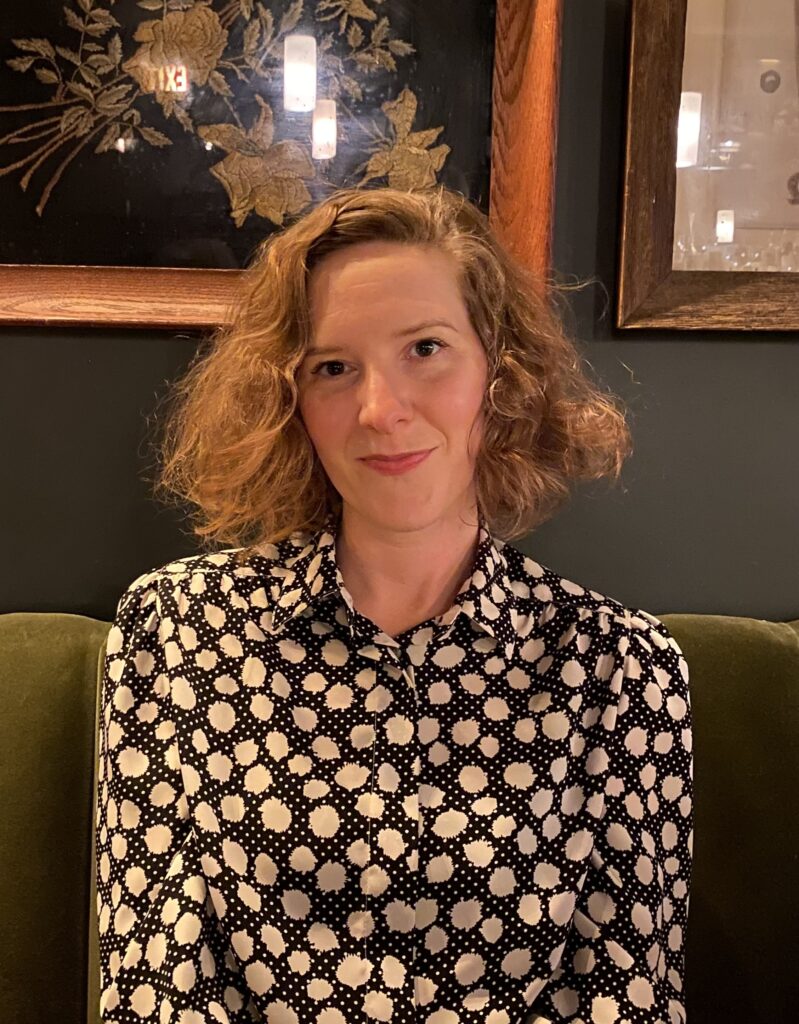
Sofia Wolfson is a musician and writer from LA, now based in Brooklyn. For the last decade, she has been touring the US and Europe with original music. She has released several albums, including Imposing on a Hometown (2024), which was on the Cosmopolitan, Line of Best Fit, and New Commute “best of the year” lists. Her fiction has been previously published in Superstition Review, Flash Fiction Magazine, Open Ceilings, Westwind, and Oyez Review. She is an assistant editor at the Fretboard Journal, a quarterly guitar-focused magazine, and received her MFA in fiction from the New School.
This post may contain affiliate links.