


[New Directions; 2025]
Tr. from the Spanish by Robin Myers
By 1625, the story of Antonio de Erauso was being disseminated across Europe through word of mouth and print alike. It was only one year earlier, in 1624, that Erauso secretly embarked on a Spanish galleon from Cartagena, Colombia to plead his innocence to Pope Urban VIII. Thanks to the many surviving letters, testimonies, and civil documents written by Erauso himself in the seventeenth century, we are fairly certain of the way Erauso wanted to be seen and the way he viewed himself. This corpus of manuscripts was eventually compiled into a concise—yet not entirely reliable—Historia de la Monja Alferez. This history, which refers to Antonio as the soldier nun (Monja Alferez), represents the cultural and historical attitude of scholars toward Erauso’s story. Even during Erauso’s life, he was imagined as a spectacle and a contradiction to the readers of his story.
After leaving his convent in Spain at age fifteen, Antonio de Erauso, born Catalina de Erauso, fled to the so-called Nuevo Mundo where he held every profession from sheriff to merchant to soldier. While breaking gender norms was certainly frowned upon during the seventeenth century, Erauso’s vocation, behavior, and dress allowed him to live unimpeded as a man. His military service and success as a conquistador gave his story, penned by himself, credibility for the Vatican and the Spanish crown. Erauso’s narrative was compelling not only because he is what we might consider today ‘transgender’, but also due to the sheer volume of violence, crime, and trouble he caused while living in colonial Latin America. In other words, Erauso was a true man-of-empire.
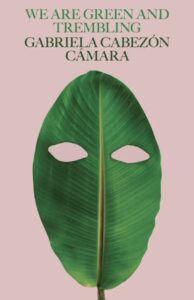
Robin Myers’ expert translation of Gabriela Cabezón Cámara’s We Are Green and Trembling introduces something new into the long history of narratives about Antonio de Erauso. This is not Myers’ first rodeo with contemporary Latin American authors—before this novel, Myers translated authors like Cristina Rivera Garza and Mateo García Elizondo.
There is a rhythm you fall into while reading We Are Green and Trembling unlike the rhythms offered by other recent novels. Cámara enters an incredible canon of Latin American Neo-Baroque writers, and does so with confidence and elegance. Her narration is not as obtuse or uninviting as some Neo-Baroque writers like Jose Lezama Lima, Carlos Fuentes, or Alejo Carpentier. But, as Carpentier did in his novel The Lost Steps, Cámara puts the forests of Latin American center-stage in a narrative ultimately built on the conquest, and counterconquest, of formerly colonized countries.
We are Green and Trembling picks up in Erauso’s history where other narratives, like La Monja Alferez and La Historia de la Monja Alferez (1829), end. After killing his brother, being imprisoned countless times, and petitioning the pope, there is the jungle. On the opening pages, Cámara introduces the reader to the novel’s multiplicity of voices. The first voice is Erauso’s, which breaks through the other text in the form of a letter to his aunt in Spain. As was typical during the seventeenth century, literate individuals wrote and read in alta voz––out loud. Cámara imitates this practice as the written word reacts dynamically to the protagonist’s surroundings:
“…I am telling you now, the story of being here inside a tree, if only you could see it, beloved aunt; its enormous trunk is hollow below and courses with cool air even on the torridest of days, the yvrá pytá, the girl taught me the name of the tree, as she taught me the name of nearly everything else in this place. The girl knows things, my dear, she is a wise child. Do you too believe that everything I have lived thus far has led me to where I am? To this jungle, to these girls, to this letter.”
The fictional letter is a throughline, integrating the original story of La Monja Alferez into the events of the novel in what sometimes comes across as an obvious attempt for Cámara to give the reader a history lesson. And though most works of historical fiction would include the bare bone facts of history into the story’s primary narrative, We are Green neatly delineates the history and the fiction, defying genre conventions. Much of the novel is written in third-person omniscient, while the letters are from Erauso’s perspective. These two perspectives follow a dialogue between the past and an imagined present with Cámara’s authorial voice coming through clearly, and intentionally in that conversation.
When you read La Monja Alferez, Cámara’s source text, you also read what is not there: the voices of the indigenous people that would have lived alongside Erauso, guided him, and fought against him. A young indigenous girl, Mitãkuña, sings a skeptical refrain in response to Erauso as he writes his letter, accusing him: “‘I hear you for hours. Lies you speak, Yvypo Amboae, lies to your aunt.’” Within Mitãkuña’s voice—a mixture of Guaraní and English—is also Cámara’s own skepticism of Erauso’s story and his Baroque, picaresque, manner of writing.
His young interrogators demand he explain concepts like ‘God’, ‘Spain’, and ‘Satan’ to them. The urge to etymologize and explain everything is reversed—the colonized attempts to define the colonizer. Erauso is the stranger in this world and he, the conquistador, becomes a subject in the dominion of this new world. This reversal, the counterconquest, is Cámara’s strongest political statement in the novel. As he escapes the Old World’s constraints, Erauso finds refuge in the environment (the jungle, animals, and terrain) and the indigenous people of the new world. Cámara often includes themes of exploitative capitalism and its effects on the natural world in her writing, and this novel is no different.
In his letter, Erauso narrates his repeated imprisonment by other Spaniards, his tendency for violence, and his various near-death experiences. Erauso attributes his ability to get out of ever-more dangerous situations to “The Virgin of the Orange Grove.” He promises the Virgin that he will help the girls survive and make an offering of oranges, a non-native fruit of Latin America. The tension between Erauso’s faith in Catholicism—historians call him the soldier nun—and environment that keeps him safe comes to a fore in the last few chapters:
“Maybe God is a she-jaguar. Or the beetle he’s just spied inside a flower. Like a precious stone glittering in the fragrance of the blossom’s white cup. He doesn’t know. What he does know is that he’s surrounded by Indians who are looking after him… It must be a miracle of the Virgin of the Orange Grove.”
His “promise” to the Virgin fades. Instead, he puts his faith into the ecosystem and Guaraní people around him. At the end of We are Green and Trembling, Erauso folds into a part of the natural setting, like the foliage, scenery, or an old colonial ruin overgrown with vines:
“He returned to America. Went back to being, yet again, anyone. To flee again, though he no longer needed to. Now, in this abiding, in this jungle, in these girls, in these animals, in this state of being with no story and no name, he feels comfortable. He could stay here.”
Cámara does not attempt to rewrite the history books with her interpretation of Antonio de Erauso and his life. She strips away boundaries between gender, the colonized and colonizer, historical fact and fiction, human and animal. The protagonist of We are Green is not the same Antonio de Erauso in La Monja Alferez. Cámara’s Erauso sees the ecosystem around him and the indigenous Guaraní who call it home. As the reader, you ask how Erauso’s letter, the only physical trace of Europe other than Erauso himself, survives the jungle’s damp and humid environment. But his surroundings seep into the letter through the increasing mentions of the Mitãkuña and Michí, the jungle flora, the songs he hears the Guaraní sing amongst the trees and teach him:
“Now I see, my dear; the girls draw upon my body. They tell me how the world was made, they believe a goddess made it, one fed by a hummingbird.”
Armie Chardiet is a translator, writer, editor, and aspiring professional hobby-jogger based out of West Philadelphia, near the old trees of Clark Park and the rolling hills of the Woodlands Cemetery. Free Palestine, from the river to the sea.
This post may contain affiliate links.