


[New York Review Books; 2026]
Has there ever been a city more primed for disillusionment than Paris? Even for those who’ve never visited, the city feels familiar for all its infinite representations across paintings and postcards, movies and social media, each endowing the city with the particular viewpoint of someone who’s come before. But because of this ubiquity, Paris risks becoming ever less knowable to its millions of annual visitors. Is it even worth trying?
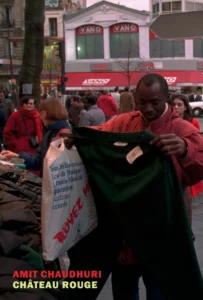
In his new novel Château Rouge, Amit Chaudhuri takes his turn at answering this question, exploring ideas of what it means to simply be, authentically, in a city so bogged down by other people’s depictions. The narrator must face down his own expectations over the course of an extended stay in Paris, situating himself after all the writers, artists, and philosophers who have preceded him and whose own versions of the city endure—a legacy that risks tilting from intellectual heft into just baggage.
Similar to Chaudhuri, the unnamed narrator is a writer, musician, and singer from India. Arriving in Paris a few hours earlier than his wife, a professor, and their teenage daughter for a months-long fellowship at the fictional American Center for Thought in Paris (perhaps inspired by Chaudhuri’s fellowship at the Columbia Institute of Ideas and Imagination), the narrator’s first impressions portend grave disappointment. He has sublet an apartment in Château Rouge, a neighborhood in Paris’ 18th arrondissement with a vibrant African community.
Exiting the Gare du Nord, the narrator finds himself “thrown into chaos.” His initial observations of the neighborhood are “how unimpressive everything was” and that “[t]he pavements were dirty.” A supermarket reminds him of “a relief camp… The migrants in the queues were impatient and obstreperous: they had an animating appetite for life.” His abiding pique suggests the condescension of an old-world gentleman jostled by a crowd. As he gets his bearings before his family arrives, doubts surface over the entire endeavor: “‘Why am I here?’ It wasn’t a question I wished to dwell on. I felt disappointed – in the surroundings, in myself. Are these people okay? Am I in any danger?”
Alas, the apartment is no better. Chaudhuri packs the narrator’s dour commentary with mischievous humor. In the main room of the apartment, “[t]hings seemed wrecked, flattened, or missing. The spaciousness was real: it was like standing in an emptied-out abattoir. The futon on the floor was a casualty. I walked around it.” The bathroom, for its part, “was suspect… In the bowl was a history of staining. It was archaeological – presenting no immediate threat.” Even before his family arrives, he decides then and there that he can’t stay in this apartment.
But it seems that the true letdown for both the neighborhood and apartment is that they don’t offer the particular type of “Parisian grime” that the narrator had hoped for and in which the other fellows will live: “I, on the other hand, would not know what it meant to live in Paris. I would be making an inventory of things in the flat that needed urgent attention.” For all its problems, the apartment is perfectly habitable, but the narrator suffers from the way in which it hasn’t met his expectations. His wife brings more optimism but is met with his deflating asides: “That’s a nice garden! (not true; more a space for prisoner access).” At times, the narrator’s bellyaching can be grating, his petulance verging on the out-of-touch.
The origins of the narrator’s preconceptions are never far from sight. He reads essays by Hannah Arendt and Walter Benjamin about the sky over Paris. He thinks about Jean-Paul Sartre, and he reflects on Woody Allen’s Midnight in Paris. The narrator and his wife even receive an invitation to visit Jacques Rancière, and he marvels at the idea that he shares the city with the philosopher. Chaudhuri, just like the narrator, is a writer’s writer, and Château Rouge evokes the autofictional conceits and travel writing of novels such as Maria Stepanova’s The Disappearing Act, Katie Kitamura’s A Separation, Ben Lerner’s Leaving the Atocha Station, and Rachel Cusk’s Outline trilogy.
Decades earlier, the narrator’s wife gifted him a copy of A Moveable Feast that he has yet to read. On their first morning in their apartment, she quips: “You know, if Hemingway were living in Paris now, this is where he’d be.” But the narrator doesn’t respond well to this, asking her not to tell anyone what she told him. The reality is that, tormented by the shadow of his predecessors, he envies Hemingway, for whom he falsely supposes that “‘the experience of Paris’ didn’t have a prior definition. It was the here and now.”
And so, equipped with so many versions of what Paris should be, the narrator sets out to seek out the authentic in the city, and is thus quick to write off Château Rouge: “Not that the neighborhood was ‘French.’ It had adopted a version of Frenchness.” In the narrator’s estimation, Château Rouge is only an imitation of Paris, not the genuine thing. His first meal at a Parisian café by Clignancourt is a disappointing assemblage of tinned tuna and tasteless lettuce, but at least, he feels, this is the real deal: “I paid up speechlessly. I disliked it; but it met my expectations.”
The narrator can never quite separate his expectations of what Paris should be, full of art museums and fine dining and Hausmannian apartment blocks, from what it is, a lived-in city where people buy ready-made dinners at supermarket chains. He lingers over the perennial question of how to be in a place that has been so documented, so mythologized, and so fictionalized that authenticity is always mediated. At one point he concludes: “This was Paris. To live in Paris means to know you’re living there. I still feel a terrible urge to conform. To live in Paris and be separated from it would be dreadful.” But just what this means, and from what exactly he means by separation, is never explained.
Indeed, it is the narrator’s gaze that seems to primarily demarcate whether something qualifies as Parisian or not. In Barbès, a predominantly Arab neighborhood, he complains: “They wouldn’t know what to say if you asked for directions. And they don’t recognise Montmartre… Barbès is a law unto itself.” He is constantly confounded by his own prejudices: “The man was kind; he had little English. He put paid to my belief that Africans might know more English words than the French.” But there is a sense that the narrator is only playacting his othering in order to fit his version of a Parisian bohemian: “I desired to be a philistine about Europe, in return for Europeans being philistines. Ignorance wasn’t easy to achieve: non-Europeans know a lot.”
Château Rouge, Chaudhuri’s ninth novel, is composed of many such philosophical musings and street observations, some sections made up of a mere sentence or two. As in earlier novels like Sojourn, in which an unnamed professor chronicles an extended stay in Berlin, or Afternoon Raag, a series of richly-drawn reminiscences about a former student’s time at Oxford, Château Rouge recalls the travel diary of a nameless narrator, full of passing thoughts jotted down at busy cafés and crowded museums: “The Palais-Royal is a gilded cafe. Its trees are like bars, orderly and placatory. They’re as substantial as spumes of smoke. Enchanted, we’re content to wander from spot to spot all day.” Some of his theoretical asides reflect on more everyday life. Shopping trolleys are a symptom of “ingrained migrancy,” while he labels pasta “the esperanto of food – the language everyone knows a bit of.”
Owing in part to this journalistic style, the narrator and his family seem somewhat alien as they explore the grand sights of the city. At the Musée d’Orsay, the narrator observes that “people in the room were like rushes – still and thick. Their bodies had the tension of those who were listening. Almost everyone had headsets on. We navigated them, keeping mostly silent.” Throughout the book, the narrator remains largely detached on his flâneur-like wanderings, hardly seeming to interact with anyone outside his family. He cultivates a couple one-sided acquaintances with local street vendors from Bangladesh and Pakistan, but they seem mostly bemused by him.
As time goes by, the narrator uses all his walking to chart out the city through meanings specific to himself, creating a personalized map. He divides Château Rouge into three regions: “the West African,” “the Arab strip,” and “the working-class French.” In effect, he has begun to create his own mythology of the city, accepting his version as intrinsically valid: “It was a good location from which to savour ‘Paris.’ I was beginning to feel it would be best not to settle down in areas recognisably Parisian, because places recognisably themselves tend to be fictitious.” He begins to feel an attachment to Château Rouge and, miraculously, even “what I’d come to think of as my apartment.”
So begins the narrator’s own pivot to romanticizing his version of the city—only the latest in a long and robust tradition. As it turns out, the narrator’s initial visit for the fellowship is just the most recent of several trips he’s taken in the past. He compares monuments like the Arc de Triomphe and the Eiffel Tower to his “staid landmarks…I had checked them out as a child and then a young man, etched my presence like graffiti on the scrawl of other presences, past and present, in those neighborhoods.” His presence in the city is simply set atop what’s come before—and will itself be buried someday.
In the later sections, after his fellowship has ended, the narrator revisits Paris periodically, drawn back to Château Rouge to see how the neighborhood has changed in the intervening years. He notices the proliferation of posters for the Front populaire left-wing coalition in the lead-up to the 2024 legislative elections, the ongoing construction for the Paris Olympic games, and the inescapable presence of the populist gilets jaunes protesters. He revisits the street vendors he used to talk to. Even though some don’t remember him, he insists on taking selfies with them.
A final visit to Château Rouge reveals that an art gallery has opened up in a former warehouse: “I’m pleased; but next moment I’m wary. Maybe bohemians – artists, playwrights – will move in, taking advantage – as is customary – of low rents. The migrants will move out. The bohemians will be drawn to the ‘music in the air’ and replace it with the energy of their creative projects – ‘biff,’ ‘bam,’ ‘boom.’” Chaudhuri entrusts the irony to the reader, seeing as, unwittingly or not, the narrator himself was the first sign of this gentrification. Either way, it’s his version of the city, already ephemeral, that he clings to—as if Paris, or any place, ever remains the same.
What is perhaps new is the ways in which Paris is changing as a result of globalization, making things begin to feel the same. For example, when the narrator and his wife go to meet Rancière, they find his apartment located above “a Brooklyn-style café.” The narrator and his family seek comfort by streaming anonymous shows on Netflix, follow the blue dots on Google Maps to get places, and evaluate a fried chicken shop as only marginally better than KFC.
The narrator recalls how, in the heady years of the 1990s, such American fast-food chains were exotic commodities, where people flocked for a taste of the future. Now, however, these places have since become so familiar that the reverse has occurred: “it’s the artifice of Paris that’s become the other, elusive commodity.” He enjoys the human-interest of watching produce vendors sell yams, cabbage, and peanuts, but he knows he’ll never actually shop there: “It’ll always be display. I’ll get my essentials from Carrefour and Franprix and meals from Marks and Spencer’s.” Perhaps, the narrator seems to suggest, a modern-day Hemingway would be an M&S shopper, too.
A family crisis spurs the narrator’s most decisive action. The illness and death of his father-in-law forces him to return twice to India, which provides a foil to his nonstop observations in Paris. In India, he is simply among family, without any need to reflect on his surroundings. For the funeral, he plans to sing two different songs, but the Acharya objects to one of them on philosophical grounds. This, in turn, prompts the narrator to push back: “I become intransigent. I say to my wife that I don’t see any reason why I shouldn’t sing bahe nirantara ananta that I would like to sing it.”
The narrator and the Acharya debate the meaning of the song in question, until his mother-in-law intervenes, brokering an uneasy compromise that ultimately allows the narrator to sing and, in doing so, to finally just be himself. This decisive action, though it comes late in Château Rouge, is almost disorienting, providing a sharp contrast to all the detached musings that have come before. It’s almost as if the narrator’s unending compulsion to observe and interrogate the authenticity of his experience in Paris—weighed down by all those books and movies—has gotten in the way of having any kind of experience at all.
Eamon McGrath is a writer based in Brooklyn. His work has appeared in the Los Angeles Review of Books, Asymptote, the Chicago Review of Books, and other places.
This post may contain affiliate links.