


This review was originally published in the Full Stop Quarterly “Tender Tongues,” edited by Natália Affonso. Subscribe at our Patreon page to get access to this and future issues, also available for purchase here.
[Counterpoint Press; 2025]
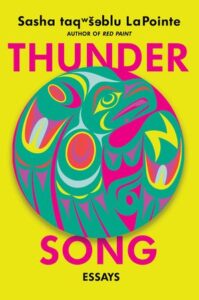
When I began writing this book review, I was hoping to do it with as much care and respect as Sasha taqwšəblu LaPointe put into writing Thunder Song: Essays (2024). Flowing from her family stories and her own memories, the essays in Thunder Song are, as Counterpoint Press put it, “unapologetically punk.” They sing Indigenous identity and heritage, addressing the interconnected matters of coloniality, displacement, and the environment. Thunder Song travels between life on Earth and the spiritual world, highlighting art, especially music, as sites of memory and decolonizing tools. LaPointe hoped to reach readers who could relate, and here I am, honored to reach back, in a way, by sharing my thoughts so perhaps you, too, will make your way to her work.
Sasha taqwšəblu LaPointe is “a Coast Salish woman, as a woman who comes from salmon people.” She is from the Upper Skagit and Nooksack Indian Tribes. She is native to the Pacific Northwest and grew up with a mixed heritage. I, too, grew up with a mixed heritage in a place we call Brazil, far removed from my father’s Indigenous roots and family. An illegitimate daughter who craved tradition, listening to a blood that sang (and sings) heritage. My mother tried to teach me, but it always felt like it was supposed to be a secret—like me. I believe this is one of the reasons LaPointe’s words resonate so much. She sings a tune that my heart recognizes, a soundtrack to so many of my yearnings.
LaPointe holds a double MFA in creative nonfiction and poetry from the Institute of American Indian Arts (IAIA). She is the author of the critically acclaimed memoir Red Paint (2022) and the poetry collection Rose Quartz (2023). In her third book and second memoir, Thunder Song: Essays (2024), LaPointe chronicles her journey of self-discovery and healing, diving into memory, music, and cultural heritage, with beautiful reflections on her life and ancestry. The collection is a powerful symphony of heritage, identity, and rexistance.
Rexistance. It is hard to live defying statistics and fighting a world that wants you gone. “In the United States, indigenous women are murdered at a rate ten times higher than other ethnicities. More than four out of five indigenous women have experienced violence.” In my reality, Brazil is not that much different. Although the numbers regarding violence towards Indigenous women are not accurate, considering the unreported violence that happens in areas invaded by illegal miners, landgrabbers, loggers and the lot. Like LaPointe, I hear unheard voices and “The thing about our stories is that they haven’t been told.” LaPointe’s words are a celebration to Indigenous women’s voices and Thunder Song feels like a rescuing mission, reverberating stories hidden behind nameless numbers in statistics.
LaPointe celebrates language as a way of reconnecting with the land, with history, and with oneself: “I’d think of the stories my great-grandmother told us about language work, about how she came to do her life’s work in language revitalization. ‘Without language, there would be no culture,’ she said. I remembered those words.” Around page eleven, I was already feeling embraced by and learning from LaPointe’s great-grandmother, Vi taqwšəblu Hilbert, an elder of the Upper Skagit Tribe, a storyteller, keeper and teacher of language and culture. Vi taqwšəblu Hilbert commissioned a symphony that she named The Healing Heart of the First People, for she knew songs hold spiritual power and the world needs them. Their songs sang my heart into remembering my own heritage. I was crying, sitting at a café, scribbling notes of kinship across borders and cultures. A few weeks later, I found part of The Healing Heart of the First People on the internet and I heard it nonstop while writing this review. And along with LaPointe’s writing, it felt like medicine.
In Thunder Song, LaPointe travels through her family’s history, facing coloniality and the (still fresh) open wounds of colonization, denouncing the many struggles faced by Native peoples and communities in Turtle Island, and, at the same time, celebrating their strength and the beauty of Indigenous cultures, as LaPointe says “Growing up against the backdrop of a colonial celebration isn’t easy. You learn to move through a landscape of erasure without ever even realizing it.”
The collection is divided into five “orations”, mostly opened with brief excerpts taken from “Chief Seattle’s 1854 Oration”, and one postscript, each focusing on aspects of her life and heritage. While she recounts fragments of her personal life weaved into her family stories, LaPointe builds something that is deeply personal and broadly resonant. LaPointe’s journey highlights the complexities of contemporary Indigenous experiences, depicting that we inherit trauma, but we also inherit medicine and ceremony: “As Native people, my parents have had to learn to fight. They carry the weight of generations on their backs, and as Native people often do, they’ve had to learn to heal, to carry wounds in a way that does not break them.” Her story is a song of survival, as she confronts personal and collective traumas in a journey marked by pain and loss but also hope and regeneration.
As LaPointe draws from her own experiences and ancestral stories, she crafts a work that speaks of resilience with such complexity. Her narrative does not feed into the hunger of those who feast on Indigenous historical trauma being the only narrative that historicizes us. Indigenous history should not be defined by pain, “There is something to learn from indigenous ways of thinking that has to do with courage and resilience, because even in the face of attempted genocide, of erasure, we descendants are still here.” In Thunder Song, as it happens in Indigenous cultures across the globe, the land—the territory—is more than mere landscape or backdrop setting. The land inscribes itself, sewing its memoir as a fundamental thread of LaPointe’s identity weave. Depicting how resilience is fostered by land, community, and cultural connection, emphasizing the ways in which ancestral heritage provides the tools to heal and thrive. For instance, LaPointe tells us how colonization still affects the landscape, opening the chapter “Tulips” with epigraphs telling settlers viewpoints of History and land. Then, she points out her ancestors’ ways, criticizing settlers’ treatment of the territory solely as a resource, violating the land in nature and culture: “When I think of what the settlers had to do in order to make this their home, I think of it as cheating. They took something beautiful and wild and broke it, like taming a wild animal.” By putting those contrasting views on the same page, LaPointe calls our attention to a system of oppression that spares no one, not even the land. She highlights how the settler mindset ignores the voice of the land, mistreating it by not listening, by not learning from it, by forcing themselves on it. A field of colorful, beautiful, manicured flowers is not enough to hide their bloody roots.
LaPointe’s prose is marked by strong imagery, carrying nothing unnecessary in form. If something is there, it is there for a reason. She never shies away from difficult aspects of her life, from her emotions, and from the complexity of her nuanced identity. LaPointe’s remarkable radical honesty depicts her as a real, flawed, and relatable person. Someone not confined to the four corners of the page, someone with sharp bones, curves, and edges. One of many examples lies when she talks about her issues with food, how she struggles with her diet, and her ongoing quest to decolonize it, as we can see in “First Salmon Ceremony.” LaPointe describes how she reconnects with her ancestors, her family and her heritage and identity as “a woman who comes from salmon people” by honoring the salmon she ate, following her ancestors’ beliefs. She considers this moment as her first salmon ceremony, although not perfect (author’s emphasis), sacred and grounding nonetheless: “I am the kind of Indian who will never hide who she is again and who will always eat the salmon. As long as the salmon returns to us.” With a personal anecdote, LaPointe brings light to the importance of Indigenous food sovereignty, to the pernicious white savior complex that polices Indigenous diets and cultures, and to the lasting effects of colonization in our minds and bodies.
Our bodies are our first texts to ourselves and to the world. The body is one way to inscribe ourselves into the external world and how we are read in return. The body is a source of autobiographical knowledge and a door to our material, sensorial, and spiritual experiences. LaPointe painfully pictures not only her experience of being a light-skinned Coast Salish and the complexities of passing in white spaces, but she also depicts the memories and trauma we store in our bodies. Our skin is a cartography of our personal history. LaPointe portrays how an Indigenous woman can be hyper visible and invisible at the same time: seen through the lens of centuries of prejudice and ignored as less than human, as invisible.

Thunder Song also delves into cultural identity and the impact of intergenerational trauma. With a thought-provoking approach to History, history, and personal stories, LaPointe confronts identity as a process of becoming, leading us through her personal journey. Her shared collective history and her cultural connections remind us, as readers, that she holds individual and collective identities at the same time.
In this sense, and as we learned from poet, storyteller and essayist Marilou Awiakta (Cherokee/Appalachian), Thunder Song is “art for Life’s sake,” for “the true artist must help create harmony and healing for the people and for the environment,” and LaPointe, following her heritage, contributes to a much needed individual and collective healing. It is more than writing, it is to voice narratives that can effect change, that can fill in the historical gaps and dismantle coloniality, and that can (re)create possible worlds. As LaPointe remembers, she is reassembling history. As she becomes herself, we journey with her in our own skins. Her ancestors’ voices are echoed in her words and her own voice resounds. Thunder Song is a poignant and powerful contribution to global Indigenous literatures. LaPointe said, “I don’t know anything about symphonies or orchestras. I don’t know any spirit songs” but, after reading Thunder Song, I have to disagree. Each word resonates, reverberating ancestry. With the utmost respect, I say: haboo, I was listening.
Fernanda Vieira is a queer Mestiza and reconnecting Indigenous woman from the outskirts of Rio de Janeiro (RJ – Brazil). She is a poet, writer, researcher, translator, and professor. Currently a Professor in the Language and Literature Department at the Minas Gerais State University (UEMG), where she is also a Research Productivity Fellow (PQ/UEMG). PhD in Literature Studies(UERJ). Founder of Ikamiaba.com.br, a site dedicated to Indigenous Literatures from Abya Yala (American continent). Coordinates the research group ALDEIA – Arts, Languages, Decoloniality and Indigenous, Afro Diasporic and African Epistemologies (UEMG/CNPq). She has publications in various media.
This post may contain affiliate links.