


[Catapult; 2026]
Tr. from the Russian by Elina Alter
From Nikolai Gogol’s Dead Souls (1842) to the recently published The Disappearing Act by Maria Stepanova (2026), characters in Russian-language literature seem to be constantly on the move. Everyone is trying to reach or escape a site. Their travels set the narrative trajectory in motion, and the protagonists encounter situations they would never be able to otherwise. The road becomes a destination.
Some authors take their characters abroad. From their travels, the characters may bring home a fresh perspective on the local state of affairs or, at times, if they are lucky, a sense of spiritual rebirth. These new experiences, intense as they may be, set the protagonists at odds with their communities. When Aleksandr Chatsky, the protagonist of Alexander Griboyedov’s comedy in verse Woe from Wit (1825), returns back to Russia’s high society after three years spent overseas, the “woe” in question does not actually come from his irreverent wit, but in his impossibility to bridge the gap in the points of view. Having discerned the vices of Moscow society from a distance, Chatsky could neither unsee nor shut up about them.
But the big picture can be grasped just as profoundly, if not more, by traveling within one’s own country. Examples abound, but none is more radical or more consequential than A Journey from St. Petersburg to Moscow by Alexander Radishchev, published in 1790. Observing and documenting everything he encounters while on the road, the author offers a fragmentary depiction of the country, paying particular attention to the plight of the serfs and sharply criticizing the imperial regime. And the text reached its intended recipient: Radishchev was sentenced to death, though by the “mercy” of Empress Catherine II the sentence was commuted to ten years of exile in Ilimsk, in what is now Russia’s Irkutsk Region. The entire print run was destroyed, and the book was not permitted to be reprinted until 1905. Its subversive status ensured it a lasting legacy and a host of literary successors.
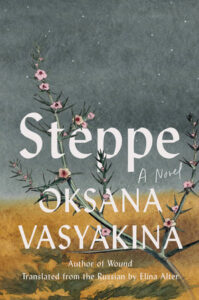
Roughly two hundred years later, and two hundred and fifty miles removed from Ilimsk where Radishchev served his sentence, the writer Oksana Vasyakina was born in the city of Ust’-Ilimsk. This is also the birthplace of the protagonist of Steppe, a novel that came out earlier this year in Elina Alter’s translation with Catapult Books. Much like Vasyakina’s previous novel Wound (2024), in which the protagonist embarked on a cross-country trip carrying an urn containing her mother’s ashes, Steppe is about a journey. This time, the protagonist travels with her estranged father. Their shared travels across Russia spans a multitude of diverse places, and ultimately allows the protagonist to reflect on her fractured relationship with the man she resembles and fears most, of whom she feels ashamed, whom she avoids, and whom she seeks. The protagonist’s father is a long-haul trucker, a man defined by grueling physical labor and a semi-criminal past, while the protagonist is a writer. At the time of her most recent encounters with her father, however, she was still a student in Moscow at the Maxim Gorky Literature Institute, the premier Soviet and post-Soviet institution for the training of literary professionals. Although the protagonist feels confined in the claustrophobic space of the truck cab, the view through the windshield opens out onto something far larger: her past, her present, and the Russia around her. While on the move, Steppe seems to ask: what happens when the body is both the point of departure and the destination?
Oksana Vasyakina entered the literary scene as a poet before turning to prose. In the early 2020s, she released an autofiction trilogy, each novel exploring family relationships and public health crises in the Russian context. In Wound, the protagonist contemplates her relationship with her mother, lost to cancer; Steppe recounts her relationship with her father, whose death, ultimately, came from AIDS. The trilogy concludes with Rose (yet to be translated to English), in which the protagonist dwells on the life of her aunt, destroyed by tuberculosis.
Yet it would be reductive to limit these novels to a meditation on family history, an exploration of the interplay between literature and memory, or a discussion of social issues in Russia. The genre—or perhaps the method—of autofiction allows Vasyakina’s novels to function on all these levels simultaneously, while preserving her lyrical sensitivity and that acuity of observation possessed by poets. Seemingly incapable of writing about herself directly, Vasyakina (and, by extension, her protagonist) seeks external figures to facilitate conversations she is dying to have occurred. These conversations are conducted post-mortem—this temporal distance allows Vasyakina to consider her relationships alongside institutional negligence, poverty, and public health crises.
Gazing at her father, a long-haul truck driver, as if into a mirror, the protagonist sees both her own face and the world around her. A conversation with him, or about him, inevitably opens onto the economic and cultural context in which the protagonist grew up. This ability to step back from her characters and portray them as parts of a larger historical process is one of the author’s primary strengths: Steppe subtly depicts Russia of the 1990s, 2000s, and 2010s through the lens of the protagonist’s personal history and the milieu that shaped her. In the chapter solely dedicated to the excavation of her father’s social standing and love for blatnaya music—music that originated in the prison culture of the early twentieth century—the protagonist simultaneously contemplates her childhood, reads the cultural moment of nineties Russia, and traces how that moment bleeds into the present:
My father loved the music of Mikhail Krug. He loved those songs the way some women love con men. A woman stripped down to her last stitch of clothing will deny to the end that she’s been had. She’ll go on believing in the myth she’s been fed and hoping for her happy ending. And so my father lived by the principles proposed by Krug, not least because they aligned perfectly with his own view of the world. […] The trouble is that I also understand the nineties through the narratives of criminal ballads. I’m still captive to that myth, maybe because I know all of Mikhail Krug and Ivan Kuchin’s songs by heart. Their cassettes and CDs were in constant rotation in my father’s car.
Whether the protagonist loves or despises her father is not as important—although we may discern that the feelings she holds are akin to those of the tormented women she evokes in this fragment. These criminal ballads hold her hostage, and she remains her father’s daughter, with an origin story in the Russian nineties: a turbulent time marked by rapid political and societal transformations, economic insecurity, and the rise of street violence. Her father, who applied physical force both at home and on the streets, looms over the protagonist even, or especially, after his death.
Vasyakina does not shy away from depicting Russian reality in its minuscule detail. The reader will either recognize or be introduced to the vegetable markets on the outskirts of Moscow, the economics of a university education, and an entire stratum of prison-inflected pop culture. In fact, Vasyakina insists that you—yes, you—share or make these memories along the way. The protagonist addresses the reader directly, breaking the fourth wall and telling her story as if she expects to hear a response. This mode of writing presupposes a common ground, but fear not: it works remarkably well in Elina Alter’s excellent translation. Vasyakina’s skillful command of the possibilities allowed by prose and poetry enables her to depict scenery with a precision that feels instantly recognizable to those already familiar with them, and physically palpable to those encountering them for the first time:
Do you know how the steppe blooms in spring? You inhale all that wormwood and you’re done for, you’re breathing in the steppe. And then those pink shrubs with their little flowers, blossoming like islands of pink mist. Inhale their scent and it’s not freedom you’re breathing in but sorrow. A sorrowful solitude.
Her direct asking establishes the novel’s very form, which could be described as an extended call and response. Even if you don’t know how exactly the steppe blooms in spring, the protagonist will take you there, and you might feel it. And if you do—you both, perhaps, will feel a little less lonely.
Vasyakina’s protagonist often finds herself alone even while with her father, but she actively engages with the surrounding world—a world that, for her protagonist, is mediated primarily by the books she holds close. It is worth drawing attention, here, to the three epigraphs that open Steppe: citations from the contemporary poet Alexei Parshchikov, the modernist Vera Khlebnikova, and the German-Jewish philosopher and critic Walter Benjamin. The entire novel is permeated by, and indeed conditioned by, the texts that the protagonist reads at every available opportunity. During a stopover in Astrakhan, for instance, when time seems to drag particularly slowly, she reads ancient Greek philosophers and Georges Bataille, and masturbates to lesbian porn. Steppe, in other words, is both a novel specifically about Russia and about how to shatter those geographical and cultural boundaries through reading and writing.
Much like the author, the protagonist grew up in a working-class Siberian family and was raised by a mother who worked herself to the bone and a father involved in semi-criminal circles. Due to her father’s activities, the protagonist was able to play with dolls that none of her classmates had, while her mother could sport an expensive fur hat, evidently stolen from another woman. Thanks to free higher education, which, in this context, effectively functions as a vehicle for social mobility, the protagonist manages to gain admission to a literary institute in Moscow, thereby drawing closer to the so-called creative intelligentsia. Such a career, of course, yields only symbolic capital. The protagonist works part-time at a coffee shop. Despite having bridged the social divide, and even having garnered some recognition, the protagonist still feels like an outsider in Moscow. Upon entering a major bookstore with her father, or ordering a mojito at a sidewalk café, she senses the intense scrutiny of the staff, who—judging them solely by their looks—refuse to believe they possess the purchasing power of real customers.
The protagonist has not seen her father in ten years; they move in entirely different circles. Given this, one might expect the father to misunderstand or outright reject her creative profession. Yet, he views poetry as a means of giving shape to reality. The protagonist is unnerved by the bluntness with which he asks whether she can describe their journey in the semi-truck—and whether she possesses any writing talent at all. In this conversation, a kind of writing program is established, one that the protagonist tests throughout the novel to see if it holds up, and against which, it seems, she simultaneously attempts to write: “Take Maxim Gorky, he was a great writer, bard of the bosyaki, the drifters, the poor. If you make up your mind to be a writer, a poet, you have to be like Gorky, nothing less. And then it’s easy enough—you’re the daughter of a bosyak, a long-haul trucker, so you have to write about us.” Maxim Gorky (1868-1936), a Russian-Soviet writer, indeed wrote extensively about those at the economic bottom, which incidentally happens to be the title of one his most known plays—“The Lower Depths.” The play characters live through poverty in a shelter near the Volga river, which Gorky modeled after one in Nizhny Novgorod, his hometown. The protagonist’s family on her father’s side similarly comes from another city on the Volga. For her father, the made comparison is obvious, and the subject and purpose of her writing are thus predetermined. To write “about us” then is to write about what she sees.
And what she sees is the steppe. An excerpt from Vera Khlebnikova preempts the novel: “The seeming silence of the steppe is its voice.” Vasyakina omits the rest of the quote, which continues as follows: “For those who do not love it—who do not know it—the steppe is silent. But ask a Kalmyk: is the steppe silent? And he will tell you that it is resonant and many-voiced. He will share with you all its songs and melodies.” Vasyakina’s task is to attempt to find this voice, through her own acquired intimacy with the landscape, and relay it to her readers.
Opting to preface her novel with an epigraph from a lesser-known Khlebnikova, Vasyakina seemingly rejects or, at the very least, avoids an opportunity to inscribe herself into the canon of Russian writers working with the steppe imagery, among which one could enlist Aleksandr Pushkin, Ivan Turgenev, Anton Chekhov, Fyodor Sologub, Maxim Gorky, and Andrei Platonov. Instead of claiming continuity with the canon, she chooses kinship with a woman whose art remains on the margins of the Russian steppe text. Vera Khlebnikova was an artist in her own right, yet she is primarily known as the sister of the prominent avant-garde poet Velimir Khlebnikov. Much like her brother, she wrote poetry in her childhood, but in her youth, she turned to painting. She was unable to complete her studies at art school (due to the lack of money, among other reasons) yet she continued to practice drawing and took private lessons in Europe later in life. Some of her works are now considered lost, while others are preserved in her brother’s museum in Astrakhan, where the protagonist’s father was born and where he was buried. In Khlebnikova’s paintings, the protagonist senses a kinship and a sense of artistic and personal direction:
The street I was walking down was where, ten or so years ago, my father had rented a house for cheap. The world of that street was endlessly aging, but the people and the plants kept revitalizing and reproducing themselves, the way the fish keep swimming on Vera Khlebnikova’s painted panel. Life keeps repeating itself and knows nothing of death.
Steppe, however, does know something of death and, even more so, of life. The novel’s very first lines emphasize the vitality of a landscape that, at first glance, might appear desolate. Observing the steppe from the airplane’s window, the protagonist notes that “the steppe looks like a sinewy piece of yellow meat. […] The steppe is no desert, you can see the life in it. Gray and blue grasses. Chirring insects, cool eels, darting dice snakes in the Volga delta.” In this opening passage, the very essence of the steppe, as encountered by the protagonist, comes to the fore. The steppe is an all-encompassing living and breathing body, but, just as a piece of meat which once was an animal, it has been cut into. The protagonist draws attention to the historical dimensions of the space unfolding before her, recalling the processes of colonization and their aftermath:
Once, the steppe was a garden. People built irrigation systems and grew whatever their hearts desired there; the steppe gets a lot of sunlight, so they could bring in three harvests in a single summer. […] When you look at it now, it seems to be pure salt marsh wasteland, dotted with blue cloudlets of camel thorns. But that’s an illusion: if you give the steppe water, it can do a lot. Then the people left. Well, not quite left. They stopped working the land. The times had changed. The communal farms blew apart like layers of onion skin. But the pipes from the old irrigation systems remained. They became no one’s. They remained simply as objects, buried in the sand and the steppe grasses.
Here, in this relatively brief passage, the protagonist alludes to the sweeping Soviet ambition to terraform the steppe—a project driven by the belief that nature could and should be remade. The steppe’s scarred body makes history legible to the reader. The eponymous novel mirrors this dynamic: the cut-into bodies of her characters mediate the institutional and interpersonal violence they have endured.
But the steppe can cause pain, too. Its thorny flowers prickle. Sleeping on its bare grounds is no fun. Dry winds and glaring sun destroy her father’s appearance slowly. Its vastness arouses a sense of profound loss of direction. In the novel’s last lines, however, the protagonist seems to come to terms with this dread:
In some other place lies a fragment of that shell from the bottom of the old Caspian Sea. In this way my father has lain in his steppe grave for seven years, feeding the steppe salt soil and the groundwater. His dead body will stay there for a long time yet. The shell sits in the steppe sand, dry and white. His dry and white skull, split in two, will lie in the steppe as the slow sea perishes and contracts.
In these closing lines, pain is kept at bay and the historical time comes to a standstill. Throughout the novel, the protagonist, never still, charted through her memories, nightmares, and familiar places of the past, desperately seeking for words to understand herself and her father. What she finds, however, is that while she knows blatnye songs by heart, she doesn’t quite have the words to describe all of the space, geographical and mental, she encounters: “The steppe requires a song with words as precise as an instrument for seeing the most distant stars. But I had no words, and it was as though I didn’t even exist. My father existed, and the steppe existed, too. But there were no words and no me.”
What does it mean for a writer to confess they don’t have words? What then remains? The body—as it traverses the country, observes surroundings, experiences grief, pleasure and rage, and, yes, remembers. Developing a framework in which bodies could be conceptually interpreted as “outgoing” and “ingoing”, American philosopher Edward Casey posits an “outgoing body” as referring to the lived body which meets “the place-world” in its difference, for example in race, class, gender, and the “incoming” body as “bear[ing] the traces of places it has known.” Vasyakina’s Steppe is a body always in motion—outward and inward, then and now, setting out and returning—all at once.
Polina Peremitina is a writer and a scholar of Eastern European literature.
This post may contain affiliate links.