


[Impeller Press; 2026]
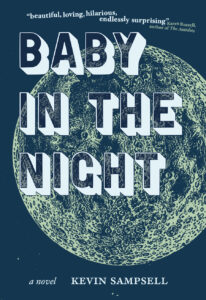
Teasing the porous boundary between surrealism and magical realism, Kevin Sampsell’s novel Baby in the Night, his second, constellates around a toddler who wanders the night purposefully, unsupervised and unencumbered. Tony and his mom live in a seedy part of an unnamed city, one festooned with garbage and energy. Their neighborhood isn’t exactly dangerous, but it certainly isn’t an ideal place for a small child to be traipsing around alone at night. Two-year-old Tony learns how to sneak out without his mom knowing, and he proceeds to do just that, continually; the night calls to him. “I wasn’t afraid of the dark,” reads the opening sentence of the book. Tony scours the city’s dim underbelly for a specific reason, one that might make perfect sense to a baby: he believes his father is the moon, and night after night Tony wants to commune with him. Dad is so close, especially on the clear nights, that he seems touchable. He talks too, at least to Tony. Not through language but telepathically, through feeling and presence. A mysterious fax machine that Tony finds in the street also possibly plays a role. Dad exists (or can exist) not only in one’s eyeballs, but also when Tony is alone in his room—and maybe even in the day, too.
This novel rests on a magicality that certain readers might quibble with. Tony’s Mom is young, just twenty-five, and she works long hours at a middling thrift store, where she is actively pursued by her boss Ben. (This pursuit fails but it’s a constant distraction nonetheless, to both Tony and his Mom.) She doesn’t have enough money for adequate daycare—Tony often comes to work with her—and at night she’s tired, very tired. Still, unknowingly allowing her child to walk out of his small bedroom (which is right beside her own), not hearing him as he unlocks the back door and dives into the night and its treasures, might be a stretch for helicopter parents and non-helicopter parents alike, among others. That, of course, is the point. Within the prism of the Baby In the Night universe Tony is an active entity. He really is out on the streets conversing with prostitutes and junkies. He really is searching for a relationship with his moonly father, just within reach.
While reading the book I was reminded of the canonical comic strip Calvin and Hobbes. In it, six-year-old Calvin and his trusty stuffed tiger Hobbes are everything to each other. They adventure, they swash-buckle, they time and space travel. Calvin is only Calvin when Hobbes is present and vice-versa. Yet when Calvin’s parents enter into the frame, asserting their wholly insufficient adult reality, Hobbes is no longer himself. He is merely a stuffed animal, bearer of orange stripes, possessor of a floppy tail. He lacks heart, mind, and soul. Especially soul. It’s sad but that’s what happens when you grow up. You can’t see things for what they truly are.
Tony exists in a similar world. His friend Tater mostly gets it, but he actually has a Dad, so Tony can’t impart to him the importance of his search. Tony’s quest is wholly his own. Baby In the Night narrates Tony from ages two to five, arguably when a child’s imagination is most potent, divergent, and, yes, surreal. At one point late in the book, Tony and Tater mount and ride wild urban dogs, resplendent in the moonlight. The scene crisply illustrates the fertile dreamworld that can be a young child’s mind:
I heard a whoosh-whoosh sound and a bell ringing lightly somewhere. I looked at the moon and saw its bright light coming down. There were shadows on the concrete that looked like holes in the ground and they were growing bigger. The dog looked at the moon too. He was smiling kind of like a human, like he’d start laughing if you told him a good joke. I climbed on top of the dog and held on to his collar like I wanted to ride him. Like a cowboy on a horse. Tater got on too, and held on to my shoulders from behind. The dog rose up and walked, his four legs moving easily and carefully so we didn’t fall off. It seemed like we were up very high—high enough to get hurt if we fell off.
…
We moved past all the sidewalk people, back in the direction of home. They were all awake now, standing next to their tents and brightly colored plastic sheets. They watched us from both sides of the street, and the spotlight of the moon made us look magical. None of them spoke or looked away. A couple of cockroaches appeared on the street, and the dog crushed them with his giant paws. I wondered if this was how a king felt.
Asking if it happened misses the point. It did, it didn’t, it doesn’t matter. What matters is the untrammeled innocence that comes through. Tony can live his life like this if he wants, and hopefully he will.
Although Tony’s Dad is definitively revealed in the end (spoiler: not the moon), the central mystique of Baby In the Night remains. Tony is twelve when the book ends, but what he experienced as a small child is foundational. “Is there a word for believing in magic that no one else can see?” Tony asks in the book’s prologue. Yes. With Baby in the Night Kevin Sampsell creates an indelible world, one effervescently fantastical and completely his own.
The co-publisher of the small non-profit press Fonograf Editions, Jeff Alessandrelli is most recently the author of And Yet: a novel about sex and shyness and society. He lives in Portland, Oregon.
This post may contain affiliate links.