


This essay was first published last month in our subscriber-only newsletter. To receive the monthly newsletter and to support Full Stop’s original literary criticism, please consider joining us on Patreon.
At first glance, the books around which this essay is framed make an odd quartet: In the first, a single mother tries to immerse herself in an eighteenth-century novel over the course of a single day spent tending to her newborn. The second follows a tenured professor as she hunts a long-dead author through dense urban markets, cemeteries, and archives. The third recounts its author’s solo overnight visit to one of the world’s most famous museums. The fourth is a dual narrative in which two young women, a century apart, inventory hundreds of species of minor flora growing in and among ancient Roman ruins. They bear few similarities to one another in terms of plot—aside perhaps from a shared minimalism—or genre—running a wide gamut from fiction to historical biography to personal memoir (and various combinations thereof). What links them, I would argue, is their fascination with settings that qualify as “heterotopias”: a subcategory of “other spaces” (éspaces autres) that Michel Foucault defined—in opposition to the “fundamentally unreal spaces” of utopia—as “places that do exist and are formed in the very founding of society—which are sometimes like counter-sites . . . , in which . . . all the other real sites that can be found within the culture, are simultaneously represented, contested, and inverted.” In Kate Briggs’s The Long Form, Iman Mersal’s Traces of Enayat, Jakuta Alikavazanovic’s Like a Sky Inside, and Katy Simpson Smith’s The Weeds, such discrete environments serve as scenes of reckoning with a phenomenon as amorphous as it is ambient: the dystopic fortunes of companionate reading in today’s vicious attention economy.
The concept of heterotopia belongs to a larger hermeneutics of space that Foucault developed in response to what he saw as the twentieth century’s chief preoccupation (in contrast to the nineteenth century’s obsession with history): “The present epoch will perhaps be above all the epoch of space. We are in the epoch of simultaneity: we are in the epoch of juxtaposition, the epoch of the near and far, of the side-by-side, of the dispersed.” In a lecture delivered to architects in Paris in the early spring of 1967, Foucault introduced this category and enumerated a set of criteria by which it can be identified, including plasticity, polyvalence, and exclusivity. Notwithstanding massive variability in terms of function, affordance, and vibe, all instantiate sites “outside of all places, even though it may be possible to indicate their location in reality.” Among the explicit examples he provides are gardens, ships, prisons, psychiatric asylums, boarding schools, cemeteries, archives, libraries, and museums.
Digital space, albeit imminent, would have been all but unimaginable to Foucault when he died in the early 1980s. If, toward the middle of the twentieth century, we found ourselves in “a moment . . . when our experience of the world is less that of a long life developing through time than that of a network,” the dawn of the twenty-first would turn us all into vertices along the vastest and most pervasive network that had ever existed: the worldwide web. The modern internet has opened up fresh horizons of anxiety: So far, for citizens of the second millennium, the ever-scarcer resource over whose distribution, monetization, and susceptibility to atomization we are constantly fretting has been our ability to focus. For the majority of human beings at this stage of the Information Age, daily life is defined by access to infinite “content,” which places never-ending demands on our psychological, intellectual, and emotional energies. We are constantly bombarded by reminders that the world’s injustices, cruelties, and catastrophes far exceed any individual’s capacity to process (much less combat) them. At the same time, social media and influencer culture traffic in the illusion of individual agency and accountability, cultivating an insidious rhetoric of empowerment and self-actualization that further depletes individuals, making us feel as if we are always already failing to know enough or to act effectively in light of constantly-refreshing feeds. As Nicholas Dames put it in a recent essay, fatigue and beleaguerment have become the principal trademarks of today’s reader:
Every cultural moment has its favorite, iconic reader types, its fantasies that become part of the self-awareness of the actual reader — of you, reading . . . [O]ver the past year, a new category has seemed to open up: the Exhausted. The almost-burned-out, frayed, fried, edge-of-collapse reader, just barely keeping it together.
Immersive reading, in particular—to say nothing of writing that invites and sustains it—is existentially imperiled by the weaponization of chronic distraction and overwhelm. It is not only that fluency in a digital idiom of emojis, tweets, memes, hypertext, etc. come at the expense of more traditional forms of literacy and habits of critical thinking; it is also that they erode our collective willingness to engage with longer, more complex forms of narrative argument and worldmaking—a reluctance that is further exacerbated by the mass use of generative AI, trained on large language models, that can produce or synthesize any volume and density of text in seconds (with results that are increasingly difficult to dismiss as mere “slop”). It seems increasingly quaint to grieve the obsolescence of attention when computers can think so much better than us. Our minds may be unraveling, but what use are they, anyway?
Content’s many discontents haunt this set of recent literary texts, all published or translated into English since 2020 (and to which could be added countless others, including Suzanne Scanlon’s Committed, Lisa Robertson’s The Baudelaire Fractal,and Doireann Ní Ghriofa’s forthcoming Said the Dead, to name a few). Each confronts the current crisis of attention by enlisting what we might call the heterotopic imaginary: cemeteries, archives, libraries, museums, and various iterations of the garden all serve as primary sites of narrative action for Briggs, Mersal, Alikavazanovic, and Smith, who use them to reflect on the limitations and possibilities of concentration and intimacy in a world that not only enables, but actively incentivizes, the denigration of both. Any attempt to summarize these books must first acknowledge the extent to which they resist the logic of synopsis or overview. All of them celebrate exquisite affective nuance and keen perception, as well as an enthusiasm for associative (but decidedly un-clickbaity) digressions, that rebuke the notion of linear plot: What “happens,” if anything, is irreducible to key points or main actions. They are meander maps rather than dramatic arcs.
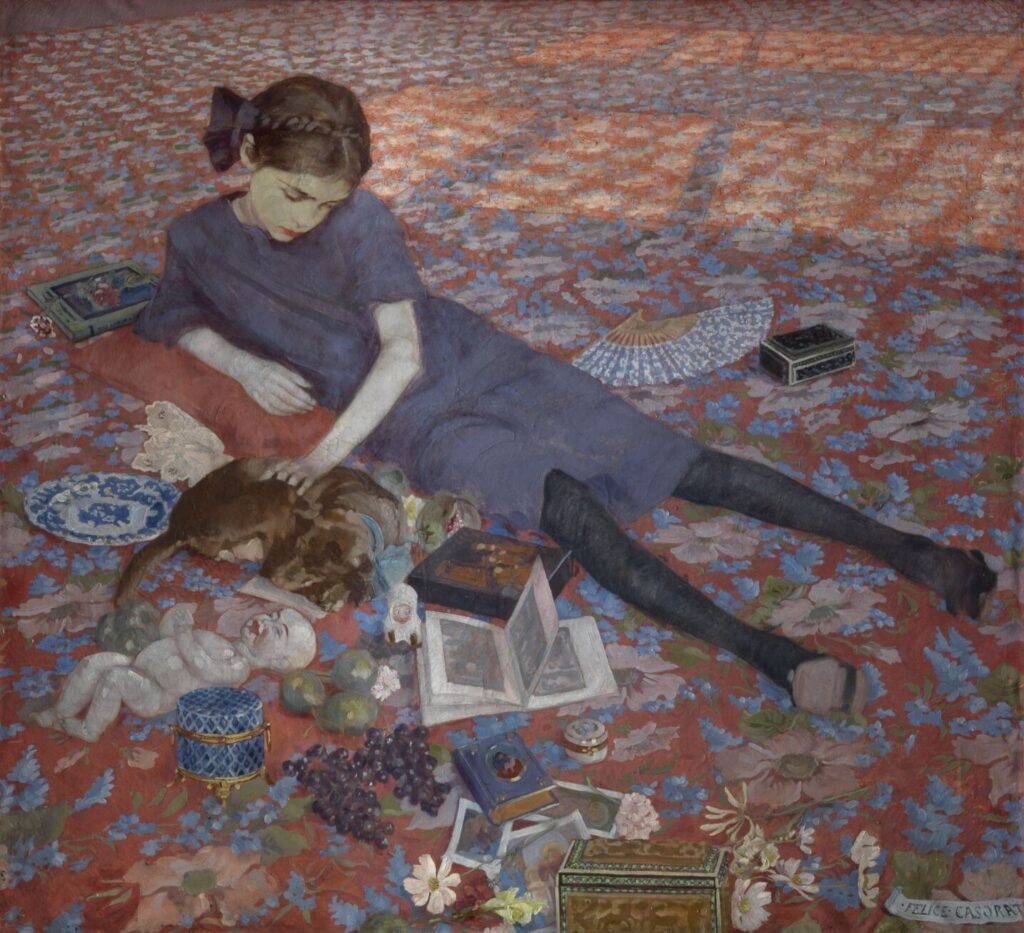
The Long Form is a neo-Joycean account of one diurnal cycle in the life of a young single mother in London as she feeds, plays with, strolls, and cuddles her infant daughter while simultaneously dipping in and out of Tom Jones (which is ordered on and delivered by Amazon but almost certainly not recommended via its own collaborative filtering models, which could scarcely infer that a consumer of diapers and bottles “may also like” Henry Fielding). The Long Form is a quiet drama—often quite literally, in deference to nap schedules—of shape-giving : “the story of two people composing a day together,” as the back copy puts it. In the opening pages, Briggs seems to allude—more or less explicitly, given that Roland Barthes and his cohort are her principal interlocutors—to Foucault’s notion that “carpets . . . were originally reproductions of gardens . . . and the rug is a sort of garden that can move across space.” At the beginning of the first section, the protagonist, Helen, says of her daughter’s playmat: “It was a garden. Say it was a garden.” This “big square” is where mother and daughter idle away the morning, Helen oscillating between communion with her pre-verbal child and (aspirational) immersion in a work of literary imagination: “a thick square divided into four distinct sections. Its colors were a bit faded. From the sun, from the heavy rounds it must have done in someone else’s washing machine. Its spaces looked touched, well-mouthed: its closer textures more or less exhaustively pre-explored.” How fitting that the name of its current, tiny proprietor is Rose.
Traces of Enayat is the story of the author’s search for a female Egyptian writer whose only novel was published posthumously, following her suicide in the mid-1960s. Mersal’s path first crosses with Enayat Al-Zayyat’s through pure serendipity, when she stumbles across an out-of-print edition of her book at a used book market (the Soor El-Azbakeya) and feels an instant, enigmatic pull toward its unknown author. She proceeds to embark on a journey of spiritual exhumation that takes her to the places that Al-Zayyat frequented, notably the German girls’ school where she matriculated as a child and adolescent; the archives of the German Archaeological Institute, where she had indexed the bequest of nineteenth-century Egyptologist Ludwig Keimer (about whom she was writing a second book when she overdosed on barbiturates in 1963); and the un-GoogleMaps-able City of the Dead, where Mersal finally, ebulliently, locates her eternal resting place among the tombs and mausoleums. Traces explores the ways in which an obsession with a subject from the past can reacquaint the author with her own former selves, opening up fresh vantage points on unrealized potentialities. In following Enayat Al-Zayyat’s trail back to Egypt, where the young mother and aspiring writer killed herself in the early 1960s, Mersal—a professor of Arabic language and literature at the University of Alberta—trysts with abandoned modi vivendi that had once defined her own daily life as a twenty-something doctoral student and member of Cairene bohemia in the 1990s. Aspects of Mersal that have atrophied or lain dormant in the transition from footloose youth to established middle age are rekindled as part of the research process. As she gradually integrates herself into a new network of scholars, librarians, and archivists that aid her efforts to reconstruct Enayat’s forgotten legacy, Mersal recuperates some of the optative aura of her own early adulthood. At the same time, she remains scrupulously reluctant to over-identify with or live vicariously through the object of her obsession: “Following the traces left by a person is not at all the same as telling the story of that person’s life. To trace someone does not mean filling all the gaps or searching out every fact in the quest to document it. It is to take a journey toward someone who cannot speak for themselves.” Some readers have been disappointed or puzzled by her resistance to the expository plenitude typical of more conventional historical biography. But Mersal’s project deviates from what historian Saidiya Hartman calls “critical fabulation”—the “combining of historical and archival research with critical theory and fictional narrative to fill in the blanks left in the historical record”—in its emphasis on her own complicity in the failure to appreciate her subject. She is more curious about the ways in which Al-Zayyat eludes her (“her life was too much for me to ever know”) than she is confident in her capacity to narratively envision and interiorize her.
Like a Sky Inside recounts the author’s solo visit to the Louvre, where she goes to commune with a beloved piece of statuary and the memory of her immigrant father: It begins as nocturne—“From March 7 to 8, 2020, I spent the night [there], alone . . . in the antiquities section”—and ends in aubade: “I leave at dawn . . . I stop at the Café de la Comédie to drink a double espresso.” Permission to inhabit such iconic premises under these conditions—“Alone. At night.”—is not easy to obtain:
The Explicit etiquette and the implicit aren’t the same, but both exist. There are interviews, more or less official; character witnesses, more or less unofficial; a certificate of criminal record is required. It’s a lengthy process, and surely a necessary one: you don’t let just anybody into such a place.
The first-person narrator is the daughter of a Montenegrin immigrant who adored his adoptive country but spoke imperfect French and often asked her (not entirely facetiously) how she would go about stealing the Mona Lisa. The book is a reflection on her complicated relationship to the cultural patrimony contained within galleries she had often visited as a child, in the company of her father, as well as to his ambiguous legacy to her—and the imbrication of the two: “What do you pass down . . . when you’ve turned your back on your past? When you’ve managed . . . to recreate yourself in another country, another language? My father took me to the Louvre.” The bag she brings with her is filled with analogue provisions: a notebook, a toiletry kit, a duvet, a square of nougat, and a secret gift (never revealed) for the Hellenistic goddess whom she has come, especially, to ponder: “And the statues around me: . . . Do they wish they could return somewhere? . . . The Venus de Milo, whose artificial shadow stretches to my feet: . . . Is it possible that she sighs for the earth, its darkness, its odor—the earth from which she was unearthed, in the spring of 1820, by a Greek farmer?” In the quietude of the after-hours gallery, without a screen to doomscroll, she is able to channel metamorphic rock.
In The Weeds, a mid-nineteenth-century New Englander accused of theft is indentured to British physician and amateur botanist Richard Deakin, to assist his compilation of Flora of the Colosseum of Rome (1855), whose publication will ensure his posterity; her twenty-first-century successor updates this meticulous herbarium in the age of global warming, as part of her doctoral training with an older male advisor whose casual sexism permeates every interaction. The latter catches glimpses of the former between the lines of Richard Deakins’s Flora of the Colosseum of Rome (1855), gradually perceiving the voice of his young female assistant as she pores over the exquisitely sensual descriptions of the plants they are both tasked with cataloguing: “‘Do you ever wonder about Deakin?’” the first-person narrator asks her mentor at one point: “‘what kind of help he had, or whether he did all the writing himself?’” When he dismisses such curiosity as frivolous (“‘I don’t question authorship’”), she doubles down: “‘Some of his phrases strike me as feminine.’” Later, she hails this intuited subjectivity directly: “I see you, D, for the tender way you see.” Only in a defunct gladiatorial stadium-cum-hortus conclusus could such an astonishing act of recognition occur.
The encounters that these heterotopic settings enable, or to which they seem especially hospitable, are ones whose value is all but illegible within the larger hegemonic framework of techno-capitalist logic. They are offline, unprofitable, and almost aggressively niche—risky investments in terms of material payout, social prestige, or viral potential. They are, to varying degrees, unilateral bonds: Due to the discrepant ontological or developmental status between the protagonist or first-person narrator and the Other with whom she is interacting, they cannot be reciprocated in kind. Mastering Linnaean taxonomy; mothering a newborn; curiosity about and sympathy toward literary characters; an ongoing dialogue with a work of artistic genius; the (dis)articulation of an archival silence: All require a painstaking commitment to detail, a tolerance for tedium, mental and physical stamina, and a refusal to be beholden to conventional notions of productivity, achievement, and progress. All of these books concern women who, for reasons that fall along a broad spectrum of volition and intentionality—from the “fourth trimester” to pure whimsy—find themselves in states of solitude or semi-isolation that render them particularly available to trans-temporal affinities. These attachments to sculpted marble, fictional consciousness, erased forebears and spiritual ancestresses, to their own unrealized potential, deferred dreams, or past lives make it possible for them to persist into the future. As Alikavazanovic writes of her night in the Salle des Cariatides: “Alone and at the same time anything but.”
And yet. However encompassing these books’ commitments to heterotopic circumstances and the encounters that take place in them, there is a shared acknowledgement of their inevitable impermanence. These situations are always temporary and fleeting, rather than terminal: Each text ends with the promise, immediate or eventual, of abandoning them favor of the “real” world. Part of this has to do with the transient or precarious nature of the protagonist or narrator’s exemption from it in the first place: sabbatical, postpartum, PhD training, penal detention, a rare exception for which many accommodations have been made. But it is also that each book is interested in how—by lavishing attention on something of little relevance, commercial interest, or practical use to the extra-heterotopic sphere (a dissertation, an eighteenth-century novel, undesirable vegetation, unconsummated love, a baby, a sculpture)—the narrators and protagonists are able to re-enter it with more resources to accept and navigate it. In our age of calamity, heterotopia mirrors and amplifies the ephemerality and fragility of the world we inhabit. In the article I mentioned earlier, Dames posits that the “avatar” of today’s jaded reader is “the mother,” and can it be a coincidence that all of the narrators are, or will soon be, conduits for the next generation? Reproductive futurity is not, of course, a sufficient or necessary prerequisite for having a stake in the health of the Earth and its population, or hope that our planet (perhaps even our species) will survive. At the same time, it is not hard to accept the mother as representative of those for whom the temptation to steal away from the evidence of its disastrous condition and all the mechanisms by which we are numbed to it is particularly acute.
Twenty years ago, literary scholar Susan Keen coined the term “narrative annexes” to describe spaces in nineteenth-century novels that momentarily disrupt, intrude on, or subvert the text’s main sites of action: The flickering alleyways, prickly hedgerows, and barren moorlands that permit the intrusion of characters and events the genre otherwise tended to preclude. Victorian literature, dominated by the aesthetics of verisimilitude, took for granted the reader’s capacity to be absorbed by a representation of the world as it (more or less) was, perhaps because the empirical version did not compete as fiercely for the reader’s time with its counterpart on the page. The heterotopic imaginary arises from an acknowledgement that this is no longer the case. At the same time, it is motivated by a longing for reading’s traditional rewards: private love affairs with inanimate objects and non-sentient beings that nevertheless feel alive. In the age of distraction, when the global prospects of pleasure reading seem far from auspicious, literature in which “other” spaces constitute (rather than being alternatives to, impositions on, or escapes from) the primary milieu of the text discreetly nurture these vulnerable kinships. Like secret gardens in which heirloom varietals continue to thrive in spite of larger-scale climatic threats, the heterotopic novel provides a fertile terroir in which the cultivar of literary sensibility can flourish, even as early-twenty-first-century life constantly threatens to frack into oblivion our neurological capacity for it.
Elizabeth Brogden is a writer and editor based in Cambridge, MA. Her essays, reviews, interviews, and short fictions have appeared in Bellevue Literary Review, The Common, Times Literary Supplement, and AGNI, among others. She can be found online at www.golightlyeditorial.com.
This post may contain affiliate links.