


[NYRB; 2025]
Tr. from the Farsi by Haleh Liza Gafori
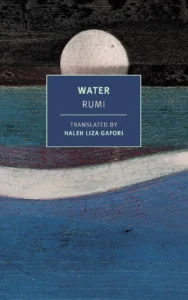
How can love save us when everything seems to hover on the edge of imminent collapse? How can we surrender our egos, liberate ourselves from the trappings of this world, and perhaps encounter the divine in our everyday lives? Rumi’s poems shuttle across time, place, belief, and tradition to refresh and guide our wearied spirits. In Haleh Liza Gafori’s translations, Rumi’s poems feel urgent, playful, and always inviting.
Rumi has been one of the U.S.’s bestselling poets for some time, in large part because his language is fresh, welcoming, and always accessible. His direct address to the “you” in so many of his poems, coupled with his searching questions, his inviting commands, and his delighted exclamations, create an intimate invitation to any reader who encounters them. Most fans of Rumi know the outline of his life: Jalāl al-Dīn Rūmī was born over eight hundred years ago in present-day Afghanistan. When he was young, his family migrated across Central Asia to avoid invaders. They eventually settled in Konya, a city in modern-day Turkey. There, Rumi became a well-respected Muslim scholar. In middle age, after years of preaching to a large following, he met Shams, a Sufi mystic whose charisma and attention to deep listening through the whirling dance (sama) transformed Rumi’s life. As a result of his friendship with Shams, Rumi turned to writing poetry. Ultimately, he wrote thousands of poems that readers all over the world continue to enjoy to this day.
For Gafori, the translation of Rumi is not merely academic, but deeply personal. As she writes in her introduction to Water, she is the child of two physicians who immigrated from Iran to the United States:
with one suitcase of clothing and two suitcases of books, among them, a 1936 edition of the Masnavi, Rumi’s vast book of narrative and didactic poetry, handed down from my grandfather. Eventually they would host monthly poetry nights, a Persian tradition called shab e sher. Friends would come over and recite poetry in rounds till the wee hours of the morning. I was one of the children on the fringes, listening in, having no idea that Rumi would become a companion for life.
As one reads the poems in Water, one gets the sense of this life-long intimacy. Haleh Liza Gafori has embarked upon a years-long project of translating Rumi’s work. The results of her labors appear in two collections: Gold (2021), and Water (2025), both published by NYRB Press. In her introduction to Gold, Gafori describes how she chooses which poems to translate: she is drawn to the poems that feel most alive and relevant. Because she knows Persian as well as English—a rarity among translators of Rumi into English—she is able to capture the spirit of the original poems with the vividness of her English word choices. Sometimes she translates a poem in its entirety; sometimes she selects several couplets from a ghazal, and at other times she isolates a quatrain and lets it appear on its own. Gafori insists that this is not meant to be disruptive; rather, she is performing the kind of curation that reciters of Rumi have deployed for centuries. Translation is always a kind of transformation, and Gafori’s methods are generative in this regard.
Rumi is interested in breaking the boundary between self and other, between ego and the divine. Even in his briefest lyrics, one can see his desire to create aphorisms charged with mind-shifting metaphors:
Selflessness is sky.
The bird of the heart
flies nowhere
but there.
“The bird of the heart / flies nowhere / but there” suggests a constraint, but the sky is limitless, as is the selflessness that Rumi defines. The reading of the poem inspires a largeness of the self. Throughout the collection, one sees similar refrains; for example, “The dead all leave something behind” offers commonplace wisdom in the form of a metaphor:
The dead all leave something behind.
Better a trail of good deeds
than a pile of coins.
The world remembers virtue—
and no one can steal it.
This brief lyric is portable, easy to memorize, and provocative. Of course, the dead all leave something behind, which challenges the reader to about their own legacy.
I love these short lyrics, but I’m also drawn to the longer poems in this collection, which reveal Rumi’s interest in the sama, or the whirling dance. To this day, sama continues to inspire devotion among Sufi mystics; in fact, UNESCO has recognized the sama dance as part of the Intangible Cultural Heritage of Humanity. With one hand turned up toward heaven and the other turned down toward earth, the whirling dancer becomes a conduit to a state of profound devotion, and this practice had a profound effect on Rumi. In a longer poem titled “What is sama?,” Gafori’s simple, direct word choices provide the reader with the cultural context that is essential for understanding this culturally significant practice:
What is sama?
Sama is deep listening.
Sama is whirling dance.
In sama,
hidden corners of the heart
send wordless messages,
soothing the exiled heart […]
Round after round of joy
and no one has drunk
even a drop of wine […]
Because of this attention to the sama, I am able to better understand Rumi’s use of the ghazal form, which, in Gafori’s translations, feels more lively and spirited than any other translations I have read. Usually, I think of the ghazal as a form constrained by its couplets, each of which must land on the same word or phrase throughout. While that is certainly still true in these translations, I can also see them as sama-like in their cyclical return those repeated end words. Consider this excerpt from “A great love settled across the land”:
A great love settled across the land.
May it live on forever.
Cynics found faith.
May faith in Love live on forever.
In a land ravaged by its demons,
Compassion, wisdom, and intelligence rose again.
May they lead us forever.
My friend broke my heart, slammed the door,
Came back with compassion and remorse.
Maybe the change of heart last forever. […]
Rather than forcing her translations into couplets, Gafori gives breathing room, sometimes allowing each stanza to expand to a tercet or quatrain when it feels appropriate to the lines.
Gafori’s selections emphasize Rumi’s concerns with form and structure, as well as his concern with the limits of language and writerly expression. In “I traveled to every city […],” for example, the poetic speaker is world-weary, tired of living a loveless, soulless life. Once he drinks “the wine of kindness and laughter,” love not only seeps into him, but builds a house in which the poetic speaker can live. The speaker is so moved by the intensity of this transformation that he tries to approximate its power in language:
And who am I when Love obliterates the I
I thought I was,
drawing me from one path, leading me on another?
I could tell you,
but every time I get to this point,
the tip of my pen breaks.
The poem stops just before it is able to arrive at its most potent articulation. This concern with the writing process, and the materials of writing, continues in the next poem in the collection, In “My heart is a pen in your hand,” the speaker’s heart is transformed into a pen for his beloved. The speaker encourages the “you” to sharpen the reed of his heart-as-pen. Together, the “I” and the “you” become a generative force that gives form to the formless. Ultimately, Rumi takes a playful view of the writing process; at the end of another poem, he writes, “Don’t fault the poem for remaining unfinished. / The bird of the imagination flies where it likes.”
Gafori’s translations showcase what is best in Rumi’s work: his insistent questions, provocative invitations, and awe-inspired observations of the divine in all things. As Gafori observes, Rumi’s poetry “is filled with startling leaps of imagery and thought, praise and critique, confessions and invitations, and through it all, his concern for humanity is palpable and his central commitment—human liberation through the cultivation of Love—unwavering.” I have taught excerpts from Water in literature courses as well as writing workshops, and I have marveled at the way in which these translations speak to all readers, even those who are usually quite hesitant as they approach poetry. Gafori’s translations do much to celebrate that openness in Rumi’s work.
Joanne Diaz is the author of The Lessons, My Favorite Tyrants, and Electric Dress, forthcoming from Barrow Street Press. With Ian Morris, she is the co-editor of The Little Magazine in Contemporary America. She is also the co-host, with Abram Van Engen, of the Poetry for All podcast.
This post may contain affiliate links.