


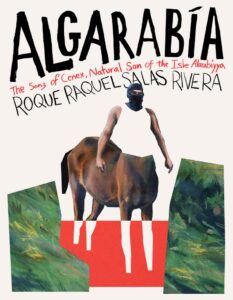
“but not how Ovid tells it, for if a tale / seems overly heroic, it isn’t ours,” Cenex cautions before setting off to chant his journey. This warning names a central tension in Algarabía: La canción de Cenex, hijo natural de la Ínsula Alarabíyya / The Song of Cenex, Natural Son of the Isle Alarabíyya. The book takes up the epic while refusing its reliance on heroic singularity and the making of a nation. How to then write into another kind of lineage when narrating the life of a trans being inhabiting or, rather, surviving in, a colony? After all, as Cenex goes on to say, “History can’t carry our five-star feats / because we love and die in battle.” In Algarabía, the Puerto Rican poet Roque Raquel Salas Rivera tentatively answers this question, offering a chorus of voices that recount Cenex’s journey across a multiverse, harmonizing “the canto of unwavering tenderness / in the face of our extermination.”
Former Poet Laureate of Philadelphia, Roque Raquel Salas Rivera now lives, writes, and teaches in Puerto Rico. He has produced the award-winning collections antes que isla es volcán/ before island is volcano (2022, Beacon Press, Juan Felipe Herrera Award), x/ex/exis: poemas para la nación / poems for the nation (2021, University of Arizona Press, Ambroggio Prize), while they sleep (under the bed is another country) (2019, Birds, LLC), and lo terciario/ the tertiary (2018, Noemi Press, Lambda Literary Award). Algarabía is his eighth poetry collection. Most of his poetry is written in Spanish and self-translated into English. In this new book, the poet declared in a recent interview that he was not sure about “which language had come first. All that mattered was what each language required of me in that particular moment.” The author’s approach to language mirrors the same commitment to freedom that runs throughout the book.
In the first of four cantos, the Muse introduces Cenex who, while sitting inside the base of a ceiba, begins to offer his audience a retrospective account of “how he came to have his name, his life, and his thirty friends.” After Cenex ensures that his audience is well-fed, comfortable, and free to rest, he starts chanting his journey across ever-shifting terrains of gender: “We are strangers, my friends, but I will / eat of your grief and you of mine, / a municipality without partitions.” Cenex’s journey spans various temporalities and locations, mostly within an alternative universe called Algarabía, a colony of Earth. There, they speak Algarum and sometimes a dialect of Earth. Algarabía is an island ruled, invaded, and subjugated by Earth. Locals even fight each other for the Earthbloods, the terringues. While Algarabía exists as an alternate universe, the island recalls Puerto Rico, a former Spanish colony and now one of the United States.
Salas Rivera’s narrative epic is an origin story deeply imbricated with violence: the violence of colonialism and its enduring manifestations, binary gender constructs and their enforcement technologies. The family is an entity that forces Cenex to perform as a “cupcake femme.” He is taken to a series of doctors who give him various diagnoses, and then to school, where he is called by his deadname. But Cenex remains steadfast. A trickster, he moves in fugue against and despite the gaze of others. Readers are taken on a series of encounters: characters that both trap and free him, temporary stays including hospitals, a school, a foster family, the suburbs, and foundering attempts with gender. These episodes build momentum until Cenex’s quest in the labyrinthine aisles of a Wolgrin/Walgreens to find something that takes him a while to realize he needs. Meanwhile, bodies and landscape become entangled—bodily contours dissolve into natural elements and the exuberance of a feathered patería. And the hero’s own existence does not eschew the realities of living in a colony: discourses are written on Cenex’s body as tourists arrive, buying buildings and driving up rent costs, displacing the local population. As natural and human geographies intertwine, his body is not just a site of gender experimentation or vulnerability, but also of colonial inscription. Central in Algarabía is the body politic, the body-land, the body-colony.
Out of this porous and ever-threatened corporeality emerges Cenex’s struggle. In the wake of different forms of violence, it is through Cenex’s sustained insistence that he asserts his persona and experience: “Before the murder and renaming. / I was Cenex before I was a number, / then a subject of debate.” Throughout the book, we see how transness is denied, vilified, used as a scapegoat, and co-opted. Rather than standing in opposition, pain—both personal and collective—accompanies him in his journey, albeit not preventing him from approaching life with joy, freedom, and tenderness. For example, he falls in love with Jacinto at the hospital where they are both confined for being trans. Together, they devise a fabulous escape from the hospital—they confabulate una fabufuga—and then navigate the marine depths together. “Pressed against each other, a yearning / spread to travel to a resort-free location, / not to before, but to another now (a trans duo), / our fugue’s faggotry,” asserts Cenex. While Salas Rivera’s poetry resists a triumphalist impulse, the alchemy of Salas Rivera’s verse distills a beauty and hopefulness that, as for Cenex and Jacinto, becomes necessary to combat the blatant fascism of our present.
Maybe every epic needs a hero. In Algarabía, heroism is not monumental, but made in small treasons and everyday improvisations. The epic holds a preeminent place in Caribbean letters as writers have turned the form back on itself, troubling the premises on which it is classically founded: conquest, divine order, a singular male hero, and the blending of history and myth to shape a national identity. Take, for example, Nobel-winning St Lucian author Derek Walcott’s Omeros (1990), which follows various heroes, including the narrator, each defined by their own journey, with a focus on the local and quotidian, or M. NourbeSe Philip’s engagement with the unEpic to propose a poetics of the small and fragmented. While many Caribbean authors take up the form’s classic themes of home, memory, and journey, their work also meditates on cultural fragmentation, grapples with the wounds of colonial history, and engages with Caribbean sensibilities. Likewise, Salas Rivera offers his own reappropriation of the genre. His hero does not fight monstrous beings, but those who marginalize him as monstrous. Troubling the pervasive narratives of resilience so often projected on the trans community, Cenex is not always cast as triumphant or condemned for failing. He is not larger-than-life, but in symbiosis with other living creatures. Gods do not offer him their help; instead, they sometimes contribute to his downfall. Rather than deploying the epic to fuel the idea of an imagined community central to national sensibility, the poet questions narratives of the nation, speaking back to colonial and anticolonial texts alike. Yet, throughout the book, especially in the final canto, Salas reveres not only Cenex but also other characters who accompany him on his journey, all borne forward by Xamsian undertows.
Algarabía features song lyrics, literary texts, laws, videos of politicians, colonial chronicles, comments on porn videos, and even an imaginative ekphrasis of the famous picture El Velorio by Francisco Ollé. Salas Rivera’s archive (furnished with Bibliographical Notes) attests to how texts erase trans people while also generating the medical, legal, and cultural domains for their intelligibility. The author pastiches these genres, an ironic, sharp-edged gesture to write back to them. Yet, it is also in the reappropriation of some other texts that enables the expression of Cenex’s own experiences. Cenex uses Bad Bunny’s songline to talk back to a transphobic teacher. In a neo-barroque engagement with Attar Farīd ud-Dīn’s The Conference of the Birds, where Salas Rivera transforms the allegorical assembly of birds into a local aviary teeming with hybrid names, soundplay, and tongue-in-cheek allusions, the alchemy of language overflows in its beauty. Algarabía, like Cenex himself, is alive, impure, and malleable.
If the text is a living body, its existence is sustained by a chorus of voices. Algarabía is indeed grounded on the power of the collective. Cenex draws his force from those present and those absent, the mutable, and the multiple: a trans elder, a Simurghian chorus, a group of inertias (beings that accompany Cenex in cantos I and II), poets, cats, his Xamsian mother Yolanda, some singular renditions of historical figures… Here are two of my favorites: Persian poet and theoretician of Sufism Attar Farīd ud-Dīn becomes a pharmacist-alchemist and Carl Sagan smokes a joint with Cenex and Titi Aixa while celebrating her birthday, only to end up telling Algarabía’s history while really high. Algarabía is a land of invention, of irony, of continuous and expansive speculation. A cacophony of voices joins intertextual references, appropriations, and disidentifications of texts. Salas Rivera uses various forms: inertias mischievously introduce themselves and play with Cenex in sonnets, a member of the Simurghian chorus chooses haikus to teach Cenex how to inject himself with testosterone, repetitions of onomatopoeias generate a soundbox that overflows the text… Voices interact, contradict, reply, repeat, and echo.
Algarabía is written in both Spanish and English, with each version presented on opposite sides of the flipbook, providing readers with two distinct experiences. These renderings resist the totalizing premise of monolingual purity. At times, words in Puerto Rican Spanish remain in the English text, or poetic lines diverge across the two. As the author himself states in a note he includes at the end of the book:
Cenex Algarabía does not exist to explain himself. The version in Spanish is its own thing. The version in English is its own thing. Together they, like the chorus, are sometimes harmonious, but most often clashing or indifferent, refusing to define poetry as if the sound of the poem were not as important to a poet as what is being said. That is what Cenex is, and that is what I am, first and foremost: a poet. I toss out the verses that don’t work in one language and trust the reader to fill in the blanks. Algarabía is the coming! together of disparate parts—half horse, half-man; half Spanish, half English. Centaurean!
Algarabía upends and sutures language simultaneously.
As a long-time reader of Salas Rivera’s work, I recognized in Algarabía overarching themes of his oeuvre, such as the present-day effects of colonialism, embodied trans experiences, an ecocritical attention to the entanglements between bodies, environment, and coloniality, and the possibilities and limits of language. In this new book, they emerge in a much more expansive register. Above all, I found this work to be the culmination of a career committed to poetry. Like Attar Farīd ud-Dīn in the book, Salas Rivera is a poet-alchemist. He takes on his authorial signature of speculative wor(l)d-making to guide the reader through a multiverse: “… the ever-expanding / //verse, a pinwheel toy, / easy as wind and light.” Through form, language, and vision, poetry is conjured up as an ethical encounter. Cenex’s revelation towards the end of the book, “a revolution as wild and communal as language”, is in fact a wager, one that steadily pulses throughout the book. Algarabía stands as a testament to Salas Rivera’s belief in poetry.
To transit Algarabía is to enter the muddy terrains of what has been, what is, what could be. To transit Algarabía is to open oneself to a chorus of voices, perhaps dissonant yet nurturing. To transit Algarabía is to betray, to appropriate, to redefine the act of naming, of discourse. Roque Raquel Salas Rivera issues an invitation in what can comfortably be described as his magnum opus: to commit oneself to collective joy and freedom. I was grateful to dwell in Salas Rivera’s book, which felt like a litany for survival amid the pervasive violence of today, a love letter and a gift to le corille trans from the Caribbean archipelago and beyond.
Gemma Garcia Parellada is a publishing professional based in a town near Barcelona, Catalonia. She specializes in Caribbean literature.
This post may contain affiliate links.