



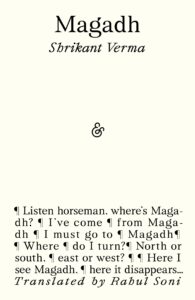
[And Other Stories; 2025]
Tr. from the Hindi by Rahul Soni
The history of civilizations is also a history of their cities, kingdoms, and capitals. Just as Greece and Rome loom large in the Western imagination of greatness and heritage, India is home to scores of such cities and kingdoms, or centers of civilization. From the ancient Magadh empire to Kannauj of medieval times, this astonishing historical geography is the source material for Magadh, the recently published English translation of the 1984 collection of poetry by Hindi poet Shrikant Verma (1931-1986). Verma was one of the practitioners of the Nayi Kavita or modernist poetry movement in Hindi, a language spoken largely in northern, western, and central India. Rahul Soni’s translation makes space in English for a bridge between the historic and the contemporary, offering a critique of power across time and space.
The fifty-six poems in Magadh invoke the names of ancient Indian kingdoms and capitals. Some occupy both mythology and history, including Kashi (today’s Varanasi/Benaras), the city of salvation; Hastinapur, the capital of the Kuru empire in the Mahabharata; Mithila, the empire from where princess Sita hails in the Ramayana, later home to the Nyaya and Mimamsa schools of philosophy; and Mathura, where Lord Krishna was born. Not so well known in the West are the other regions including the Mahajanapada republics (6th-5th century BCE), easily among the earliest experiments in republic governance anywhere in the world. Some of these cities and empires are more famous (in India as well as in West) than the others: Magadha was the empire that Ashoka the Great ruled over and Kapilavastu was where Gautam Buddha was born. Others – Avanti, Ujjain, Takshashila, Vaishali, Kosala, Shravasti, Champa, and Kosambi – are not well known, but were home to great empires and centers of learning. Among the places that became famous as seats of power much later are Amaravati (late BCE and early CE centuries), Nalanda (5th century), and Kannauj of the Medieval ages.
While the material seems historical, its ethos and form are modernist. Verma’s poetry is free verse, a hallmark of modernist poetry as most visible in the Western tradition of modernism. It also speaks of disillusionment with tradition: there is a questioning of history and received wisdom, even a critique of it. His poetry shocks the reader with its profanity, attacking every great historical and mythical city and exposing its hollowness, rather than adding to their celebration.
Magadh reads like a cartography of entering and exiting the historical cities in present times, but it is a cartography of emptiness. There is really nowhere to go, and those heading to some illusion of grandeur while invoking the heritage and glory of a bygone era are no travellers but ridiculous specimens of humans that refuse to learn from history and to imagine or reinvent spaces that change the idea of being and belonging somewhere.
The speaker is Vetal, a folk-mythical ghoul who has been hanging from a tree and witnessing the passage of Time. Through this position, he has witnessed humans living the same old follies: waging wars in the name of virtuosity or greatness only to realize that greatness remains elusive or is meaningless. Magadh, the kingdom of Ashoka the Great, and Hastinapur of the Mahabharata have fallen so far from grace that they are rendered unrecognizable. For instance,
If you can,
consider
Hastinapur,
for which
time and again
a Mahabharata is fought,
and no one cares
except that person
who comes to Hastinapur
and says,
No, no, this can’t be Hastinapur!
Hastinapur, as mentioned earlier, is the site of the great war in the epic Mahabharata; the war lasts for eighteen days but destroys everything, including the successors of the victors. The ghoul says in another poem:
Listen or not then
people of Hastinapur! Beware!
In Hastinapur
your enemy is being raised; Thought
– and remember
these days it spreads like the plague:
Thought.
The war fought in Hastinapur is an example of greed and power driving cousins apart. Nobody is thinking. Maybe the reverse is also true: there is a lot of thinking but the thinking is about outsmarting the other faction.
Elsewhere, the problem is that no one is thinking, and that is the cause of the empire’s downfall:
Kosal can’t last much longer,
there’s a lack of thought in Kosal
The poet juxtaposes these two downfalls. One is mythical (Hastinapur of the Mahabharata), and one is mythical as well as historical (Kosal): Kosal is Rama’s kingdom in the Ramayana but it was also one of the Mahajanapadas that was absorbed into the Mauryan Empire after a war. The speaker has seen the same things produce different reactions in different places: in Hastinapur, thought causes war, while in Kosal (the great rival of the Magadh empire at one point of time), it is the reason for the downfall of the empire.
It is not uncommon in India to invoke cities in terms of a sacred geography and visit them in one’s own lifetime. For instance, Ujjain, the city of Lord Shiva, was the site of a sacred religious pilgrimage gathering in 2016. Verma turns it into a place that cannot be returned to:
All travellers going to Ujjaini:
this road does not go to Ujjaini
and this same road goes to Ujjaini . . . .
Then
where should those going to Ujjaini go?
They should go to Ujjaini
and say,
This is not Ujjaini
because we
did not arrive here on the roads
that go to Ujjaini
or on the roads
that don’t go to Ujjaini.
In this portrayal, Ujjain is no longer that mythical sacred city. The kingdom of Avanti was annexed by a Mauryan emperor who also founded Ujjain as a great capital of Avanti. This status of greatness too has disappeared. Here, the poet suggests that sacredness and greatness are temporary moments in the histories of cities.
An engagement with spaces, especially cities, has been a feature of modernism: T. S. Eliot’s Waste Land, the “unreal city” of the famous poem, and Joyce’s Dublin are two examples. Literary critic Joseph Frank called modernism a phenomenon of “spatial form.” Recalling that modernism gets expressed in cities, or in ways that foreground spatiality, Magadh’s use of cities embraces these urban, modernist aesthetics.
Spaces are also metaphors of positions people occupy: left and right (in the sense of directions, situation neighbouring countries, but also in the sense of political positions), one’s own country and enemy country, and so on. The kingdom of Avanti was a rival to the kingdom of Magadh. In this rivalry, Verma captures the shortsightedness of all kinds of enmities:
Will it make a difference
if I say
I’m not from Magadh
I’m from Avanti?
Of course it will
you’ll be taken to belong to Avanti
you’ll have to forget Magadh
And you
will not be able to forget Magadh
you’ll live your life
in Avanti
without knowing Avanti
Then you’ll say
I’m not from Avanti
I’m from Magadh
and no one will believe you
You’ll cry –
‘It’s true
I’m from Magadh
I’m not from Avanti’
and it will make no difference
No one will believe you are
from Magadh
No one will recognise you
in Avanti
Pride in empires amounts to categorically belonging to one position, taking an oath of unconditional commitment to it. Belonging to one place means letting go of one’s humanity and the right to occupy any other space. The biographical context provided in the book about Shrikant Verma hints at the rigid borders between the self/other and the binaries between political parties. Verma was a member of Indian National Congress, a political party that was in power for a long time in independent India. He was the spokesperson for the party and was also a Union Minister. Throughout his association with the party, he witnessed all kinds of political games of one side claiming moral and political superiority over the other. Having witnessed the voting in and out of diverse political parties in India, Verma seems to have written most of the poems included in the collection to express the absurdity of it all, as if to say that a Democrat has to be a Democrat in all aspects of intellectual thinking and lifestyle choices, and a Republican has to live life in opposition to the life of a Democrat. The poem about Magadh/Avanti is an allegory of geopolitical, and even civil, tensions anywhere in the world. The tragedy that the poems unpack is that there are only thesis and antithesis left in the world; the world does not move towards a dialectical understanding or synthesis. Fighting for the territory amounts to little more than “fighting for a fiction.” At a time when patriotism and nationalism have become more powerful, the poems drive home the point that spirituality is the most political aspect of life: the problem is not the Magadh/Avanti divide; the problem is one’s inability to see the division everywhere else and choose neither side.
The choice—as if the choice between poles is ever reasonable or fair—in the collection is what makes the-personal-is-the-political pivot to the-personal-is-the-urban. Citizens convene primarily in cities, empires, or the capitals of the empires, making them the primary site of reflection for Verma’s Magadh. The individual is thus intertwined with the urban, and Verma’s aesthetic of conveying truths about human experience not through specific characters but through these spaces renders somewhere as everywhere: it is a way of understanding human experience though geopolitical terms anchored in history. What happened in these ancient Indian cities and empires is representative of downfall everywhere. Verma’s modernism is spatial and speaks to what one might be able to identify as the apocalypse in the Indian ethos: the apocalypse has come in the sense that even death has died. The Manikarnika Ghat in Kashi is known as the most active cremation ground; the dying always come here and the pyres burn round the clock. One poem says that this space which is the greatest witness of sadness and mourning is itself in mourning because corpses have stopped coming. Death is a sign of life; the place where there is no death is the site of apocalypse.
The ghoul at the center of Magadh has seen it all: the world divided between the victors and the murdered, the silencing of all questions about where one is headed and if the chosen road leads to the intended destination, and how one can know what one’s destination is or should be:
We are all
going to Kannauj,
because everyone
is going to Kannauj
There is no sense of purpose or direction in life. One is going to Kannauj because everyone else is going there. The lack of geographical orientation is a symptom of lack of moral orientation. For example, a similar lack of personal, moral conviction is visible when the ghoul describes changing laws when they become inconvenient:
I don’t break the law
like everyone
I fear it
But sometimes, citizens,
when it starts to smother
I make
amendments –
the law, after all, can be relaxed.
Rahul Soni’s translation retains the directness and the simplicity of Verma’s original. The shortest poem – of three lines – in the collection illustrates this. What he translates as:
What I wrote, useless
What I did not,
meaningless
is an uncomplicated rendering of what can be variously translated as:
What was written was wasteful, wasted
What was not written,
disastrous
or
That which was written, in vain
That which wasn’t,
catastrophic
(translations mine). Thus, for those who can understand the original text, the translation provokes more translation, as an ideal translation should, setting in motion fresher thoughts and feelings from an original. But for the way it retains the voice of the ghoul, Soni’s translation is wiser, making the poetry of Magadh accessible to English-reading audiences
For Hindi, often hailed as the national language of India, Soni’s project of making a regional modernism drawing on antiquity visible in the Anglophone has helped reframe how histories of translation need to be reshaped. It also helps to re-explore texts that might otherwise be lost, like the lost cities in Magadh.
Soni Wadhwa teaches English at SRM University, Andhra Pradesh, in India. She is a regular contributor to Asian Review of Books.
This post may contain affiliate links.