


This essay was first published last month in our subscriber-only newsletter. To receive the monthly newsletter and to support Full Stop’s original literary criticism, please consider joining us on Patreon.
When I first got out of college, I worked at a library in suburban Atlanta, secretly judging people from the circulation desk as they checked out books on true crime. Deriving any kind of satisfaction from real tragedy seemed crass and profane. But then my sister and father died within a year of one another, and it was only after I’d experienced profound loss that I began to understand the insatiable desire to read—and then write—so-called “true” accounts of it. I began to judge true crime readers and writers less harshly.
Fast-forward two decades and true crime’s everywhere, permeating pop culture, social media, and even my own playlists. For me, it started innocently enough with This American Life’s Serial and S-town podcasts. Now I’m a paid subscriber to Dateline, enjoying commercial-free episodes, occasionally settling for 48 Hours when I’m out of new content and need a quick fix. Like others who listen with a sense of unease, I wonder what compels me to keep returning to these stories week after week.
I spent a decade writing a novel that now languishes in an untitled folder on my desktop screen. The narrator searches to find the father she’s never known. In contrast, I knew my father well; we met for coffee at Waffle House every Wednesday night for a decade, working the New York Times crossword together and discussing the Atlanta Braves lineup. But once my sister was gone—and him, too— a lifetime’s worth of memory and experience seemed like smoke and mirrors. Had I really known them? Could I know anyone, including myself? What happens to the self when your self-perception is irrevocably tied to the perceptions of people who are dead? Through fiction, I tried to make sense of the past, both theirs and mine. The true crime genre, which had once seemed voyeuristic and tawdry, now felt like a version of what I was doing: investigating and confronting what happened in order to draw some answers from it, even when that feels like an impossible task. The writing process itself can seem strangely mystical, driven by elements of the subconscious that aren’t fully knowable.
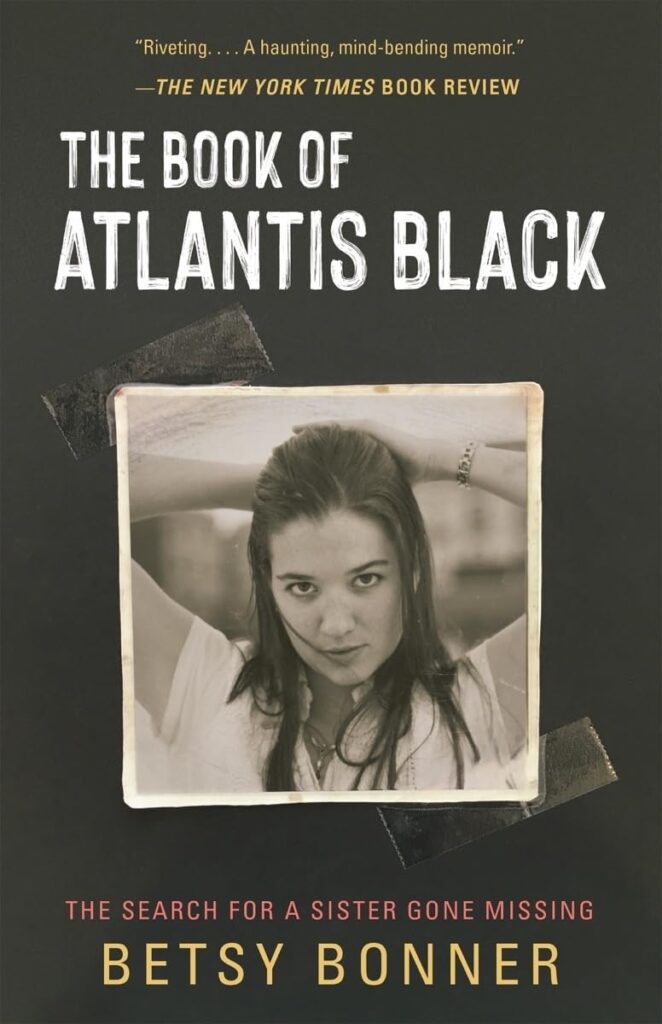
We don’t always know why we write what we do. But the impulse to “order the disorder” of grief, as Gregory Orr once put it, is present in both Betsy Bonner’s The Book of Atlantis Black and Erin Slaughter’s The Dead Dad Diaries. Both books are fraught, fragmented memoirs defined by lyrical prose—Bonner and Slaughter are poets, too—and an attempt to trace familial lineage through explorations of trauma and grief. (Full disclosure: I know both writers, but did not know them when I first encountered their writing.) In her memoir, Bonner attempts to reconstruct her sister Atlantis’s disappearance and probable death, while Slaughter retraces the murder of her father on the eve of her senior year of high school. Both books blur the line between memoir and true crime, treating evidence (letters, interviews, police files, photographs and digital footprints left behind) not just as factual record but as emotional keys that add up to…well, I won’t say answers. But they add up to something profound about the ways in which grief resists resolution, even as we keep circling it, searching for patterns that might never fully emerge.
How both authors navigate the idea of “true” facts versus emotional truth speaks to the impossibility of ever fully recovering the dead, and yet we still try, by necessity if nothing else. In an interview with the podcast Wake Island, Bonner even states, “I mean, for one thing, I wrote [the book] because I had no choice.” In her use of official police documents, Facebook posts, emails and interviews with those who last saw Atlantis, Bonner invites readers to consider how the search for the “truth” about her sister’s life and death is as much about shaping a narrative as it is about uncovering facts—especially when the so-called “truth” and evidence contradicts itself. This process of building a “case” is mirrored in Slaughter’s own search for meaning in her father’s death, though her investigation is less outwardly structured by law enforcement materials and more driven by her own memories and intimate artifacts. The Dead Dad Diaries begins with the surreal funeral preparations and reunions right after her father’s murder, and ends with her studying court records and his rehab diary entries in a cathartic act of acceptance years later. For Slaughter, the “evidence” is personal, often emotionally charged, but equally significant in the process of constructing her father’s life story—each letter or photograph is a piece of the puzzle, a clue to understanding who he was beyond the loss.
This gradual piecing together of evidence reminds me of the ways in which Perry Mason’s questioning and exhibits gradually build to reveal the true killer in the last act of the show that bears his name. But there’s something innately human and intuitive about this mode of investigation that precedes our justice system or the ways in which it’s depicted in the media. What could be more personal or natural than a sister or daughter mining artifacts of their loved one’s past to come to some answers about their life?
I remember finding a video of my father ten years after he died. He’s at an Alcoholics Anonymous meeting, in the back of a crowded room, organizing a haphazard display of coffee cups hanging on hooks screwed into the wall. Someone at the microphone makes a joke about him. The camera lingers on my dad after the laughter in the room has died down. He’s pretending to be engrossed in his task so that people will stop looking at him. The camera’s only there for a second but I recognize the real him, deep down in there; it’s my dad, and then the camera pans away and he’s gone. That’s one artifact in my own attempts to resurrect my father—create enough of a character in the present to have something to hold onto—even if all it amounts to is a printed piece of paper with words on it that I’ve written.
While these physical artifacts along with police reports and court transcripts) promise authority, they can never capture the fullness of a real life, or what’s left in its absence. Instead, layering these documents with memory, imagination, and lyric reflection gestures toward something truer—and larger. Nothing definitive like resolution, but a reckoning with absence itself.
In both memoirs, evidence serves less to solve a crime than to reconstruct a self—both the dead family member and the writer grappling with their loss. In The Book of Atlantis Black, Bonner does some of her own resurrection work, using passages from Atlantis herself, often interspersed between chapters in white-on-black text, offering a chilling sense of a voice that speaks to readers from the grave. In one passage, Atlantis says: “I got it—my next album will be called Glamor. Spelled the American English way, not the British. Glamor is just a Midwestern girl who wants to get to Hollywood. But she doesn’t make it.” Part of what is most heartbreaking about this book is what feels like the inevitability of her fate: from the little girl in Chadds Ford, Pennsylvania abused by her father, molested by her neighbor, to the riot grrrl punk musician, struggling with mental illness and jailed decades later for being caught in a prescription drug ring before her death.
In the final chapter of The Dead Dad Diaries, called “Rendering,” Slaughter describes a folder of fragments in a drawer of “notes, cards and clippings,” which she has “scraped together to divine from these fragments what is left unexplained: how [her] father’s murder was foreshadowed by the history of damage that led to it, and how it became the catalyst for the damage that occurred in its wake.” Ultimately, both authors engage with the act of investigation as a deeply personal, almost intuitive response to loss. These “grief archives,” as Slaughter calls them, reveal the complex relationship between truth and memory, offering readers a meditation on how we process and narrate grief and ultimately survive it.
In a Lithub interview, Bonner states, “I think it’s impossible to know what happened to Atlantis—and what happened isn’t the point.” I know what Bonner means here, but I don’t purport to know or understand what the actual point is, even in my own writing. In Poetry as Survival, Gregory Orr describes this collage and archiving process: “Survival begins when we translate our crisis into language—where we give it symbolic expression as an unfolding drama of self and the forces that assail it…the [writing] we compose still accurately mirrors life’s interplay of disorder and order.” Constructing stories of the dead is nothing new, and neither is our need to find order in chaos. Slaughter, who has studied Orr’s work, states in her memoir, “To attach meaning to the events of our lives is to armor ourselves in the hope that we can control how the stories of our lives are told.” In this case, the act of writing is not merely a passive recollection of events; it is a powerful process of shaping and reframing, a way of imposing order on the chaos.
Through their respective use of fragmented recollections, interviews, and objects of personal significance, they transform their loss into a narrative they can control, making meaning not just from what was lost, but from how the story is told. About these constructions, Orr writes, “two crucial things have taken place: First, we have shifted the crisis to a bearable distance from us, removed it to the symbolic but vivid world of language. Second, we have actively made and shaped this model of our situation rather than passively endured it.”
Both memoirs also interrogate the very craft of the genre and the act of investigation itself. Bonner and Slaughter don’t simply recount the facts of their loved ones’ deaths or disappearances; they actively question the role of storytelling and memory in creating meaning from tragedy. At the end of the third chapter, Bonner mentions Andrew Wyeth’s grief at never having painted his own father before a train hit his car stranded on the railroad tracks. Bonner states, “…would [Wyeth] have been any less grief-stricken if he had? I wonder the same thing about writing this book.” The answer, unspoken, is no. Memoir here is not confession for its own sake; the act of writing is its own gesture of survival, shaping fragments into a language that bears the weight of loss. Later in the book, rifling through Atlantis’s things, Bonner thinks, “what was I doing there, digging like a rat through my sister’s junk?”
I remember talking to Bonner once about a long-term leak in her bathroom and her fear that such a leak could spread into mold, damaging the home and the items in it. The reality of her circumstances as the lone survivor of her family hit me then: when your entire family’s dead, the artifacts they’ve left behind become the only tangible remains of their lives. In the memoir, she recounts that Atlantis’s nickname for her was “Lucky Betsy,” which seems cruelly ironic now. “That was just how life went for us; our destinies were already written,” Bonner says in the book.
I recently interviewed Slaughter for the Southern Review of Books. In an unpublished excerpt, she discussed the differences in writing about what feels like versions of her father’s death in different genres. “I think you have to acknowledge that if you’re writing any confessional, first-person account,” she said, “as memoir is, you are crafting from a place of using literal truth to get at emotional truth, and sometimes the emotional truth takes the reins a little bit more than the literal truth.” One general critique of memoir, especially the confessional genre which these two books fall under (perhaps especially when they’re written by women) is “who cares?” But in both books, the writing process of collaging memory, artifacts left behind, and the family members’ own words feels like more than a mere act of survival, and rather some kind of statement of bravery and resilience, like Bonner and Slaughter are each saying to the Fates sister trio, fuck you, guys, I’m still here.
Bonner and Slaughter’s memoirs remind me that the point is neither resolution nor justice—not in the way true crime podcasts like Dateline might promise. When I find myself replaying that grainy A.A. video of my father or flipping through my sister’s 80s pop CDs that I keep under the bed, I realize I’m engaged in the same kind of work: building a grief archive, layering evidence with memory in hopes of arriving not at truth, but at something I can live with. As Maggie Nelson writes in The Red Parts, “Maybe some things are worth telling simply because they happened.” In telling these stories, however fractured, we keep the people we’ve lost close enough to feel them, if only for a moment, before the camera pans away.
Amber Wheeler Bacon is a writer and teacher whose work has appeared in Crazyhorse, Ecotone, Epiphany, Five Points, New Ohio Review, Post Road, Prairie Schooner, and Witness. You can find her writing online at Ploughshares, CRAFT, Fiction Writer’s Review and New South. She’s the recipient of the 2018 Breakout Writers Prize sponsored by The Author’s Guild and a 2021 scholarship from Bread Loaf Environmental. She received the 2022 Lit/South Award for flash fiction, a 2023 Prairie Schooner Award and was a finalist for the 2023 Chautauqua Janus Prize, nominated by Ecotone Magazine. Amber has an MFA from Bennington College and teaches writing at Coastal Carolina University. She lives by the beach in South Carolina.
This post may contain affiliate links.