


This feature was originally published in the Full Stop Quarterly “Tender Tongues,” edited by Natália Affonso. Subscribe at our Patreon page to get access to this and future issues, also available for purchase here.
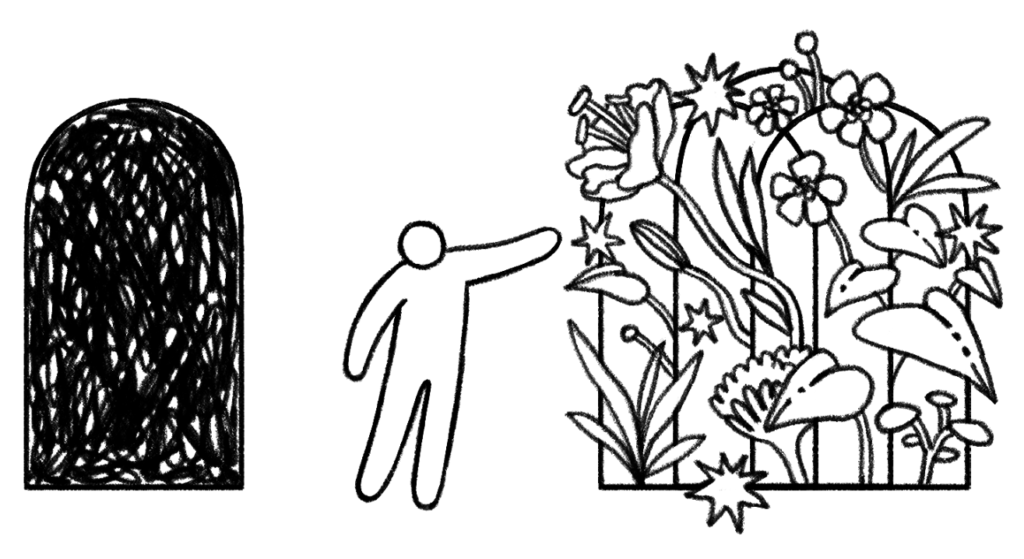
Cisheteropatriarchy names with violence; does violence with its names. The project of diagnosis, embedded in medico-psychiatric clinical research as practice, seeks to consolidate power over the epistemological and material conditions of life itself. Given these violent efforts, it is critical to examine the myriad breakages, trapdoors, and lines of flight forever in cisheteropatriarchy’s shadow, embedded in the omissions, ambiguities and evasions in what I have called elsewhere transMad practices—those that combat hegemonic frameworks of knowledge and practice by centering those that deliberately do not make sense in the entangled shadows of cisness and sanity.
Following Andrea Abi-Karam and Kay Gabriel in We Want it All: An Anthology of Radical Trans Poetics, I understand poetics as a “way to inhabit revolutionary practice” (2022:2) particularly for those whose bodyminds refuse to comply with hegemonic demands for legibility. transMad poetics are creative tactics of reorientation away from the institutional mandates of “cure” and “recovery” of one’s capacity for labor, but shared orientations against cis/sane ways of life and linear storytelling (Cavar, 2022). These linear modes mark a highly institutional[ized] form of storytelling, whose long shadow—what Liat BenMoshe calls the institution yet to come—pervades even trans | Mad lives relatively untouched by the physical space of the clinic.
The story of trans | Mad non/compliance begins with a hegemonic Story, whose capitalization reflects its ability to accrue social and monetary capital. For decades, trans scholarship has acknowledged the curatorial labor of trans embodiment when seeking vital healthcare, legal legibility, and, however minimal, protection from the most immediate and devastating forms of social violence (Coyote and Spoon, 2014; Gill-Peterson 2022; Malatino 2019; Spade 2003; Stryker 1998). To enter into the clinic and declare dysphoria is to embark on a justificatory project, one that is at once epistemically incriminating (“I suffer from a disease called dysphoria”) and desperately self-justifying (“my relationship to my bodymind is real, and I have narratable memories to prove it”).
In the poetic interventions I will be reading, authors disrupt attempts to “make sense” of disparate, profoundly ununified bodyminds in a way that undermines (under-mines, undermines) emergent practices in the cracks of the real. It is in these cracks, in the margins and the alleyways and “cripistemic” backwoods, and in moments stolen (Moten and Harney, 101) from and apposite to the Institution, that transMad projects event themselves. With the term “apposite,” I follow Moten’s (2004:274) account of appositional enlightenment within the Black radical tradition:
Appositional enlightenment is remixed, expanded, distilled, and radically faithful to the forces its encounters carry, break, and constitute. It’s (the effect of) critique or rationalization unopposed to the deep revelation instantiated by a rupturing event of dis/appropriation, or the rapturous advent of an implicit but unprecedented freedom.
Amid what Moten identifies as demands for “universality in language” (as opposed to the “merely phonetic” (273)—which might also be called word salad (a term ascribed to the “nonsensical” forms of speech attributed to people diagnosed with schizophrenia) or mumbo jumbo (whose anti-Black origins were immortally satirized in Ishmael Reed’s 1972 novel by the same name)—exists a legibility killswitch. Moten writes of an “ordinary” (white, sane) reality necessarily undercut by the simultaneous Otherwises: “the extraordinary is the always surprising path through the ordinary that is made by way of the montagic, transversal sequencing of events” (273).
To do transMad means, having passed (again and again and again) through the spiny gates of the ordinary, to find recourse to the very corners of the imagination, to take pleasure in the nonsensical. transMad involves a disidentificatory recognition that the very violent regimes of diagnosis that both invent and destroy us are also sites of fugitive pleasure, to make poetry in community in the face of carceral grammars. This is a refusal of a kind of so-called care that is, in truth, curative, seeking to erase ambiguities in favor of the easy, the legible, and even the “accessible” (false claims of ableism sometimes emerge in attempts to quash transMad modes of communication). Inasmuch as it gestures toward truths, realities, and experiences not-yet (or, perhaps more accurately, not-here), the speculative and even secretive elements of transMad creativity—including the interventions I read below—refuse calls to speak legibly, simplistically, and universally on non-normative embodymindment.
transMad poetic interventions address/undo violent projects of hyperindividualized, medico-psychiatric storytelling, and manifest lines of flight toward realities otherwise, which cannot be collapsed into linear narrative frameworks. In spite of extractive structures, fugitive, opaque, and poetic practices circulate, leaving evidence of transMad poetic methodologies without revealing their secrets. Departing from the carceral politics of the Story and toward lyrical resistance, I explore transMad poetics as radical speculation, as challenging windows into words worlds wounds rooms of our own.
Recognizability and its Discontents
Love my aggression. Spy on me, I beg you. […]
What you understand is not what I am. What you fail to understand.
(Besemer, 2018: 19).
If permitted to exist at all, the story of trans subjectivity under the medical gaze must remain oriented toward approximations of cisheterosexuality, conditional abled/saneness, thinness, and class-privileged whiteness, which together constitute and are constituted by acceptable gender performance (Snorton, 2017). Of course, the mandate to story ourselves as sensibly is critical not only to trans oppression, but Mad oppression, and illustrates the inextricable entanglement of these two systems. The testimony of the “recovered” once-ill is a powerful narrative technology, and has served to advance mainstream mental health policy agendas, and individuals with the requisite “lived experience” may even be coached into narrating their respective stories intelligibly for institutional gain, whether for themselves or for an institution (Woods, Hart, and Spandler, 2022). In response to this, and to the parallel and intertwined issues of epistemic subjugation in trans clinical encounters, trans (Radi, 2019) | Mad (LeFrançois and Voronka, 2022) epistemologies find recourse to the experiential knowledge of trans | Mad persons ourselves, particularly those who have survived institutional oppression, whether within a discrete, walled space or under epistemological frameworks that render us what I, following Mel Baggs, call “perpetuallyabusable unpersons” (Cavar 2023:16).
In the long shadow of the institution and its narrative mandates, relief rests in the minor literatures of transMad life. Following Deleuze and Guattari, Berlant (2006: 34) describes minor literatures as “space[s] of internal displacement [which shatter] the normal hierarchies, clarities, tyrannies, and conclusions of compliance with autonomous individualities,” comparable to “digging a hole” in the face of an unlivable reality. These holes are ambivalent spaces of processing, grieving, and (re)imagining, which must hold complex traumas, yet refuse to confine themselves to recognizable trauma frameworks. This paradox undergirds much transMad poetic writing: we fight to recognize each other carve illucid and illicit intimacies, even while stealing (ourselves) from institutions and steeling ourselves against medico-psychiatric violence. [Our bodies] are floating in space, ready to be explored (Leungsuraswat, TTL 82). But the map is not the territory, and transMad poetic strategies offer obfuscation as a way of engaging with trauma, while blocking the pathological pathways of institutional possession.
With small, stark font, wide-spaced and replete with gappy blackouts, autistic, Chinese-Canadian poet Jane Shi’s Leaving Chang’e On Read unveils a DSM of a different variety. The poem, “History Flipping,” indeed flips the DSM-V criteria for autism spectrum disorder into a text nearly unrecognizable, studded with white space and black bars. Tellingly, Shi leaves available to the reader words readily applied to autistic children by clinicians: “affect,” “nonverbal,” “absence of,” “excessive,” and, of course, “disorder,” fumble across the page, attempting and failing attachment (16-17). These words, decontextualized, become stark in their dehumanizing ethos—the autistic subject (object) is defined as necessarily in excess or in absence, but excess and absence of what? Stripped to its bare bones, the autism diagnosis is no longer a label for a preexisting condition, but a means of measuring distance from agreed-upon behavioral norms. The result of noncompliance with these norms, as Shi indicates, is a detachment to the point of illegibility. Autistic personhood falls through the fractures created by clinical diagnoses of unwholeness. The disordering is deliberate.
The epigraph to this particular poem is also telling. In it, Shi quotes Theresa Hak Kyung Cha’s opus, Dictee:
She mimics the speaking. That might resemble speech. (Anything at all). Bared noise, frown, bits torn down from words. Since she hesitates to measure the accuracy, she resorts to mimicking gestures with the mouth. The entire lower lip would lift upwards then sink back to its original place. (quoted in Shi, 16).
Cha’s meditation on illegible, unrecognizable speech and is rooted in her experience as a Korean woman and immigrant under U.S. empire—and empire’s demands for a fluent (in English), sanitized (sane-tized) story of assimilation and forgetting on the part of dislocated people. Redeploying the quotation for her queer, Chinese-Canadian, autistic purposes, Shi highlights and rejects white supremacist, cisheterosexist, and ableist epistemic violence. She marks up psychiatric texts, both to come to terms with the terms set for her existence, and to implant the total institution with an exit row: below the repeated word “disorder” sit several lines of blacked-out text—speculative space which refuses to serve readers not already in-the-know. Shi’s refusals double as invitations to speculate on experiences whose horrors (and possibilities) defy language. (Leslie Feinberg (2014:5): Do I have to tell you every detail? Of course not. | Franz Kafka: I am constantly trying to communicate something incommunicable, to explain something inexplicable, to tell about something I only feel in my bones and which can only be experienced in those bones).
In fat feminist and public scholar Caleb Luna’s (2022) hybrid poetry collection, REVENGE BODY, which intervenes in anti-trans, anti-fat, and ableist/saneist medical projects, these redactions are preempted elsewhere in the text: it refuses to specify individual persons in its poetic dedication (italics in original):
for the sick & disabled
crazy femmes who are surviving,
those who chose not to, &
those who died trying
This dedication tells a micro-story in stark contrast to those of recovery-through-transparency, instead allowing “failure” up to and including suicide to be in conversation with trans | Mad survival. Luna’s line breaks add ambiguity to an anonymous litany, identifying the “sick and disabled” and “crazy femmes” as distinct, yet overlapping and soon-to-be-expanded categories. The third line, “those who choose not to, &” once again gestures ambiguously to its predecessor an ampersand opening space for the weighty conclusion: “those who died trying.” Strikingly, Luna calls in a wide array of interlocutors in this dedication, while choosing not to reprise the medical interpellation that placed them into contact.
(Bo Leungsuraswat:
“I guess this is how recognition works
Every sight leaves
a scar
A cut
That alters the shape of your body” [76])
Luna also gestures at something darker. Throughout REVENGE BODY, they recognize the ongoing horrors that have consigned them to the abjected categories of trans, fat, disabled, and Mad. However, this very shared status of abjection creates the conditions for comradeship, and lays the groundwork for anticarceral coalition. The community Luna invokes is both concrete and ambiguous: the “sick & disabled / crazy femme(s)” are someone(s), known and loved, yet also unknown, perhaps even to themself. Luna subtlety recognizes that the violence that renders sickness, Madness, fatness, and queerness inimical to full personhood leaves in its wake a powerful solidarity.
Luna’s dedication offers counter-recognition, a way of seeing and inviting transMadness while necessarily obscuring “incriminating” details. The poet gestures to, and, at the same time, chooses not to capture events of carceral violence: both out of a decision not to rehearse an ongoing project of medical humiliation enacted against fat trans | Mad people in particular (Baggs 2018; Mercedes 2020; Mollow 2015) but also because they cannot linearly, chronologically, matter-of-factly describe those events: traumatic events are indiscrete and ongoing, an unending sentence evading linguistic capture. Not only because ruptured memory defies chronology, but also because the language of “trauma” so often rests in the hands of its perpetrators. The well-worn dictum “do no harm” becomes, for abusive medical institutions, a promise: we are ontologically incapable of harm, and you, unperson, cannot be hurt.
The genre of remembering required here is unavailable precisely because of its dehumanizing implications: “You can’t be present while another person stops being a person. If even for a moment that other person is just shivering meat,” writes McKenzie Wark (2020: 12-13). Unpersoning becomes both event and non-event, eminently recordable (via sterile medical documentation) and yet unwritable (in terms of addressing trans | Mad lived experience). Redaction from the record of personhood, while necessitating counter-poetics, also necessitates their own redaction. To reflect the inescapability of medico-psychiatric violence is to reflect the very absences through which we, together, escape.
In the opening pages of Reverse Cowgirl, McKenzie Wark (2020: 11) writes: There are moments when I don’t exist. I both want and fear those moments. Both Shi and Luna express ambivalent orientations toward nonexistence, contending with the ways in which their voices are foreclosed from medico-psychiatric record, yet at the same time facilitate a “voicelessness” that can wield its own obfuscatory power. If to be transMad is both to reject (as a point of creative pride) and be rejected (as perpetually-abusable) from legibility, what dreams might we express with words that cannot be read?
Poetics After Knowledge
If the mind is a terrain, cut in complexity like any other indescribable landscape
then let us be cartographers because we need better maps.
If pathology is a map
If language is a map
If the language of pathology is our map, then we need better maps.
(kitty lu bear, 2022:6).
transMad poetics cannot and should not be consigned to the realm of “trauma processing”—even when, as Luna’s work indicates, these poetics can serve as a vital, life-saving technology. For my interest in transMad survival, I am perhaps even more interested in flight: thinking transMadness as its own kind of off(er)ing, perhaps providing a response to the query of why poets off themselves (Ching-In Chen, TTL 97). What if to off oneself is not inherently a practice of self-killing, but self-obfuscation—which, arguably, includes self-killing and ego-killing. Under this framework, the poet, and certainly the transMad poet, practices offering in striking out against language—pilfering the resources offered by institutions and smuggling them into an Otherwise reality.
Offing: a killer’s gerund. A likely possibility. A horizon in the far distance. Where can poetry take us? In her practices of transreality, game studies scholar and performance artist micha cárdenas “use[s] a poetic lens to subvert the power of the cisgender gaze” (2017:8) whose devotion to a biologized, overdetermined Real World forecloses trans lives. Instead, she calls for an approach that embraces a multiplicity of contradictory realities, all simultaneously “true” and “untrue”: what Ching-In Chen identifies as “messy, chaotic, overrun, contradictory, blowing every which way” (97). The chaotic possibility of transreality is kin to the concept of tranifestation, coined by Kai M. Green and Treva Ellison to describe the process of “renaming and refiguring” the world such that “ruptures [in ‘reality’] are mobilized as generative sites for solidarity and transformation” (2014). To these chaos-notes, I add speculation, alongside an illustrative quote from author Karen Russell, whose orientation to the craft of speculative fiction has been critical to the analysis in this essay:
I’ve always loved speculative fiction because it shows us that there are alternative ways of doing things and alternative ways of living. You have to imagine a way forward before you can get there. It’s so easy for my imagination to list in dystopian directions, but it feels very active to pivot and ask, “What could happen? What is unwritten? Where do I have agency?” [in Westenfeld 2023; emphasis added]
While remaining ambivalent about the language of “agency,” especially for trans | Mad subjects unpersoned by institutional violence, I linger on Russell’s call to ask what could happen and, even more, what is unwritten? The ambiguity of these questions echoes the “flexible epistemology” offered by tranifestation, as well as the call to contend with “difficult knowledge” (Costa and Ross, 2023) coming from Critical Mad Studies scholarship and praxis. To identify with trans | Madness is to practice speculation on a daily basis: to commit trans desire, to open oneself to trans becoming, is to speculate on a bodymind relationship not-yet-here; to walk through the consensus reality which deems you Other while at the same time moving through a psychological landscape to which sane people lack access. What happens when we collude on the ward, exchange tips and contacts? When we pirate knowledge from the medical industry to care for our comrades in the shadows? transMad speculation contends with the possible (and the immanent impossible) without fixing (in any sense of the word) these possibilities to the rational, sane, and/as the real. We follow Russell’s ambiguous calls of what and where in order to expose the inherent weakness of “a totality that cannot stand, in its orderedness, in the face of the rough non-sense or extra-sense” (Moten, 2004:272).
Speculation, while often ambiguous, can also provide us practical steps toward that which we seek to tranifest. NM ESC’s poetics point to the importance of embracing danger, including crime, within a framework that criminalizes transMad existence. In their experimental essay “Sunset Vans,” ESC opens with a scene as familiar as it is unimaginable: a government shutdown that they and their comrades hope is “for good” (305). Moving by backslash from thought to thought, “Sunset Vans” rapidly contextualizes this hope in its naming of what Sara Ahmed calls affective alienation from the cisheteronormative, white supremacist project of “recovery.” ESC’s “strange dreams” (205) of hope are not divorced from the violent realities under which they and their comrades live. Strange hope and normative violence are inextricably linked: a summer evening of front porch sex gives way to the memories of winter: tight-wound friendships that medical hegemons “tore at the seams / & called it suicide watch” (306). Medical interventions hostile to transMad life keeps ESC and comrades running, running down deadly stretches of I-95 and toward a summer always receding—a summer free/d of the “material consequences for living how we do” (206) [italics in original].
For ESC, the experience and promise of summer (re)presents a fugitive hope for (non)realities behind, beneath, and obscured-by medico-legal “truth.” Taking up Moten’s call for the nonsensical, ESC remixes the slogan “property is theft”: “if property is theft and theft is proper then I’m going to put my fist through the sun and pull the light out” (306), thus imagining a transMad craftworld capable only under the cover of darkness. Pulling the light out is only partially a “sentimental / lingering” (306) project; it is also a form of un- and re-writing: “we didn’t choose or want these bodies / but we are losing the right to repair them,” ESC continues, linking together multiple forms of technosocial injustice,
“& we need that warmth to hold each other up” (306-307)
Hold up through what, for how long? We will not receive these answers, instead receiving implicit despites: despite incarceration, grief, expulsion, subjugation, survival is as unrelenting as it is opaque: the strange dreams of warmth that keep us loving and fucking and fighting are as impermanent as the highway and thin as /.
In “Sunset Vans,” we hold up in order to address spatiotemporally mingling traumas whose paths routinely overlap. Nominally “individual” experiences coexist with the ongoing, ambient traumas of climate violence, eugenics, and enforced poverty. While “optimistic” recovery approaches presuppose limits to the length of ugly feelings, marking them as temporary roadblocks on a longer path to a healthy-balanced-normative future, “Sunset Vans” uses ugly feelings as a cudgel, a brick through the glass front of happiness which condemns transMad people to oblivion. ESC illustrates the ways in which transMad poetics cannot be contained in the language of “coping”—to live on, transMadly, is to bump directly against the demand to (appropriately, legibly, in a timely manner) “process trauma” as such. It may very well instead require a poetics of paranoia, rumination, perseveration, obsession, and friction, in and through behaviors decidedly “anti-social” whose implications text on a page can only begin to address.
In another contribution to a transMad poetics of the “anti-social,” McKenzie Wark’s Reverse Cowgirl, freely fucks and fucks with the “sensible” in terms of transition, ultimately demonstrating a language-averse language of joy. Wark eludes the fealty to “realness” often demanded of trans memoir. Instead she freely blends fantasy (sexual and otherwise), fairytale, and “real life” happenings, particularly in her recounting of life prior to realizing that she was trans. Yet the textual moments oriented around her own trans-realization, too, prove different from conventional autobiographical notions of “writing-into-being” (Moten, 277) which appear to invent / event a legible and immutable subject (Moten, 277-278). Such a form, Moten notes, constructs, predicts, and ultimately restricts, leaving no space for generative defiance (278). It is precisely this generative defiance that Wark deploys in her transreal description of trans-realization:
Its decided. I’m giddy with resolve, adventure, logistics, epidermal charms, demigod blessings. I will transition. I am going to make my exit from masculinity. I don’t know how far I can get away from it. I don’t know who this I is or who she will have been or become. And I know I have left this too late. But it doesn’t matter. I’m out. Out as trans. Out as trans to the trees and the hawk up in the tree and the lake and the fish down in the lake and the beaver downstream in the river. Out to the sun, out to the sky. Hello world, I’m trans! Am I binary or non-binary? Am I trans-femme or a trans woman? No idea. Well, some ideas, some steep inclinations. But the decision that’s made is to jump off the edge of masculinity and hope to float.
The immediate emotional texture of Wark’s realization, as she writes it, is one that simultaneously embraces intellectual deliberation and flights of fancy: she has been taken in like a lover by the charms of trans life, pushed to the brink of that “exit from masculinity” by an enabling and unnameable force. The process of her realization is fuzzy, marked by momentary pleasures and cyclical intellectual explorations: she is concerned with the continuous process of what Deleuze and Guattari might call becoming-trans / trans-becoming, one disoriented from existing notions of “ideal” gendered embodymindment and instead concerned with fleeting, intuitive, ecological relationships.
Wark compares her “outness” not to persons who have legibilized their trans identities to a human public, but to trees, lakes, hawks, fish, beavers, and rivers. Yes, she is out, in the way of something ejected from a burning capsule: out of a narrative “benevolently given—which is to say violently imposed—by the one who took [her] and [her] ability to tell, [her] ability to tell and [her] ability to know, [her] ability to tell and to know in the interest of that which [she] would know or would have kin” (Moten, 278). This time, Wark hails herself instead: a “you there!” replaced with “hello world!” and followed by “I’m trans!” and a purposeful avoidance of further description. Unlike what we might call “sane transition” narratives, wherein the moment of trans realization is one of closure (“this is who I am, that past person is ‘dead’ or never truly alive at all”) Wark’s is of what could be described as a beginning but could even better be identified as a rupture in the very project of trans self-description—of the idea of the medically-authored/authorized “trans individual” at all.
ESC and Wark exemplify transMad poetic impulses to disrupt the legible, as a means of survival and/as becoming. This combination means that the practice of speculation is happening as we happen: ESC’s anti-/ante-hospital care work is speculative and happening precisely because it cannot happen, and yet it is, and yet, by medical mandate, it is not. Wark’s trans, having been hailed by herself with and through nonhuman beings, is both unarrived and having always been: what is new is not her gender, but the rupture this new orientation produces in the narrative fabric of her life. Here, transMad speculative practices disturb language from “inside the house” or disturb the master’s house with its own tools, irreversibly damaged in the process.
Conclusion
Names stick. Notes gather in the traces we leave. Yet, we render lives, texts, and socialites Otherwise: We may speak in gossip, paranoid patterns, deny medical authorities the benefit of the doubt precisely because there is no benefit to doubting the extent of their cruelty. We keep secrets with our lives because they make the difference between incarceration and relative freedom. Our poetic approaches reflect this ever-shifting relationship with safety and danger, with what can and cannot be put into words, resulting in feats of imagination that portend new worlds even as they (the approaches, the feats, the worlds themselves) are already-arriving.
What is the purpose of poetry that refuses to be read? What is poetic about the refuse, the detritus that defies interpellation? While poetics is not inoculation against the cruel optimism of recovery toward the legible, it can serve as a trapdoor, an opening of alternative possibilities. Rather than coming to specific conclusions on the purpose of transMad writing (or even a concrete definition as to what transMad writing is), I have outlined two key elements of transMad speculative poetics.
The first: a poetics of, against, after, and beneath the institution, both in its material forms and in its long discursive shadow. The interpellation of trans | Mad subjects into intolerably violent lifeworlds necessitates a poetry of obfuscation, redaction, risk, and rage.
The second, highly related element is one of speculation, of what Marquis Bey calls “fugitive hope,” described as “the living outside of time and civilization because it yearns for something not legible in current frameworks” (216). These are not worlds free of the lingering memory of violence, but moments, trap doors, and hiding places Otherwise to everyday realities of violence and death.
So long as trans | Mad existence exists, it exists toward that which cannot (yet) be understood, pushing ever-further from the shores of fixed, stable, and legible knowledge of selves and others. As we steel ourselves for increasing assaults on our ways of being, un/knowing, and becoming together, I look forward to further engagement with transMad poetic practices, taking comfort amid terror in mapless moments and cunning feats and disheveled language. In the long shadow of the hospital, the prison, and the terrors of their demands for transparency, transMad writing refuses, offers alternatives just out-of-sight. Now: what wor(l)ds might we take into what lies beyond?
NM ESC:
If property is theft and theft is holy then i am proud
of every single year we’ve stolen back
of how much joy
is possible
to haul away from here
before the fuckers catch us.
For a full list of references, consult the Full Stop Quarterly issue “Tender Tongues.”
[sarah] Cavar is the author of Failure to Comply (featherproof books, 2024) and Differential Diagnosis (Northwestern University Press, 2026), with genre-nonconforming writing in Kairos, The Rumpus, Transgender Studies Quarterly, Electric Lit, and elsewhere. They hold a PhD in Cultural Studies with a concentration in Science & Technology Studies from the University of California: Davis, and are interested in the politics of queercrip & transMad knowledge production. More at www.cavar.club, @cavar on bluesky, and at librarycard.beehiiv.com.
This post may contain affiliate links.