


[The Song Cave; 2026]
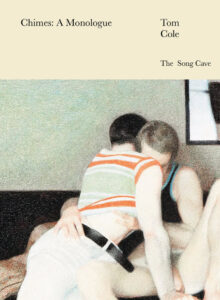
Chimes: A Monologue opens with the silence of the pandemic-emptied city (“there is for the first time quiet, finally quiet on my block”). The rich, the able, and the revelers with second homes in the Hamptons or Sag Harbor or upstate getaways have fled, leaving behind those without such choices and, in the case of one of the narrator’s neighbors, wind chimes: “five hollow metal rods circling a ceramic disk in the center—a UFO.” The residents have absconded to the safety afforded by wealth and privilege and left behind a tinkling torture device. He sees it as a hostile act. The chimes drive him first to distractions with their nightmarish idiot-jingling, then to rage, then to a stream of memories that appear unbidden, conjured one after another. His agitated interiority is distilled and expressed as a jittery Beckettian burble of self-confrontation delivered with a mix of blunt vulnerability and bleak humor. The chimes have unleashed an existential whirlpool that is less Proustian morsel-memory recall and more cockroach-Eucharist from Clarice Lispector’s The Passion According to G.H.
For the narrator, who has lived with HIV for over two decades, the chimes, the pandemic, and the isolation have rattled loose old fears. He reflects back on when he used to get tested for HIV in the ‘90s: the kit, the cost, the phone call with its 15-digit code to have an automated voice deliver his negative status. “I was negative then,” he notes. “I can only sense my soul when I am looking down at my body.” Depersonalization, some TikTok amateur therapizer might judge, but diagnosis is the slipperiest of beasts in this book, changing meaning, temperature, and timeline.
Cole isn’t interested in static answers, conclusions, or final judgements. Rather he’s drawn to the staticky fuzz of lost signals, hesitations, and miscommunications.
To distract himself from the accumulation of urban indignities he goes for a jog:
When I go outside, I see the wind chime, I hear the wind chime, which makes me run faster, harder, longer, and it reminds me of when we used to take elevators—like someone who lets the elevator door close, even though they see you rushing to get in.
His mind moving as fast or faster than his body, summoning his recent rewatch of the 1990 Mexican soap opera Cuando Llega el Amor, a story of two sisters that includes sexual betrayal, a botched homicide, paralysis, and ends with a literal bang (explosives). The narrator’s breathless, bonkers summation concludes when he coolly observes, “The bad sister shouldn’t have been so careless with the poison.” He recalls the story of his one-legged grandfather losing a leg in a train accident and using his wooden prothesis to store “[a] bottle of Jack Daniels, pills, a vial of mercury, guns.” Then, a man he met online who asked to photograph him. The shoot took place in a squalid apartment and involved convoluted poses and props. The results are not the strange, quasi-erotic Jimmy DeSana-esque images the situation suggests, but “a series of small black squares, my hand here and my foot there, dismembered.” This triptych of lost mobility, lives, and limbs doesn’t require a co-pay and a 54-minute recline on a sturdily practical couch. The narrator makes the natural associations. His own self-destructive impulses always have this startling and droll observer’s eye.
He returns home to discover his package of Chinese herbs prescribed by an acupuncturist (they are called Six Gentlemen: three after lunch, three after dinner) have been stolen and fully snaps, erupting in a stream of obscenities and punching walls until his neighbor Thaddeus fesses up that he saw a man wildly rummaging through packages and saying he was cold. Thaddeus gave the man an orange jacket, a Good Samaritan providing warmth but not intervening in a theft. A bewildering hunt for the herbs and the orange-jacketed culprit ensues. It’s a condensed chase movie, a nighttime tragicomedy of errors that ends with him blacking out. Was he hit or did he pass out?
Threaded throughout the monologue are memories of sex and fantasy:
And as a child, I wanted to be a slave, to be tied up. I once handcuffed myself to a desk at school and said, “Someone did this to me.”
And I wanted to be split up.
A hundred eyes of night. More like a million, I thought. So—a rough time—spiraling—back to shooting up meth and sex where men beat the shit out of me, regularly, and I knew I had to get sober.
A hazy orgy in his apartment that begat a squatter who had to be evicted, but as soon as he was gone the narrator believed they were fated to be together. He fantasized of a Freaky Friday-style body swap, of experiencing the squatter’s drug detox, then his own. Six months later, he ran into the man walking down Seventh Avenue, looking disheveled, in bad shape. The man didn’t recognize him. He considered approaching but thought better of it: “I saw him try to take a picture of the sunset, with a flash.”
All the scrambled signals and feral insanity recalled led to sobriety, which at the moment of the monologue, the chimes, and the stolen herbs feels fragile, maybe even tentative. The murmurous possibility of relapse burbles in the background, a grumbler’s chorus of fatalistic naysayers. The narrator remembers how he has ferreted out every stripe of surrender, or at least loss of control. From shooting meth and doing hot rails (“a way of inhaling crystal meth that involves coarse rocks and a gas stove”) to being beaten and humiliated to the hunger for spiritual and mental surrender, including youthful fantasies of joining the Hare Krishnas, a fascination with the Manson Family, lobotomies, and electroconvulsive therapy.
The sections aren’t written as sonnets, but they all have voltas, reversals, and reconsiderations. This is a mind on hyperdrive, lost in the blurus pandemia, trying to find a coherent guide-rope through the unknown. The narrator knows that ultimately everything in life is unknown, but this particular unknown is the spooky carnival ride where the floor drops out, and you look to the sky to ground yourself. When everything starts to connect, it’s either psychosis or art. Cole makes art that flirts with madness, reminding me of Lucas Samaras’s trippy photographic self-portraits, in which his body is convexed and concaved and made disgusting and holy and trailed by light. All shot in his tiny apartment.
After the news of his HIV positive diagnosis, which he received on a trip to Disney World with his sister, the narrator was contacted by a scientific study for an experimental drug trial. It turned out he was in the control group, and the toxic drugs made him very ill. He asked to exit the study, but they begged him to stay, and he did out of shame and guilt twisted up in loyalty. Only when another doctor raised the alarm did he quit.
Cole writes debasement and forfeiture with barbed ease. The power of being powerless, of succumbing to whatever comes along. It’s not defeatist because there is no template of success or failure. The desperate desire of the submissive to surrender control, to become someone else’s responsibility and, by extension, problem is a localized, personal waiver. An abandonment reflected all around him in a society where people relinquish power to the worst institutions and their leaders, be they politicians, priests, or technology created by the greedily depraved.
Words from other writers’ narrators-in-extremity are repeated as a mantra by the monologist, as ventriloquized confession. “I jumped in with no willing and eager friends around and when I sank, I sank to the sound of loud laughter” cribs from Jean Rhys’s Good Morning Midnight and “Am I a monster or is this what it means to be a person?” from Clarice Lispector’s The Hour of the Star. A monologue can take many forms: intimacy, confrontation, identification, a disembodied voice, a mouth in search of a scream. Cole deftly mixes all of these, often on the same page. Like the best monologues and performances—Sarah Kane’s 4:48 Psychosis, Will Eno’s Thom Pain (based on nothing), Wallace Shawn’s The Fever, and Ron Athey’s body-extreme ritualistic blood-lettings—Cole has created a singular work that connects to and disrupts a lineage. Some sections read as prose poems, reaching from Baudelaire’s spleeny Parisian whirl to Richard Siken’s recent stroke and language recovery block-texts. Others have diaristic blunt force. It’s a sleight-of-hand nude illusion rather than a striptease. Part of the power of the onward rush of words and emotions is what is left out, what is foregrounded, and what is revisited like a worrisome fever dream.
His selectivity highlights how associative and obsessive our thinking is and how ordering these flashes of life creates origin stories, heroic journeys, and personal fables with neat messages of meme-able uplift. Instead, he gives us a stream of thoughts and recollections; the narrator is in fact a speaker, closer to a poet’s recitation than a storyteller with beats and arcs and explanations. The monologue form requires the ability to capture and hold an audience, and Cole’s speaker enacts this control, all the while telling us stories of chaos and disorder.
Toward the end of Chimes, the narrator remembers essentially auditioning to join a leather family of a pig, sub-pig, master, sir, and boss to be their oral pig boy. After meeting Tattooedmuscledad online, a convoluted series of interactions—an introductory letter of interest, a lunch, and a family interview—takes place to join. The master who lived in Michigan (distant in every way) orchestrated beatings and torture via Skype. The family falls apart, spectacularly and pathetically, as many do, and the narrator has a dispiriting and deflationary one-on-one with Tattooedmuscledad. In the aftermath, he prays for forgiveness for wanting to please and blame others, and also wonders “What’s wrong with these people who can’t find drugs for themselves?”
The monologue’s anti-denouement hinges on a misheard word—Ryder for writer—that creates a brief charade until a direct question is asked and answered to no one’s satisfaction. Dodging conclusion or false resolution, the narrator/speaker lands instead on a beautiful image of purpose and bliss, a road trip fantasy that is also an escape from one self into another. A fabrication, a fiction. And yes, he decides to get his own set of wind chimes.
Nate Lippens is the author of the novels My Dead Book, a finalist for the Republic of Consciousness Prize, Ripcord, a New Statesman Book of the Year, and Bastards, forthcoming from Semiotext(e) and Pilot Press.
This post may contain affiliate links.