


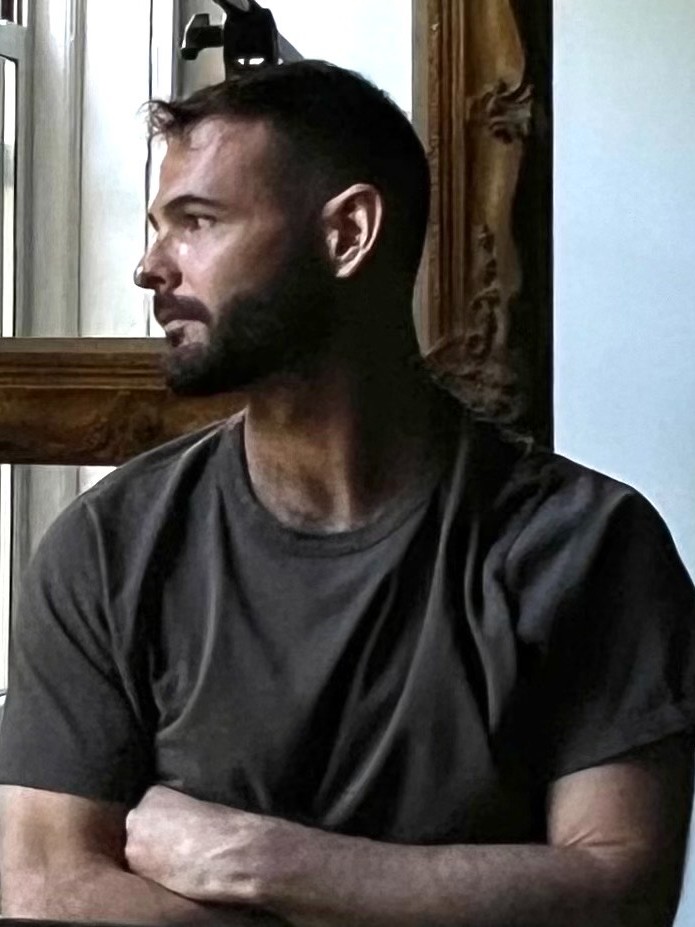
I had the privilege of first meeting Dan through his writing, while I was working as Arts Editor at Boston Review and found his poems one day in my inbox. They were prose poems, one line falling into the next without rest or break, as if each poem were written in a single breath. I remember feeling cold while I read them, though it was summer and the room was hot. The poems were haunted with the kind of attention to detail left only by loneliness’s imprint. Time passed in silence. Immediately, I wrote to Dan asking to publish the poem, “Leaving the Party.”
Reading the poem, one walks into the night. Inside, a child practicing the flute in an apartment is heard from the street. A car drives six miles too slowly. Rain spits. Among other things, the poem’s speaker circles around addiction, his own and his brother’s. Only near the poem’s end does it become clear his brother has died. Then a new shadow begins to unfurl across the poem. Of his brother, the speaker pronounces, “He was like that; I always sort of knew what he meant.” Perhaps our greatest pursuit in life is this: to know and to be known. Dan’s poems trace the unknown that occurs after loss. They observe absence. When I wrote to Dan, I told him that my brother, too, had passed away, and that writing had become a pathway down which I found I could still walk beside him. We quickly began speaking about writing and reading, the places from where we came, and writing into absence. I felt the kind of kinship often rare in a medium as solitary as writing. When I learned of Dan’s new book, Atria, I immediately requested an ARC, and then read it in one sitting. As Dan’s poems traversed mourning, language, observation, and artmaking, they prompted question after question. They are, sometimes, difficult poems. They don’t offer simple resolutions, nor any answers. Rather, they ask us to think about how we see and understand, and that which we don’t. They prompt us to consider language and writing. I was fortunate to chat with Dan over e-mail about Atria.
Hannah Liberman: I’m curious about the process of your writing, the intertextuality. Did you visit exhibits and read specific books as a way into the poems, or did the poems come as an accidental byproduct of your living and reading?
D.S. Waldman: The art poems came as a result of a much more intentional writing process. I had a press pass to SFMoMA, so was spending a lot of time in that museum, and I started letting my museum experiences guide my reading—a lot of art theory and art criticism. I would usually take notes while I was in the museum, then compile and start drafting poems at home. The other poems in the book arrived more organically, usually as a result of talking into my notes app while on long walks in Oakland, or on flights. It’s funny, those seemed to require less revision. I just sort of arrived.
Do you write by hand or do you type?
I have limited function in my right hand, so I can’t type very well. I write everything with my left, dictate it into a Word file, then go in and clean up the errors and typos.
An epigraph by John Berger begins the collection, quoting, “The relation between what we see / and what we know is never settled.” This, to me, foregrounds a tension teased out throughout the works in this collection. In writing, I feel as though I am seeing while rarely knowing. Or the written world feels as if it observes without necessarily making meaning of that which is observed. Generally, how do you conceptualize the relationship between seeing and knowing as unsettled? How does poetry trouble or bridge this dialectic?
It’s been a difficult question to answer, what is this book “about”? Is it about grief? Art? Relationships? The body and its limitations? These themes all recur, of course, but I do think this book is interested in, more than anything, the act of looking—looking at visual art, looking into memory, into old notebooks—as a way to move closer to understanding the unresolvable. What does one do when they suddenly lose a loved one? Or when the body no longer functions as it’s meant to? How does one explain the way these losses have fundamentally changed them as a person? I like what you said about the written word as an observer. That feels true. It brings to mind Keats’s familiar notion of Negative Capability, that practice of holding, at once, two competing or ostensibly contradictory truths. Poetry is, for me and many others, an arena for this practice.
In “At Lake Merritt,” you write, “thoughts are of the body, too, I thought or said, knowing’s a filter for sensation.” This line is funny, in a way—the speaker’s inability to recall whether they were thinking or speaking about thought and the body. When I read this line, I’m most struck by the speaker’s inability to remember, the speaker’s forgetting. In another poem, “Meditation at Hunters Point,” you write, “Of course, if it is the soul, and if it / Cannot remember the phrase, exactly / Same knot as yesterday, same pattern, the / Task is to forget. Forget it by heart.” In this last sentence, you superimpose “forget” over “remember.” How do you see the relationship between knowing and forgetting? Knowledge is so rarely anchored in the conscious, while forgetting and remembering are more immediately conscious. For instance, when we taste, hear, or smell something and become suddenly reminded of something thought lost. I wonder if you might speak to the relationship between writing and forgetting? If forgetting, too, can be generative?
I like that idea that forgetting can be generative. And I would add that forgetting is sometimes necessary to learning, to change. The middle section of the book meditates on this childhood accident I was in, which resulted in the loss of function and feeling in my right hand. I’d been right-handed up to that point, so at the age of twelve I basically had to forget how to do everything—how to write my name, brush my teeth, throw a baseball—in order to learn how to do it again, with the other side of my body. There was grief in that loss, overwhelming and almost debilitating grief, especially for such a young kid, but being in my thirties now and having had over twenty years to forget, to learn, to evolve, I experience next to that loss a profound opening and expansion.
So many poems in this collection are about loss. Considering the Berger epigraph, I wonder if you might speak a bit about seeing, knowing, and loss. I well recall, when we were first becoming friends, speaking with you about the fact that we’d both lost our brothers, and writing into or toward that loss. As I go through the world after my brother, I can see that he’s gone, sometimes, but I don’t know, really ever, that he is. I see him in different places, and I don’t know, I really don’t, that he is gone. Writing, for me, has opened a space that can hold that discrepancy between seeing and knowing, the ambiguities of seeing and knowing. I wonder how you might conceptualize writing as a container for what is seen but not known, or known but not seen?
It’s weird losing someone like that, to whom we were so close, and at once experiencing the vastness of the absence—our brothers are never coming back, in human form anyway, or the human form we knew—while also, like you said, seeing him all the time, everywhere. My brother was almost five years older, and it’s been a totally weird experience to age in his absence. Sometimes I see myself in photos or catch glimpses of myself in the mirror and I see him; I’ve grown into him in some ways. Or in my poem “Likeness” I write about the experience of seeing a guy with a pretty similar build to my brother’s wearing this Carhartt jacket he used to always wear. For a split second I had the bodily experience of being near my brother. For a flash it was true that my brother was there again on earth, smoking by the lake.
HL: In “The Clarinet: (1913) 37 ½ x 47 ⅜ papier colle,” you write, “tactile qualities define a space.” Throughout the collection, you invoke dimension frequently alongside the distinction between temporal and spatial dimensions. I wonder how you conceptualize spatial dimension in poetry, which is an inherently two-dimensional medium? I’m very interested in how your work also traverses verse and prose, which seems to me less about spatial dimension than it is about temporal dimension. Line breaks shift the duration of reading. Is the temporal dimension something you think about while you are writing, which is often an inherently linear medium?
Lineated verse is definitely pressurized. It’s almost like a channel has been opened to the gods, but a timer starts when the channel opens. I think that’s part of the lyric sensibility, and the reason for the compression of language. That channel is going to close. I think I’m drawn to prose, and especially prose poems, because I don’t like feeling rushed. I prefer meandering toward what I need to say. They’re such a narrow margin of error in lineated verse.
Reading the book, I similarly found myself most emotionally connected to the pieces unfragmented. That is, those where both form and content are immediately parseable. Perhaps this is only subjectivity and my experience as a prose writer. I wonder, though, if you might speak a bit about the somatic and intellectual experience of writing prose versus writing verse?
Continuing my above answer, I think linebreaks sort of announce the poem as lyric. It’s almost like flipping over a milk crate at the public square, stepping up on it, and clearing your throat. My first mentor in poetry, Blas Falconer, would sometimes ask the question, does this need to be a poem? Couldn’t it be an essay? A piece of short lyric prose? I find myself asking these questions all the time now, and I think my bar keeps getting higher for what constitutes/warrants lineated verse. Most of what I write that feels like it could be a poem really, in the end, just wants to be energized prose. And I don’t think there’s anything wrong with energized prose. I love it, actually. I just finished Paul Beatty’s The Sellout, and my god that whole novel feels like a prose poem.
Speaking of The Sellout, what are you reading?
Well, The Sellout is one of the best novels I’ve read. Now I’m starting from the beginning with him, reading his novels in order. I tend to do that, identify a writer I really like and read everything they’ve written. I’m also reading some of Denis Johnson’s short stories. I’m pretty loyal to the fiction writers who were trained as poets.
In an analogy in “Low Poetics: A Meditation,” you write that you frequently privilege form over context. You elaborate that works with a fragmented form allows readers a more generative experience, as they are able to move between fragments, the content rendered open to ambiguous or varied interpretations. I’m interested in your relationship to form, given the variety of forms your writing takes. Might you speak a bit to that? To the varied forms throughout this collection?
My educational background wasn’t in creative writing, but in art and architecture, so I think I came into Poetry with an underlying proclivity for form, for the shape the words take across the page and how that shape affects the reader’s experience of those words. Even something as simple as linebreaks totally alter the experience of a sentence. But I think it’s also easy to use linebreaks, and form more broadly, to create tension where there otherwise is little tension—I think this is one of the traps of verse. For instance, the sentence I just wrote is pretty flat, emotionally. It’s an informational sentence. But I could also lineate it and create these instances of ghost tension, or the illusion of tension:
But I think it’s also easy to use
linebreaks, and form more broadly, to create
tension where there otherwise
is little tension
So, just as my bar keeps getting higher for what constitutes/warrants lineated verse, so too does my bar for deploying form. I think it needs a purpose. I tried, maybe with mixed results, for the sonnets in the book to serve a particular purpose, as though those poems truly needed to be written in that form and no other. Otherwise, again, I should just be writing prose.
Throughout the poems, there’s a movement between interior and exterior worlds, both of which are punctuated by technology. This is interesting to me—there’s the interior world, the exterior world, and what seems to me a third, virtual world tied somehow to both. This virtual world, in a way, seems similar to the way artworks function across the pieces—they serve as an interlocutor. I’m interested in how the third, digital world serves as a kind of mirror or hiccup in the collection.
It’s funny, Poetry is this ancient technology, and one thinks of poets as these luddite bard-type characters, but of course we all have smart phones and computers, and many—many—poets are semi-constantly on social media. So I think rather than concealing phonescreens and smartphone cameras and AirPods from the work, I’m interested in a Poetry that incorporates these things. I mean, so many of these poems, or at least early drafts, were dictated into my notes app. I think that’s true for a lot of poets. I mean, while writing this book I spent time in certain museum spaces where I wasn’t allowed a pencil or pen, so the notes app was essential. So, while I’m as skeptical as anyone of these technologies, and especially of the companies that create and sell them, it would feel disingenuous to completely exclude them from the art. But I think you’re right about the digital world feeling like a hiccup. It’s almost like—in a museum gallery, for example—that “pure” attention between viewer and painting is to some degree interrupted, or at least altered, when the smart phone comes out to snap a photo. But it’s a part of the experience.
Considering that, in the poem “Man Ray,” you speak to the artist’s photographs, or rayographs. You designate as two distinct works the photograph and the photograph with the viewer’s reflection—first, the rayograph held behind glass and, second, the viewer’s reflection in the glass caught between their gaze and the photograph. I wonder if there’s an analogy here for writing, if the poem’s virtue is that it allows a new reflection caught between the gaze and the words. “Man Ray” suggests that the viewer can attempt to remove themselves from obstructing the composition, though they’ll ultimately fail. I’m interested in how this analogy bears upon writing and reading.. That staring back from the page is more difficult to make out.
I think part of what draws me to Poetry is its inherent ellipsis—poems leave things unsaid, leave space for the reader to enter and draw their own connections, project their own stuff onto the language, flesh things out for themselves. In that way, maybe the poem is like the rayograph, encased in glass, and once it’s energized by the reader’s attention we start to see the overlay of reader and written word, the reader’s semi-transparent self caught in the glass, hovering over the language.
In “HOWL, eon (I, II),” you quote a distinction an artist draws between preservation and annihilation. Though the quote designates the two as counterparts to each other, the works in Atria seem to suggest otherwise—that preserving is, too, a form of annihilating. I think of what the writer Jon Fosse means when he writes, “I don’t write to express myself, but to get away from myself.” I think here of a line, too, in “Notebook Fragments.” You write, “Louise says my work suffers under the speaker, / that I should consider removing the I.” This is funny, too, the “I” considering removing the “I.” Across the collection, the speaker often shares your name—Dan. Excuse the banality of this question, but I am interested in the relationship between Dan the speaker of the poem, and Dan the poet. How do the two relate to one another? Did you consider removing the “I”?
It’s funny, I think I did the opposite of what Louise suggested. For years up to that point writing poetry, my lyric “I” felt far away from me, Dan, the poet; the “I” in my early poems, before this book, was closer to Merwin’s oracular “I,” this sort of elevated voice that knows more than the poet does, is infused with some otherworldly omniscience. And working with Louise, I think my lyric “I” returned to me in some way. The voice in these poems, the speaker, is pretty close to my own voice. It’s a little elevated sometimes, and intellectual—I love reading theory, love reading hard texts—but I also write about hot browns and WoFo Reserve and doing ketamine in a beat old apartment. I think maybe that’s an aspiration of mine, for my lyric “I” to move ever closer to my personal “I,” even as that personal “I” is probably always changing.
This is a question closely related to your “I,” in both life and lyric. In your work, you mention some sense, throughout your life, that something would happen to your brother. I remember, prior to my brother’s death, writing about his death. Do you think there are precognitive elements of art-making? An aspect of remembering the future? Time comes up frequently in the collection.
Man, probably. I think of this both on a collective, historical scale—Orwell, Butler, et al—but also on the private, personal scale, as you mentioned with our respective brothers. To one degree or another, writers and artists have to think in terms of pattern and structure; if we’re writing fiction, and we are writing a scene, we are also probably, if only in the background, placing that language and that scene within a broader pattern or structure of a story. So I think with my brother, watching certain behaviors happen in real time—which I describe in my poem “Thirty-three”—I was probably, if again only in the background, fitting those behaviors and vignettes into the broader narrative of his life. It sounds like J.D. Salinger was an evil man, so I apologize for referencing him, but I read him in high school and this does all make me think of his linked stories “Franny and Zoey,” “Raise High the Roofbeam, Carpenters,” “Seymour,” and “A Perfect Day for Bananafish.” We get these little moments in the first three stories that clue us into the fact that Seymour will kill himself. It’s never directly named, only alluded to, but we are able to piece it together. We are able to see the end before it happens.
That makes me tear up—being able to see the end before it happens. I had the privilege of reading some of these poems prior to their publication. Can you speak to the different incarnations of the poems, the process of writing and rewriting? How revision plays into your practice?
I was writing these poems while writing a novel, which I mention because I think the novel took a lot of pressure off the poems. They could just happen when they happened, as opposed to my laboring and obsessing over them with singular attention. The poems also happened a little more slowly, more methodically, and in the end they required a little less revision than other poems I’ve worked on. Mostly line-level stuff and cuts. I also wrote these poem while in the Stegner workshop, so I had an incredibly smart and talented group of poets helping me shape and fine-tune these poems. I’m super grateful for that.
Across the collection, I was struck by the book’s intertextuality. Some quotes are attributed to their authors, while others are not. Some are housed in quotation marks, others italics, others undifferentiated from the text. I’m interested in the decisions you made around formatting, the way other voices come through throughout the book. Were these choices made in editing? Or did you know they would appear this way at the time of writing?
A mentor of mine, Aracelis Girmay, would talk about the collective “I’ we all write with—that is, the “I” or the self we take for granted as uniquely ours, our voice, our ways of saying, etc., but which is really an accumulation of selves and voices. The families and communities we come from, all the people we’ve encountered in our lives, and past lives, every writer we’ve ever read, these “I”s are all part of the tapestry that is our “singular” voice. All the language in the book is mine, and none of it is mine. So I think in terms of quoting other writers and thinkers, I was maybe interested in including their voices in a way that might better reflect how they present in my mind, as opposed to always executing citations the way we see in critical papers.
That’s lovely—it reminds me of the book My Poets. Considering language more broadly, do you think there exist things that can be said in writing that cannot be said? It’s interesting, in that much of your poems reference conversations, things that have been said aloud. Is there a change that occurs when something said is transcribed into writing? In an interview for the Paris Review, the interviewer asked Sharon Olds if she lies in her poetry. This seemed interesting to me, particularly when content closely tracks autobiography—do you lie in your poetry?
On one hand, I think of the Sontag quotation I use in my poem “San Francisco”: To photograph is to confer importance. I think the same might be true for reported speech in poems—the fact that the speaker is referencing a given conversation insinuates there is something important or noteworthy about that conversation. And of course this is Poetry, not nonfiction, so the speaker could also be reporting or referencing a conversation that never happened! I’m sure there are instances of that in my book.
Some of the poems in the collection seem to attempt to shed the “I,” to invert the subject and object, speaker and addressee. I wonder if you’re at all interested in psychoanalytic frameworks?
Definitely. Before getting my MFA I’d been in (and dropped out of) a PhD program in depth psychology.
Speaking about life before the MFA, across the works, you mention growing up in Kentucky. What was it like growing up there? When did you start writing?
We grew up pretty far out into rural Kentucky, on a horse farm. It was beautiful out there, but super remote. I went back a couple years ago to the farm where we grew up—I hadn’t been in ages—and I came into contact with this feeling, as I waded into the creek behind our old house, that the world could totally leave me behind there. That was overwhelmingly the sense I had growing up, that if I did not go commune with the world, I would never know the world. I’m very grateful for that upbringing, and I’m also very grateful to now live in New York City.
I didn’t start writing seriously until I was in my mid-to-late-twenties. We had a lot of books in our house growing up, though, and I very much count reading as a part of writing, so maybe I was a writer all along.
I agree with reading as writing. Considering place, the ocean often leaks into your poems. Do you see landscape as tied to language? Do you write about a place while you’re in the place, or in retrospect, after you’ve left it?
I have an old friend who is a linguist—I think he speaks thirteen languages—and he was talking to me one time about the relationship between language and place. He’d grown up in the Caribbean, and used the example of Cuban Spanish, which is a slower and more languid form of Spanish, a reflection he said of the hot, humid, equatorial climate. He contrasted this with Icelandic, which to my ear is a sharper, more clipped language, maybe influenced by its colder, semi-Arctic origins. To be clear, I know nothing about this stuff. But it sounds convincing!
I think about this, even with people who live on the West Coast versus the East. When I consider verse, I often think about the silences or rests contained in line breaks. I think a lot about rests in language. What do you think can’t be held in language at all?
I mean, I think language universally falls short. I wish I remember where I read this, but just recently I read somewhere about a school of thought that says grief sounds were the origin of language; those deep guttural grief noises became vowels, which were eventually broken up by consonants. I don’t totally buy it, anthropologically, but something about it does ring true. The noise falls short of the feeling. And language is really just noise.
Hannah Liberman is a writer and editor. Her editorial work at Boston Review has been recognized by PEN America and anthologized in Best American Essays, and her writing appears in Boston Review, Los Angeles Review, Los Angeles Review of Books, The Drift, among other places in print and online. She teaches fiction writing at UC Irvine and lives in Los Angeles.
This post may contain affiliate links.