


[House of Anansi, 2025]
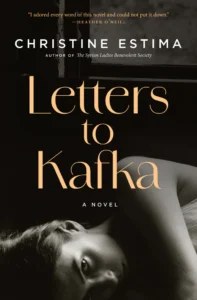
A look into a lost world, Christina Estima’s debut novel Letters to Kafka traces a love affair between two shining intellects of pre-World War Two Europe: Franz Kafka and Milena Jesenská, a Czech writer, translator and journalist. It follows the two from literary salons in Viennese coffee houses to desolate railway hotels, to a final meeting at Kafka’s deathbed.
Living in Vienna after World War I, Milena is unhappily married to Ernst Pollak, a literary critic and man-about-town who keeps a mistress. When we meet her she’s adrift and stealing sundry items like letter openers for thrills. She’s at a coffee house when she runs into Kafka, a name she’s heard from mutual friends and her reading. The two hit it off: “I’ve been lost at sea,” says Milena, “And, for the first time, I’ve glimpsed the lighthouse on the shore.”
Before long the two are exchanging a flurry of letters and Milena becomes not just Kafka’s lover but his first translator. She spends her days at her husband’s typewriter, working on a Czech version of Kafka’s fiction. Once published, its success enables Milena to become a freelance journalist. As her fame grows, so does her infatuation with Kafka. He returns her telegrams and letters with similarly steamy replies but is also engaged to be married. Soon things come to a boiling point.
The best thing about Letters to Kafka is how contemporary Milena seems. She’s a character that leaps off the page and is a woman of almost boundless energy and ambition. She translates, writes, commits small thefts, and knows the backstreets where she can fence stolen goods and track down stuff on black market. She is more than a match for every man in this book, who seem dull and two-dimensional by contrast.
Here she is when she gets a telegram saying Kafka’s in town and wants to see her: “I knock over a chair as I fling myself toward the front door. It goes ker-smash and Pani Kohler calls after me in a panic as I slam the door behind me. I dart out of the building, sprinting through the winding streets. The sun blazes like Beelzebub’s cauldron; my hair sticks to the back of my neck.” Where her female peers are reserved and demure, Milena is all action, emotion, and wits: when she sprints to her lover, the passage blazes like something out of Gothic literature.
She’s such a dynamic character you wonder what she’s doing there. She’s technicolor in a city of muted browns. Next to her, characters like her husband Ernst Pollak, literary associate Max Brod, and Kafka himself don’t stand a chance. For example, Pollak is largely only seen through glances and brief flings with his wife; we never see the intelligence or wit that makes him both a literary critic and a well-regarded part of the Viennese literary circle.
Partly this is because Milena is an outsider: she writes for a far-off newspaper, not a local one, and as she cultivates a reputation as a writer she never becomes part of the inner circle. She’s an independent-minded woman in an era when women largely stayed at home and had similar inner lives as that of her houseservant Pani Kohler: they think about family before themselves and have little aspirations for a career that would take them beyond traditional gender roles. The very things making Milena such a larger-than-life character are the things that set her apart from this world.
At the same time, Kafka is handled well. When writing a historical figure who is as well known as Kafka, Estima has to walk a tightrope: she needs him to be a certain way to carry the plot and be a cool foil to Milena’s hot flame, but he also has to read true to life. After all, this is not an alternative universe where he got to live to see his fame. Here he’s a man who is torn between loyalties: his fascination with Milena, but also his engagements with women back home, notably Dora Diamant. It’s a blaze of an affair, two intelligent people who deal with words, but ultimately it burns bright and rapidly.
Which is not to say the book is hot or even steamy. Their love affairs are primarily through letters and when they do meet, it’s for quick getaways at hotels and a walk though a large outdoor garden. When they do, it’s intense:
He circles his arms around me and I bury my face in the nook of his neck. A very real fear is penetrating both of us now. Before, in letters, the reality of our predicament could be ignored, but in person, the consequences seem to be hunting us from the shadows… that feeling of being thrilled to my core was addictive. Of losing my footing on purpose. Of rocking a fragile boat until everyone and everything had capsized.
Milena’s language is that of someone who wants to do everything to the hilt: she wants to experience love fully and completely, to be washed away by its powerful emotions. She loves the thrill of an illicit romance, the danger of being discovered in a tryst with her lover. Such powerful feelings can’t last in any relationship and they eventually fizzle out here, with lingering feelings on both sides hanging like smoke from a snuffed out candle.
Eastima’s novel shows a lot of promise: she’s able to draw a scene and create characters that come alive. Scenes between the two leads are memorable, but less so are those between Milena and her Viennese peers. There are also moments that ring false, like when Milena reads about Adolf Hitler in the newspaper and sees a painting of his on the wall of the cafe she’s sitting at. There’s a subplot set during the Second World War that runs throughout the book where she’s being interrogated by a Nazi official and her mix of arrogance and bravery—she spits on her interrogator and sets fire to the room after being beaten—comes across like a Tarantino character.
Still, Letters to Kafka is a good book and an engrossing account of an ill-fated love affair between two towering intellects: one unjustly forgotten and one who’s so familiar his name has almost become a cliche. It inspired me to look more into these two, particularly the letters Kafka wrote her, and to an anthology of her journalism. I’m curious to see where Estima takes readers next.
Roz Milner is a freelance writer and critic who lives just north of Toronto. Her writing has appeared in the Toronto Star, Lambda Literary, PRISM International, Broken Pencil, and elsewhere. She is currently working on a book of short fiction.
This post may contain affiliate links.