


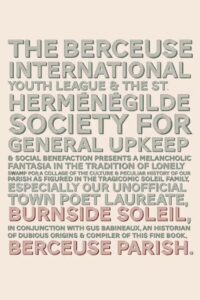
In what may hold the record for the longest title of a poetry book, Burnside Soleil’s debut collection, The Berceuse International Youth League & The St. Herménégilde Society for General Upkeep & Social Benefaction Presents A Melancholic Fantasia in the Tradition of Lonely Swamp Pop, a Collage of the Culture & Peculiar History of Our Parish as Figured in the Tragicomic Soleil Family, Especially Our Unofficial Town Poet Laureate, Burnside Soleil, in Conjunction with Gus Babineaux, an Historian of Dubious Origins & Compiler of This Fine Book, Berceuse Parish, shimmers beyond its lengthy and humorous title. Written for its region, the Louisiana Bayou, the collection extends well beyond swamps and parishes.
The collection opens with a word from the narrator, Gus Babineaux, describing the town and an inkling of the town’s personality: “Michel Lefrere drank too much the previous night, indisposed at his shack where he will tell you some news if you knock on the kitchen window and furnish the sill with an offering of whiskey.” The very next page includes a full “cast” of characters for reference, much like Ilya Kaminsky’s Deaf Republic. Kaminsky’s collection is an apt comparison for Berceuse Parish: both works are lyrically driven, both tell a cohesive story with multiple key players and changing perspectives, and both include a “cast of characters” at their outset. Berceuse Parish, with its strong musicality and muscular language, is so skillfully executed that it reads more like a fifth book of poems rather than a debut collection. The dance of these poems keeps a keen rhythm, is downright infectious.
Soleil has crafted a mysterious poetic persona through Gus Babineaux, the narrator at the center of the collection, but even Gus doesn’t have the full tale right: “I have what’s left of that Berceuse. I have the incomplete record, gaps and silences generous enough. I do not know what became of everyone in our cast, not exactly.”
The entire book seems written with the same imagistic and narrative intensity as the very best of the renowned lyric poet, Larry Levis—if Levis grew up in the Bayou and not in California. Take the book’s second poem, “Nel”:
When we swim at night,
as we did then, we hold
on to so little, passing
through leaves stippled
in our wake. When my kids
ask what you were like,
I tell them about the plains,
where you moved, how it
once was an inland sea.
Here, Soleil allows readers to fall effortlessly through each line, savoring a long-running sentence in its weaving and unfolding. Few poets since Levis seem to have embodied this level of skill in continuing the poetic line in what seems like effortless turning and precision. It’s the poetry equivalent of a Formula 1 driver smoothing a car around a track at two hundred miles per hour.
Another aspect that sets Berceuse Parish apart from other collections is its overt “thinky-ness,” paired with wry humor. Take, for example, “Maggie,” which has these lines: “You found a floating bag of coleslaw / one time. // Nothing has ever happened.” The contrast between mentioning coleslaw in water, a surprising detail, then following it up with the mention that nothing happens because of it takes the rug out from under a reader’s feet, so unexpected a turn that it made me laugh. Or take the many “A Few Particulars” poems, some of which have footnotes that broaden the poems with funny asides. As an example, the last poem in the book, simply titled “A Few Particulars,” has this wry yet poignant footnote from Gus: “In the Inferno, fraud is the rankest sin, punished at hell’s depth, as it’s peculiar to human beings, which means the most human part of this canticle is the most fraudulent.”
Berceuse Parish advocates for its region while at times admonishing it, with insightful observations about tourism and stereotyping of Cajun people:
By the way, you might be looking for more about gumbo or étouffée, or perhaps I’ve been remiss and chosen poems replete with zydeco and washboard similes and metaphors, whatever kind of cultural kitsch that typically interests the tourist—which is to say, they seek what they can recognize.
The narrator leans into commonly stereotyped views of Louisiana at first, before turning the knife around at the reader with a whiplash ending: “Do you think we know only swamps, not the mountains and rivers and snow? Read a book.” It’s a stellar poem and it reminds me of Robert Lynn Wood’s poem from Mothman Apologia about how to pronounce “Appalachia.”
Soleil structures the collection around a group of characters, whose voices he evokes and distinguishes beautifully. Take, for example, the difference in voice between “Jeremy”:
Childhood is deciduous,
like this evening when two white egrets
plumed in the median, and then one flew
to the bayou, the other nearly into my car.
…and “Maggie”:
You smoke
outside, bonfire
for gnats.
You hear the lilting
brawl of the moon.
Grits
hot in your belly.
In these examples, “Jeremy” has lines that unfold elegantly, coursing down the page, while in “Maggie,” the speaker communicates in terse bursts of image and information.
Other poems in Berceuse Parish act as letters between the book’s cast of characters, all written in thick Louisiana French, a beautiful buoy in the collection, breather poems, bouncing in and out like driftwood across the bayou.
There are so many knockout lines in the book that remind me of Louis Glück, building up a poem slowly then suddenly taking a reader’s breath away. Poems like “A Few Particulars on Purgatorio” with an ending line like “It wasn’t love, but like love, and enough” and one of the “Uless” poems: “I thought the dark was like maw, / like a bear, that it was a cave. I wanted it to be a cave.” Or one of my favorites, “A Few Particulars on Thimbles”:
You could almost say, if you prefer the imaginary, that those might have been the calls of the minor gods of the woods, trees that had seen so many kids pass through their branches, so many paddling in the water, and it won’t always be like that. Summer is really only summer in childhood.
You grow up. Watch out. You grow up, and can’t return.
Berceuse Parish is that rare poetry collection that seems to accomplish all that it sets out to do. It is a perfect collage: of a parish in Louisiana, of the family Soleil, and of the folks who trespass the life of the poet.
Daniel Lassell is the author of two poetry books: Frame Inside a Frame (TRP: The University Press of SHSU, 2025) and Spit (Wheelbarrow Books / Michigan State University, 2021), selected by Gabrielle Calvocoressi as the winner of the 2020 Wheelbarrow Books Poetry Prize. He grew up in Kentucky and lives in Bloomington, Indiana. Visit his website at: www.daniel-lassell.com.
This post may contain affiliate links.