


[Joyland Editions; 2025]
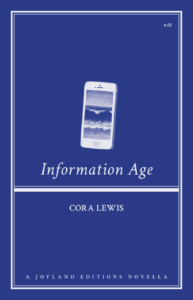
You probably know the meme, the one that accompanies some image or video of a group of people doing something. Medieval peasant rituals, pre-iPhone concerts and nightclub scenes, vintage photographs of historical events, always with the same caption: “Not a cellphone in sight. Just people living in the moment.” Get too deep in the chronically-online discourse and you’ll be told to log off and “touch grass.” These sentiments—often expressed in the comment sections of social media platforms and, increasingly, real-life conversation—reflect an individual and collective desire to return to a life before we had to be online all the time. Is such a return even possible anymore? Or are we just seeking idealized versions of the past to cope with technological advancements progressing beyond our control? Can we ever truly disconnect, especially when our continued interactions with these attention-capturing technologies have permanently altered how we behave in and experience community? People have never had this much access to each other, so why do we feel so alone? These are some of the questions haunting Cora Lewis’s debut novella Information Age.
Reading this book was not entirely unlike scrolling through my phone. Lewis’s narrative unravels across five multi-chapter parts through an assemblage of vignettes, observations, memories, descriptive lists, and snippets of overheard dialogue—all recorded and ruminated on by an unnamed, ambiguously twenty-something millennial narrator navigating life as an overworked online news reporter in New York City in the late 2010s. I relate to the contradictory way she tries to present herself and her recollections with a journalist’s detached tone while still unable to completely disassociate herself from profoundly emotional anxieties about her career, motherhood, friendships, and romantic relationships that resurface in these fragmentary scenes. My eyes flicker from one passage to another, toggling between chapters of compact prose, at times only a single sentence or page long. Lewis’s revelations unfold carefully, a slow accumulation generated through acts of attunement that leave the reader still processing between each line break. She refuses the instant gratification of communicating social critique through email, text, or post. I find myself caught up in the engrossing momentum of passively scanning each page, only to have this ease of consumption disrupted by a scene or line that sends me back to previous sections for details I might’ve missed. I do not expect this friction of narrative inefficiency building up gradually across the novel, especially with its setting in the post-Great Recession’s accelerated precarity. It’s a necessary recalibration for comprehending the life of Lewis’s characters amidst this American techno-capitalist realism.
Yet, I hesitate to characterize Information Age as an Internet novel. Its fragmentary form, narrative fluidity, and concern with dystopian, digitally-induced disassociation are established conventions of the genre. But Lewis neither limits her characters nor defines her narrative by these familiar tropes. When the pressures of working in the digital mediasphere become too much, her narrator ditches her computer to go on reporting trips across the country, attempting to recalibrate her sense of the world beyond what dominates her news feed. While in Missouri covering a political debate, she’s cautioned by a farmer who lends her a pickup truck to “go slowly, but don’t stop” to avoid igniting dry prairie grass. A practical warning that also reads as advice for reevaluating how she balances her digital life with being IRL. “It seems a lesson for a person living a certain kind of life,” she considers, “maybe even mine.” Eschewing a dichotomy between online and offline, Lewis frames her character’s relationship to technology as casual and quotidian. In what could be the narrator’s proverbial “touch grass” moment, I’m moved by how Lewis complicates her desire to find deeper meaning offline. The protagonist can’t fully escape the destructive force of people using machines even in this pastoral place droughted, presumably, by manmade climate change. I, like her, wrestle with the suggestion to not stop and opt out completely from this overwhelm, but rather to change my pace and refocus my attention to the impacts my actions have on others in the world and through screens.
In the face of the cool lifelessness of the machine, Lewis does not shy away from the flesh’s painfully beautiful aliveness. “It’s information in my body,” the narrator describes being observed as she wanders through Prospect Park after a breakup, “A charge between us. And if there were a switch to throw, to interrupt that current, would I?” Her characters fuck and fantasize about fucking. They share meals, venture outside, go on exhaustingly long runs, drink and smoke and get high, spend hours crammed in cars on road trips, give birth, and experience days of bleeding in the aftermath of an abortion and a failed IUD. While Lewis makes a handful of references to emojis and other forms of disembodied reaction imagery, she avoids Internet-like dialogue and excessive slang in favor of embodied prose that conveys the physicality of her characters’ unique personalities and their rhythmic speech patterns. As the protagonist converses with a lover in bed, Lewis oscillates her description from digital to bodily expressiveness: “Simon scrunches his face up…Scratches his head and his chin like the emoji of a thinker. Crinkles his brow. Then, in the darkness, he relaxes and shrugs. ‘As if there were anything simple about desire.’” I am made hyper-aware of that electric strangeness when the ways I express myself online bleed into how I behave and communicate in real life.
In this era of autocorrect, Lewis’s characters speak in typos. A series of utterly human misunderstandings and mishearings like “knotty” mistaken as “naughty.” The narrator accidentally calls an ex-boyfriend “hateable” when she means “hateful” in the middle of an argument. “Miss America” is misidentified as “Miss-an-thropic,” then “Miss Ann Thropic?” A child who grows up watching Youtube videos believes that saying “Don’t forget to subscribe!” means goodbye. Motherly advice to the narrator (“Why not aim for greatness?”) is incorrectly reacted to with “Definitely, Mom…You should.” After getting laid off, the protagonist becomes engrossed in a freelance research project about Biosphere 2. Conceived in 1984 as a fully enclosed artificial ecosystem for scientific research on climate change and space settlement, Biosphere 2 became the site of two infamous missions in the 1990s to see if teams of researchers could survive together within a hermetically sealed replica of Earth’s biomes. Previously mired in reporting on the frontlines of the climate crisis, the protagonist’s obsession with Biosphere 2’s failure grows as she learns about how this optimistic science experiment of human self-sufficiency quickly collapsed due to conflict amongst the test subjects and miscalculations of data. Other slippages are more intentionally playful:
Driving through a state park, we approached an ‘Information Center.’
“Do we need any information?” Susannah asks.
“How?” I say. “Why?”
“Where and when?” she says. “And, for that matter, what?”
As she pieces together these dissonances and disconnects, Lewis employs a language of networks to describe her protagonist and the people and places in her orbit. “We’re media, after all: conduits for words, data, color,” Lewis’s narrator contemplates her profession. Her friend calls her “a human weathervane.” “Where do you begin and end,” the protagonist wonders aloud. In Information Age, people transmit histories, link up, share knowledge, come into contact with each other, receive messages, and fail to process mixed signals, mirroring technology’s open networked systems of exchange.
As a general-assignment reporter working on the breaking news desk of an online media company, Lewis’s narrator strains under the growing weight of information-as-currency. Lewis’s own experiences as a journalist imbue her protagonist with insight into the unsustainable virtual media landscape of the 2010s. Subjected to the pressure to achieve constant virality, she and her fellow reporters in the newsroom compete to draft the wittiest clickbait headlines, churn out articles the fastest, and drive as many eyes to the site as possible to generate ad revenue clicks. Information Age sits somewhere between the Internet novel and its contemporary cousin, the workplace novel, interested in how the prevalence of technology has impacted our ability to do corporate jobs and has further alienated us from our labor. Lewis’s fragmented prose emerges from the structure of online platforms as much as the quick recording of a soundbite or a quote in a journalist’s notebook. The narrator flippantly runs through her list of subjects (conspiracy theories, environmental disasters, political rallies, cute animals, scandals, celebrity deaths, mass shootings) with a tone of detached numbness. “I gloss the leveling effect of the screen,” she remarks. She even measures her time by the unprecedented episodes she covers, such as “the year of the declassified UFO dossier and the blaze in Glacier Park.” Despite the expectation to stay productively plugged in to current events, the narrator remains haunted by media fatigue. This hyper-engagement, Lewis notes by the end of the novel, has exhausted the narrator’s capacity to pay attention and be present within her body. “I am capable of ‘looking,’ as the artists encourage. I do have eyes, sometimes,” she reassures herself upon stopping to observe the beauty of a sunsetting sky, “At a screen so often, it’s a sense I neglect.” The protagonist’s search for meaning and attempts to reclaim her identity as a creative writer while working in this dehumanizing industry recall the frustration of trying to untangle charging cables and computer wires you’ve neglected for too long.
In the wake of getting laid off, a new complication in the narrator’s relationship to words results in one of Lewis’s sharpest critiques of the Internet age. When she’s hired to contribute to training a tech company’s Large Language Model (that transition from the media industry to tech that so many made in the 2010s), the narrator comes into contact with the rapid emergence of AI. She also learns that her old news site allowed an AI company to train its models on its archives, an unexpected turn in the exploitation of her labor. “Do I feel more human than ever, correcting the automatons?” she muses as she embarks on determining its ‘voice.’ For all of the overpromises of today’s AI bubble, Lewis ruminates on how these technologies still rely on continuous people-run creative management to make these tools desirable to interact with. “We imbue these tools with human qualities,” an engineer tells her in a Zoom training, “But they don’t have feelings, goals, desires, dreams, or abstract thoughts.” She is frequently reminded of the bots’ inability to generate truth and knowledge, only text itself. Artificial intelligence comes to life under human interaction, and has no actual intelligence of its own to speak of. “The ‘most likely next word’ is almost always cliche, language so familiar it’s void of information,” she concludes the chapter. While many writers today lament the theft of their work by AI model training, Lewis reaffirms writing’s powerful capacity for reclaiming human agency despite these attempts at extractive technological displacement, a refreshing antidote to the dread and anxiety many of us digital-era writers currently feel.
After reading Information Age a second time, I am struck by the cyclical nature of the novella’s structure—a mirror of breaking news and trend cycles, tech booms and busts, biological cycles of life and death, the repeated refresh of a webpage or an app’s feed. At the beginning of each part, the novel’s chapter numeration resets back to one, and we resume our time with Lewis’s narrator at a new stage of her adult life. We re-encounter many of the same people, each additional experience building on the previous. Complicated questions around motherhood, fertility, creation, reproductivity, how pregnancy transforms the body, all resurface again and again across the novel. The narrator learns she’s pregnant and decides to terminate. Afterwards, she finds out that her grandmother also had an abortion. Lewis’s protagonist becomes further engrossed in these issues of personal agency, bodily autonomy, care, and community when she watches a documentary about the 1970s underground abortion service Jane Collective. Years later, she revisits the experience when she and her friend, a young mother, divulge stories of pregnancy loss to each other. The slippery algorithmic circularity of Lewis’s narrative inspires a larger reflection on how our relationships influence the people we become even when modern life makes us feel so profoundly divided from each other.
Lewis’s experimental form is intriguing and also sometimes frustrating. Although this narrative structure contributes to Information Age’s fractured atmosphere, I’m dissatisfied when the narrator gets distracted and drops threads of revelatory thought, doesn’t describe resolutions of conflict, rarely returns to important conversations, and forgets to mention characters drifting through her life. Lewis leaves many of the novella’s entangled story arcs incomplete. A sudden jump to the narrator’s mid-thirties life in the final chapter feels like a hurried epilogue about the book’s themes of reconnection, care, and relationality. The narrator meets up with her ex and reflects on their respective grown-up lives with new stable jobs, health insurance, and long-term partners. As their conversation slips back into the comfortable nostalgic patterns from before, I’m left wondering about the details of her actual life beyond the put-together image she projects to a former lover. What kinds of healing, community, and self-love has she discovered for herself? Does she still have that lingering sense of economic precarity from young adulthood? How has her relationship to writing changed? What are her views on motherhood now? Are there new technologies shaping how she experiences and relates to the world today? After a narrative so rich with observations of precise clarity, I come up against an uncomfortable opacity, this person’s inner world I can no longer access. I’m still not sure how I feel about the protagonist’s story concluding entirely offline. Close to her in age and professional background, I yearn to connect even more to the narrator in that parasocial way one follows a close friend’s life through social media, a problematic entitlement Lewis ultimately denies me.
Eleonor Botoman is an art historian, critic, poet, and museum worker living in Brooklyn. Their writing and research practice explores sensoriums of decay and the emergence of culture out of climate disaster. When they’re not experimenting with perfumery or science fiction storytelling, you can find them curating multimedia wonders for their newsletter, Screenshot Reliquary.
This post may contain affiliate links.