


In December of 2016, I read “Most Die Young,” Camille Bordas’ first published short story. I was enamored and intrigued. The story centered around a Parisienne dealing with relationship troubles while trying to work on some investigative journalism, which is all disrupted by a nearby terrorist attack. “Most Die Young” overflowed with anxiety at a particularly anxious moment in time, but more importantly it was a joy to read: funny, moving, surprising. I was even more impressed when I learned that Bordas had already published two novels in her native French. After that I was grateful for the arrival of a story of hers doled out approximately annually. In the following years she published two terrific novels as well, How to Behave in a Crowd and The Material.
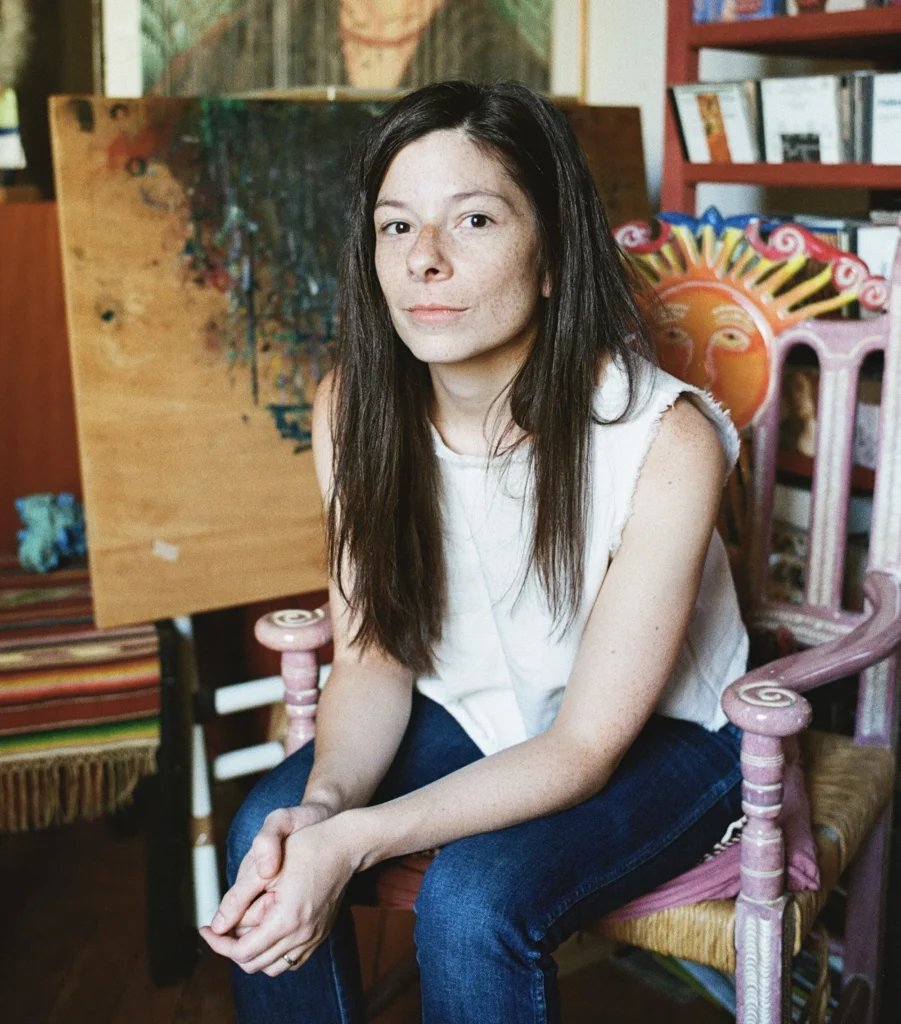
Her new book, One Sun Only, is her first collection of stories. I’ve been waiting for this book for a while now, and I’m excited for it to be out in the world. The twelve stories are playful and morbid, charming and hilarious. Maybe even a little magical, despite the adherence to realism. I think Bordas just really gets the human condition. She lives in Chicago but generously spoke to me on Zoom while she was in Paris over the recent holidays. Our conversation has been edited for length and clarity.
Sam Axelrod: Let’s start at the top. One of the many things I admire about your stories is their unique and creative titles. “Offside Constantly,” “Only Orange,” “Most Die Young,” to name a few. I’m wondering if you have some secret magical process for this.
Camille Bordas: I’m really bad at titles. I’m hesitant to title anything until the very last moment, when I have to send it out. For the stories, I never even have a working title, just the first few words of the story. “Understanding the Science,” for example, was named “The Journey,” for a really long time, which is the most boring title you can think of. My husband, who is my first reader, told me I couldn’t possibly name a story that. And when he read it, he told me, “how about ‘Understanding the Science?’” and I liked it a lot. The words were there in the story as well, but it had never crossed my mind to use them for a title. The only story I had a title for fairly early on in the process was “The Lottery in Almería,” just because even though it’s not a riff on it, it does reference Borges’s “The Lottery in Babylon,” so I liked to have that classical undertone. I think my non-negotiables when it comes to titles are: it has to sound good and not reveal anything about the story; it has to be mysterious.
There are common themes throughout the book––anxiety, siblings, parent death, death death––but you really bounce around with your protagonists. Gender, age, location, occupation, and yet at the same time, the collection feels really cohesive. For those of us who may be less creative in our writing, and who may find this versatility somewhat astounding, how do you wind up with a 12-year-old boy at weight-loss camp as a protagonist in one story, and a middle-aged woman ophthalmologist in another?
I think it might be the opposite of what you’re saying. Maybe I lack imagination. I just apply my thought processes to all kinds of characters. I assume Eugene in “Beyond” could have been me as a 12-year-old boy. His circumstances are different, he’s at a weight-loss camp, he dreams of being an actor, which I never did, but these are small, surface things. At his core, he’s just a human having a human experience. I’m also a human. It’s not impossible for me to believe that a 12-year-old boy could have the same thoughts I had as a 12-year-old girl, or as a 38-year-old woman, for that matter.
I read that “Chicago on the Seine” came out of a novel that you wrote a whole draft of and abandoned. So, clearly writing that story wasn’t your original intention. I’m assuming that was an anomaly.
Thankfully, yes. I usually write a story knowing that I’m writing a story. This one I really thought would be a novel. And I didn’t abandon it––I mean, I ended up abandoning it, but I finished it. I just didn’t like it at all once it was done. It was really clunky, and there was a lot of flashbacks and big family drama, and I thought, “Why did I bother writing all this? What was ever interesting to me about these characters?” And I realized I was mostly interested in what the narrator did, working in medical repatriation, and so I just wrote a whole story with that protagonist, made it a workplace story. It’s not a chapter or a piece of the abandoned novel, by the way. It’s just the same narrator. But fortunately, that’s not how I usually write stories. I don’t spend three years writing a failed novel beforehand. That wouldn’t be a very sustainable process.
I heard that you’re a one-sentence-after-another kind of writer. Does that mean you never outline and never see the big picture, or are writing towards an ending? You’re just going one foot after the other?
I never had the big picture in my life. I’ve never really had an idea in my life, either. In my head, it’s just, “Oh, what if someone said this? Then what would the next person respond? And by the way, who’s this person answering the first one, and why are they there?” It sounds dumb, but it’s the discovery process that interests me. For instance, I thought “The Presentation on Egypt” would be the story of this surgeon, but he ended up killing himself after paragraph one. The story became about his daughter. I don’t fully remember why. I don’t think he bored me, but I was writing down his thoughts, the darkest inner monologue, and I thought, “This guy’s depressed. This guy is at the end of his rope, he wants to end it, he wants to be done suffering.” And then I had to figure out what happened next, the aftermath of his suicide. To me, it’s one of the only fun things about writing: seeing how the characters will surprise me. If I had an outline, I don’t think I would be interested in the process. It would feel like a very easy jigsaw puzzle.
You’ve said before that you grew up [in France] not really reading short stories, only novels, and that you didn’t really read stories till you got to the US when you were in your twenties. You’d already published two novels in French when you were quite young, and then you published the two in English. So now that your first book of stories is coming out, I’m wondering if you think of yourself as a novelist moonlighting as a short story writer, or possibly vice versa? Or is this something that you’re not really thinking about, and it’s like, you do both, and that’s cool.
I think I’ll always want to do both at this point, but I find writing stories a lot more fun. I’m working on the novel I’ve been working on for many, many years, on, and off, one month here, one month there, and it truly feels like it will never be done. The way I keep from despairing is by thinking once I’m finished with this novel, I’ll only write stories for the rest of my life. I almost see writing stories as a reward, a cessation of novel-writing suffering. Writing stories is no picnic, either. Every story I wrote took me a very long time to write, but it’s just a lot more playful. It’s like going to the lab, in a way, just making little experiments and having fun and seeing what happens. If a story doesn’t work, I can blow it up, too, see where the pieces fall and start again. With a novel… a novel is just such heavy machinery, so much harder to blow up or steer back in the right direction once you realize you’ve made a mistake… which is what writing is, in great part, realizing you messed up, understanding why a scene you wrote doesn’t work, or a chapter, or the entire first third of a novel. You just start over again until it does. But I love writing stories. The plan is to… I mean, there’s no plan, but the fantasy is that I could only write stories in my life.
I’ve heard people say, “Oh, if it were up to me, I would only write stories, but for the publishing world we live in, you have to write novels.”
That is true, but also, I realize that I’m lying to you right now: I do have a deep love for novels, novels are the best thing that ever happened to me growing up, and the real ambition and dream of my life would be to write a great novel one day, and in order to write a great novel, I definitely will have to keep trying to write a novel. So, in all likelihood, I’ll keep writing novels until I can’t do it anymore. Two dreams: to write a great novel and to keep writing stories.
Good dreams. Looking through The Material today–– I think it’s a great novel.
Thank you.
Speaking of which, do you have someone in your life who knows everyone’s birthdays? [Olivia in The Material is noted for this trait.]
I know someone like that, yes.
I’m that person, too, so I felt seen.
I used to be like that, but now I just… since I started teaching, there are too many birthdays to remember, a lot of students come in telling me it’s their birthday, for example, when class falls on their birthday, and I used to think “Well, I guess I’ll remember this for the rest of my life then” but now I think I’m at capacity. Maybe I know a hundred birthdays, and that’s it. I can’t commit a single new one to memory.
Okay, let’s see if I can turn this into a question. In the title story, a successful writer, Henry, says to his friend, the narrator, that people don’t want to read about “one-hundred-percent-fictional characters anymore.” My first question is, do you think of your characters that way? Because I’m someone who, as a reader, kind of agrees with Henry, and yet I find your stories such a pleasure to read. So that’s one thought I’ll lob over to you. Then the other half is about the final story in the book, “Colorin Colorado.” You said [in the accompanying New Yorker interview], about the narrator, a fiction writer herself, that she would feel “compromised writing about sensational situations. How often do those actually happen?” And one thing I appreciate so much about your stories is how lively and energetic they are, but with very little… sensationalism. You’re just writing about “normal people,” as the narrator of “Colorin Colorado” might say. So I just threw three sort of half-questions at you.
I do think fewer and fewer people want to read about 100% fictional characters, yes. The trend is still autofiction, or veiled autobiography, and I do find it a bit sad. I love some of these books, by the way, I’m not throwing the whole thing with the bathwater–I’m a huge fan of Emmanuel Carrère, for instance, and of a lot of writers who write about themselves–but I’m also a real sucker for fiction. As a kid it was my passion, and I don’t want fiction to get lost. It’s fine that autofiction exists, but where are the fake people? I want the fake people to continue to say made up stuff at length, I want to see what happens to them. And the question of sensationalism… I do try to have plotty things unfold, something dramatic happen in my stories, but in my experience, the most dramatic thing that can happen is someone dies, and so I write about that a lot.
A lot of death. In terms of sensationalism, I was thinking of the moment in “Presentation on Egypt” where the girl swallows the lighter––it’s high drama. Anyway, there’s something classic about what you’re doing, but it’s done in a way that feels very fresh.
To me, the most sensational thing in life, the real trippy thing, is to realize that everyone you know, everyone you hang out with, everyone you’ve ever met: they’re all thinking at all times. To really know that, to really understand that is sensational. That girl you were in middle school with and haven’t seen in 30 years: she’s somewhere right now thinking thoughts. Leonardo DiCaprio is out there thinking thoughts. The guy who is about to interview him right now is having thoughts as well. And you can never know what these thoughts are, because we’re all so guarded. And the sensational aspect of my stories is you get to see these random people thinking. That’s the kind of fiction I like to read, too. Let me see other people’s thought patterns, how they go from point A to point B, and what they end up doing as a result–that is wild to me. Wilder than dragons or unrequited love stories.
It feels very intentional that “Colorin Colorado” is the final story––almost like a statement. And it’s the most formally ambitious story in the book. I was wondering how you decided to close the book with it, and do you imagine getting more formally inventive in your future work?
I’m really proud of this book. I’m not a proud person by nature, but this book I’m really happy with, and there are some stories in it that I really, really like, and I think “Colorin Colorado”–– I wanted to finish with one of my favorites. Not that the middle ones are duds, but I really love this one, it was a lot of fun to write. It kept opening up as I wrote it, and it started having to accommodate more and more characters and timelines, so the form of the story evolved to make room for this. It’s what I was saying earlier: stories are interesting to me because it’s a place to experiment with form in a way that is harder for me to do with a novel. Not that I don’t want to experiment in novels (The Material was an experiment in its own way with the shifting perspectives and all that), but the stories being on a smaller scale, I get to feel freer to mess up and start afresh.
Right, I mean, if you’re not keeping yourself entertained… I like this quote of yours, about how you set out to do two things every time you sit down to work: write good sentences and not be boring.
It’s a goal.
It sounds more modest than it is.
I write boring stuff all the time. But then I cut it. I love cutting. Cutting is my favorite thing. Sometimes I think it’s the main reason I write, to have the reward of cutting out all the crap. “Oh, I did something not bad, by cutting 90% of it.”
Whoa, so you must get a lot down in a day.
Not really. I cut as I go. A good day for me is a good 100 words down on the page. But to get to the good 100, I probably wrote 2,000 and deleted most of them as I went. Like, “Nope––boring. Erase. Next sentence––still boring. Erase.”
Do you ever wake up in the middle of the night being like, “Oh my god, I can’t believe I deleted that paragraph,” or are you saving stuff somewhere?
If it’s gone, it’s gone. It’s not coming back.
Do you drink a lot of coffee?
I do, yes. I quit smoking, but I still drink a lot of coffee. I miss the jolt of nicotine, though. Coffee doesn’t really wake me up the way cigarettes used to.
Much has been written about your switch from French to English, but I was thinking about how two of the stories in the book take place in Spain, and I know you grew up some in Mexico City, so I’m wondering if you’re fluent in Spanish, too.
I learned Spanish in Mexico, when I was three. I still have a strong Mexican accent, and I can understand everything I read in Spanish. When time comes to speak, I feel like I can say anything I want, but sometimes I will take the roundabout way to say it, because I lack a lot of vocabulary.
Do you ever think about writing in Spanish, or that’s––
Maybe one day, if I spend a lot of time in Spain, I would consider it, but I think English has taken over at this point. I do feel like I’m getting better at writing in English, so it seems wise to keep up with that. I had to translate The Material into French, and there were definitely sentences I wrote in English and had to translate that I knew I would never have written in French. The process of learning and honing one’s writing skills, even if one is bilingual or trilingual, it kind of only works in the language one’s working in. I don’t feel like I became a better writer in French the last 12 years. Because I didn’t work with that language every day.
Is there ever any talk or ambition of translating your first two novels into English?
Not really. I was really young when those books came out. I don’t think I’m ashamed, but I’m nervous. I should look at them again. I was 19 when I wrote my first book, and my father had just died, and I’m afraid it’s very earnest. Or naïve. Or I don’t know, actually. Maybe it’s a great book. I just don’t particularly want to revisit that time in my life.
As someone who didn’t start writing until I was almost 30, the idea of publishing a novel at 19… Publishing a novel at 19 is young, period.
I published at 21 or 22––I don’t remember––but I wrote it at 19. Took me about a year. Which I now think is definitely not long enough to write a good book.
Okay, so you wrote the two novels in French, and then you’ve since published three books in English. I was thinking about writers who have switched from one language to the other. Is there another writer who made the switch who you admire, or who you think about? Nabokov is the person who always comes to mind, and who I’m a big fan of.
I’m a huge fan of Nabokov as well. Ada is one of my favorite books ever. But I don’t really think about it. I think people are really impressed with the bilingualism thing, and it’s not that they shouldn’t be, but… languages were just really easy for me to learn. I don’t feel like I’ve worked that hard, so it feels false to say I’m doing this really hard thing. I shouldn’t speak for Nabokov, but he grew up speaking English, with English nannies, and he loved the English language, adored it, and so he started writing in it. I don’t think he saw it as a steep mountain to climb. I think it was fun and interesting to him to write in English. I was doing a radio show in France the other day, and they played an excerpt from an interview with Nabokov, and he was talking about why English was superior to any other language: it was more precise, it had more vocabulary, it sounded better, was more efficient, etc. And he also said that the English that he wrote was his English, and that spoke to me. All I can do is write my English.
Is there anything about the switch that you’ve never been asked about, and never gotten to talk about that you do want to talk about, or that’s interesting about it to you? Because it’s amazing to a monolingual simpleton such as myself, and, I imagine, to others like me.
I think the problem when I talk about it is that I end up sounding new-agey. The more constrained you are, the freer you are, things like that. But I do find it to be true. Because I can’t say everything in English, then I’ll probably find a way to say it that’s interesting.
Do you ever write fiction in French, or you feel like that’s over?
I think it’s over. I do translation work from time to time. I translate from English into French, but not novels, sometimes articles or small things––or my own books.
That’s like Nabokov, right? He translated some of his own books.
It’s not a lot of fun.
I can imagine if you have control issues, it’s better than handing it over to a stranger.
I would’ve preferred someone else do it, though, a professional translator. But my French publishers insisted I do it, and in the end, I’m glad they did. Even if it was a painful process. Re-reading yourself for the hundredth time, finding ways to say the same things you took pains to figure out how to say in another language, trying to maintain character voice, rhythm, etc. in a language that takes five or six more syllables per sentence on average to say the same thing… I was tempted to cut a lot again. Every time I re-read something I wrote, I want to cut. I’m sure if you showed me “Understanding the Science,” which was published just last week [in The New Yorker], I would still find things to cut. It’s just endless work, and so there’s frustration there, because you’re never happy with your writing. And also, The Material was so––I don’t know if “topical” is the word, but such an American book in many ways… it was quite torturous to make it land in French.
“Most Die Young” was the first story you published in English, in The New Yorker in 2016, and to many people, my mother and many others, this is kind of a big deal, and I was wondering if you could talk about what that was like, and also, besides all the good things that come along with it, I wondered about the downsides, if you felt like, “Oh, there’s some pressure now.”
Even growing up in France, I knew the magazine existed, so I knew it was a big deal. It was my first short story, though, and I wasn’t sure I would ever write another, so when they accepted it, I was extremely happy, but I was also thinking, “Okay, now I’ve been in The New Yorker! I never need to do it again!” But of course, that’s not how humans work. As I realized I was, in fact, very interested in writing more stories, I found it hard not to wonder, every time I finished one, whether they would like it or not. One thing I absolutely love about the magazine, too, is that I have no idea how they decide what to publish. I don’t know how they work. I’ve never been in the building. I don’t want to. I like to imagine it. The fact-checking department. The art department. The professionalism. I’m a real admirer of this. My editor there, Willing, is a genius, and we only communicate when there’s work to do. I’ve met him once, briefly, in ten years. There’s an aura of mystery around all things New Yorker for me, and I like it that way.
“Most Die Young” was the first story published, and now it’s nine years later. When you were putting the book together, I imagine it was the first time you looked back at this body of work in this way, and I’m wondering, what did you learn from that? Do you see an evolution of your work? Is it trippy just to see them all in one place?
It is. Looking at them all in one place… I mean, there’s definitely thematic coherence! As I said, I’m really proud of these stories and happy with the book. But it is true that I also think it might be time to stop writing about death and anxiety so much. At the same time, though, these are the kinds of things I like to read about. But I do dream of suddenly writing a western, or a sci-fi book, something completely different. A great career for me is the kind John Williams had. He does Stoner, he does Butcher’s Crossing, he does Augustus, just completely different books. He published very few books, but they’re all great, and they couldn’t be more different from one another, and that’s a trajectory I really admire. But… I also admire Salinger’s commitment to the Glass family.
About your confidence, you once said that “seeing things in a positive light is not natural for me. Most of the time, I think I suck at this, or that I’m somewhere between good and terrible. Who can tell? Is there a writer out there who knows his worth? How would he react if he came across his own story or novel, having not authored it?” And that was a bunch of years ago, and so now, with the book coming out, nine of the twelve stories have been published in The New Yorker. And so by certain metrics in the Western world you’re arguably the most successful short story writer of our generation. In the old days, you would see this in a book, like, “Most of these stories appeared in The New Yorker,” and that’s not a thing you see much anymore, and so, kudos. What does that do for your confidence, and also, does it affect what you’re actually writing, as well?
No, it doesn’t. People are always telling me to relax, but I have never relaxed in my life, and I feel like if I start now, everything will fall apart. It’s probably unhealthy, but I’m wired a certain way. The way that I get through life is by thinking that I suck, and so far, my conviction that I suck hasn’t prevented me from writing, or from being published, so it sounds like I should keep thinking this way. There are people who like me and tell me all the time that I shouldn’t do this to myself, though. That I should cut myself some slack, etc., the popular “Be kind to yourself.” I don’t know how to do that. I don’t even know what that could look like. I don’t recommend self-loathing as a way of life, but I also think it hasn’t been such a huge problem for me. It hasn’t kept me from doing things. If anything, it might have pushed me to do them. The lack of confidence is real, but I’m a functional person. I’m able to teach, I’m able to write. It’s fine. Everything is fine. But yeah, I should probably go to therapy or something. The thing you quoted, though, I think it’s one of the less dumb things that I’ve said. It is hard to know your worth. It’s impossible. I would really like to encounter my work, having not read it, and form an opinion of me as a writer. I do really try to write things that I would like to read. It’s just as simple as that. Books are my passion, number one. I read, like, six hours a day if I can. It’s just what I want to do.
That sounds like the start of a speculative novel or story: a writer gets to read their own work, but they don’t know it’s theirs.
That’s a great premise, actually.
Five or six years ago, you said, “I am someone who will fear ridicule no matter what, and yet I’m also someone who intentionally exposes herself to it. I still think of shameful moments from middle school, that day I mistook Finland for Norway, for example. I am and will always be full of shame, no matter what I do, though. I might as well write fiction and take the risk of feeling stupid in that particular way.” So that’s one quote. And then, in “Chicago on the Seine,” the narrator says, “I’d realized that it wasn’t so much that Europeans thought we [Americans] were idiots as that they understood us to be simply less ashamed than they were, and in the end, I’ve concluded they’re jealous of our confidence, our belief that maybe we were the first to have thought of something, that we might ever say something new.” My two questions are: How’s your relationship to shame evolved in the last few years? And 2) Do you think Europeans generally, as a people, have more shame than Americans? Because I feel like I know a lot of us over here are carrying around a hell of a lot of shame.
I definitely know a lot of Americans with shame. In the story, he’s American, he talks about Europeans as a whole, but I think there is a massive difference between France and America in the way that children are educated. I think in France, there is a lot of shaming that happens in school. And as a result: not a lot of student participation in class. If you say something stupid, your teacher will tell you, “That was incredibly stupid,” in front of everyone, and then you never speak up again.
Even in elementary school?
Absolutely. I remember a teacher saying, “Well, that was dumb, thank you so much for this, Marc.” It took me a little while to see that this was––I don’t know if not normal, but it’s very French, and I think maybe it’s changed now, but everyone in my generation, my friends, we all remember being shamed, basically, for not knowing this, for not knowing that. Like the Finland-Norway thing. People wouldn’t make much of it nowadays, and I think in America, the teacher might even be encouraging, say “Good enough! These countries are, indeed, very close to one another!” but in France, the vibe was more “You’re a fucking idiot.” And so this builds up over time. As a result, French people are less confident speakers, I think (this is a broad generalization, of course). When I moved to Chicago, I was a student in anthropology, and I was a super fan of this anthropologist, Marshall Sahlins. I went to listen to him at University of Chicago, and he was talking about teaching in France for a few years when he was a young anthropologist, and how he was surprised that no one spoke in class. He would just ask, “What do you think of this?” and his students would stay silent. He was really surprised by that, so he dug at it, and his conclusion was that because the French shame their young, they’re less confident speakers. I think it was true in his time, it was true in my time, and maybe now it’s changing. When I started teaching, at University of Florida about seven years ago, I’d never taught before, and I was terrified, I thought, “I’m gonna have to speak in front of a class for three hours,” but Adam, my husband, told me: “You don’t have to speak for three hours: they will speak for three hours.” I didn’t believe him. But then of course, he was right. Young adults here are just so open, and it’s so nice. They’re not ashamed to say what they’re thinking, they understand that saying it will help them forge a more complex thought in the long run. Even if they have half of an idea, they will volunteer it, and it’s the nicest thing to witness, because then you see the whole class elaborate upon it, and everyone benefits.
Do you still feel shame about the Finland-Norway thing?
No, no, that was too much shame for me to feel about this. I think I feel less and less shame, in general. I used to think that being caught not knowing something was shameful. I used to lie when people asked, “Did you read this book? Have you read this classic?” I would say yes, because I knew roughly what it was about. I think in the last ten years I just stopped lying about this. I simply say, “No, I’ve never read War and Peace, should I?”
The peace parts are good, the war stuff is tough. You’ve read Anna Karenina, though, right?
No, I didn’t.
Oh, that book is amazing.
So I’ve heard.
Sam Axelrod’s writing has appeared in The Paris Review. He lives in Kingston, New York, where he’s at work on a novel, Brief Drama.
This post may contain affiliate links.