


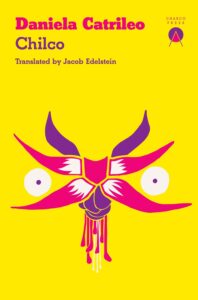
[Charco Press; 2025]
Tr. from the Spanish by Jacob Edelstein
Founded in Edinburgh in 2016, Charco Press publishes the best Latin American literature in translation. In 2021, they began their Charco OriginalES series, which publishes Spanish-language original works alongside English translations. Per their mission statement, Charco aims to bring you (presumably, the Anglo reader) books you want to read, maybe even need to read; to bridge your world to the rest of the world; to challenge perspectives and spark debates. Implied here is a thesis about what reading literature in translation does in the world, and the urgency of broadening of Anglo horizons. They demand that readers direct their attention to the cultural production from communities deeply cognizant of their relationship to colonialism and capitalism—and it ain’t about spending three thousand pages with Karl’s struggle.
As an American reader, I can’t help but think about this mission with a twinge of gloom, given that Americans—perhaps the western-est, most-oblivious-to-empire citizens of the world—are famously not readers. We tend to be terribly easy prey for the attention harvesting algorithms of image, audio, and video content. We are basically a bunch of consumption-drunk toddlers lobotomized by limitless screen time. But Charco Press is in Scotland, and their distribution infrastructure is most developed in the UK and Ireland, where the market indicates that Anglos do read to learn about the world. And, second counterpoint: Charco Press’s 2023 title Of Cattle and Men won the inaugural Cercador Prize, which recognizes works of literature in translation as selected by a committee of independent booksellers across the U.S. Whether or not I can personally cultivate hope about the power of empathetically reading literature in our contemporary global moment, Charco Press is doing gorgeous work, facilitating publication avenues and translation partnerships, and platforming Latin American authors for international audiences.
Daniela Catrileo’s Chilco is part of Charco Press’s 2025 catalogue, and was itself a finalist for this year’s Cercador Prize. Its translator, Jacob Edelstein, has also translated Catrileo’s collection Piñen, forthcoming from FSG in 2026. The paperback is a tactile joy, with sturdy paper and bright, striking designs on the interiors of the French-flapped cover. The reading experience is part baroque fugue-state, part ominous, screw-tightening gothic, perforated occasionally with the painful comic relief of self-awareness. An urgently poetic and deeply layered novel, Chilco simultaneously pulls a reader into the deepest of intimacies and resists the reader’s easy access to its chronology, riffing with the anthropological, classificatory narrative structures that dominate the “translation” of Indigenous life in the Americas to Anglo audiences.
Chilco centers Mari and her partner, Pascale, as they try to survive the literal and figurative collapse of their home in the “vertical slums” of “Capital City.” This collapse is engineered by the multinational corporations developing more and more biodiverse and sacred jungle and curated narratively as a natural disaster by the very same corporations and the government. Mari grew up here with her single mother, single aunt, and single grandmother, running a market and trying not to fall in love, while Pascale grew up on the island of Chilco, and moved to the mainland for the (theoretically) greater possibility of queer life. When they survive the disastrous collapse of buildings and the rupture of the societal fabric of Capital City, Mari and Pascale consider moving to Chilco: a homecoming for Pascale, and a discomfiting move for Mari, who isn’t sure she ever belonged anywhere. The mystery of the island’s cultural character haunts the novel, first as a musty smell that drives Mari half crazy, and later as the threat of hate-based violence.
Catrileo’s protagonist is much like the author herself. Daniela Catrileo is a child of the Mapuche Nation, though her own identity is complicated, as it is for so many Indigenous people in cultural contexts that attempt to define ethnicity and Indigeneity by degrees of authenticity or purity. One side of Catrileo’s family migrated from La Araucanía to Santiago, where their Mapuche language, Mapudungan, was heavily suppressed. Catrileo’s mother is not Mapuche. In interviews, Catrileo has discussed and affirmed her use of the word champurría to describe herself, with its connotations of a mix, and of impurities: she is interested in impurity as political potentiality, breaking through false barriers of identity separation and facilitating transnational alliances toward liberation.
In Chilco, Mari’s grandmother, Awicha Flor, immigrated to the Capital City from Peru, and doesn’t necessarily claim Indigenous identity but speaks Quechua and illuminates the rules of Mari’s world with cultural knowledge of the Quechua gods. Mari begins to pursue her own Indigenous and diasporic urban identity, articulating how Mapuche identity, and Indigenous identity more broadly, is made to disappear in urban spaces.
But just when Mari’s exploration of queerness, love, and mixed identity brings her into a relationship with Pascale, Capital City begins to crumble. If Capital City is supposed to represent the urban landscape of overt colonial cruelties, where an ongoing capitalist settler state terrorizes a poor, urban, transplanted Indigenous population, Chilco serves as a kind of idealized holdout of Indigenous authenticity—even if that authenticity is bitter and tragic.
Why does Catrileo choose to work with the imaginary and allegorical “Capital City” and “Chilco,” instead of carving her fictional world into Mapuche history and present, the legacies of colonialism in Chile, and actual vertical slums of Santiago, by name? The choice puts Catrileo into a vibrant lineage of Latin American writers manifesting and subverting the imaginary projection of colonial storytelling about Latin American peoples and places on this continent—Gabriel García Márquez’s One Hundred Years of Solitude is an inescapable reference, situated in the fictional, terra nullis-invoking town of Macondo; as are the stories of Jorge Luis Borges. Marquez and Borges are both white writers who are considered, in the global canon, the greats of Latin American literature. They have become representative of Latin America. Both are considered fundamental contributors to Latin American magical realism and surrealism, respectively. Catrileo places her work in conversation with this lineage but also unsettles it. By setting “Chilco”—a seemingly place-specific novel—in imaginary places, Catrileo is toying with the imaginary place(s) of Latin America, and with the (white) subject position that gets to tell transcendent, representative stories of this place. And, by framing the novel within the confines of an Archive crafted from colonial documents, Catrileo emphasizes the complexity of telling stories both about and from this place.
Chilco opens with a page from this “Chilco Archive,” which tells readers that the word Chilco is an island; a shrub that thrives in moisture and humidity (also called wild fuchsia); and, “to become watery” and “full of water.” Catrileo won’t let the reader out of the “Chilco Archive”: documents from the Archive partition the book, and even close it, encompassing the entire novel, so that the narrative arc is contained in this classificatory and anthropological framework. With this pseudo-scientific lens, Catrileo interrupts the relationship between the reader and the island. Who is the audience? Who is speaking? Who controls this narrative?
About halfway through the novel, we discover that the Chilco Archive is diegetic: Mari has curated this text. Mari works at the Museum of Natural and Social History—an institution founded by an “English philanthropist who, the story goes, fell in love with the country’s cultural heritage”—and there, she befriends Leila, a Haitian woman who left her home peninsula because it was wholly owned by a cruise corporation. Both women know the repercussions of Anglo fascination with their homes. Mari and Leila simultaneously love the rarefied space of the museum and the archives, and they loathe the museum’s administrators, a “liberal elite” with “aristocratic pedigrees, white faces, extremely expensive clothes, and foundations in various artistic disciplines.” Mari and Leila especially despise the way the administrators performatively support the populist movement happening in the heart of the city: “And they made hollow, embarrassing gestures in support, like raising their clenched left fist, or wearing a pin featuring a building in ruins, the symbol of the movement, as if they were consenting to our rage, like they knew what it meant to stand in line for hours to fill a couple of bottles with water.”
It’s evident that Catrileo’s protagonist is hyper-aware of the documentary impulse that facilitates extraction and dehumanization. And still, she and her friend make the Archive as a gift for Pascale, who has been hired by the museum to build shelving. And so the Chilco Archive puts this question to readers: is Mari implicated in serving up legible and consumable colonial narratives of Pascale’s homeplace? Is Catrileo? Can Indigenous storytelling for global audiences ever happen without this haunting?
But in Catrileo’s hands (and Mari’s), the Archive is not just a colonial tool of erasure. Mari and Leila wield this cataloguing practice of colonialism, but they also modify it with their own documentation and organization, including both the 1870 diary excerpts of a European woman seeing the island for the first time from a boat, and their own “Lovers’ Lexicon,” a multilingual and “arbitrary selection by Leila & Mari” of words for family members, love, nudity, sacred beings, community members, memory and time.
In an essay for Words Without Borders, Catrileo writes about the difficulty of gaining recognition for the imaginative and political space of Mapuche literature in Chile, as Mapuche literature has long been subsumed into fields of scientific research, or categorized as a kind of sub-field of Chilean literature. Wielding the Chilco Archive, Catrileo engages with the dominant narrativizing forces and re-animates them with Mapudungun and Quechua logics. I won’t describe exactly how Mari and Pascale’s relationship does this, but it does it in the way I most love as a queer reader and writer: subtly, withholding disclosures, emphasizing cultural assumptions within the world of the novel.
The relationship between Mari and Pascale is the narrative tether that pulls a reader through the rubble of the novel, and I wish I’d gotten a little bit more of that relationship. For the Anglo-American reader I am, the book feels a little heavy on abstraction. The plot feels sometimes so symbolic and allegorical that it becomes a treatise on capitalism, the ongoing settler state, Indigeneity, language, and/or love. It is a beautiful articulation of the resilience and grief-stricken failures of collective struggle; still, I wanted more immersion in the moment-to-moment materiality of the characters’ experiences.
What did keep my brain crackling for the duration of the novel was its fierce critical precision. Sharp, biting, and transcendent lines abound. After the dissolution of the populist demonstrations in the heart of Capital City—after the developers, banks, supermarkets, and government officials have abandoned it—the people are left with no public services, no jobs, no supplies, and very little shelter. “And indeed,” Catrileo writes, with no small irony, “the absurd could become more absurd.” While children eat dirt and ash, and families stand on street corners begging for food, they are leafletted with advertisements for the new city being built closer to the mountains, for which the developers are clearing jungles and destroying habitat, and which they have named EcoMahuida—taking the Mapudungun word for mountain and forest, and, absurdly, branding it with the “Eco” prefix. The leaflets scream: “DON’T FORGET THE DREAM OF OWNING / YOUR OWN HOME.” And isn’t the dream of owning one’s own home, in so many words, the original dream of postcolonial Indigeneity? And isn’t the premise of return, the possibility for Indigenous life in the present and future, the most important question to which we must turn our attention?
I return to my initial skepticism about marketing the empathic capacity of literature in translation to transform Anglo orientations toward, in this case, Latin America. I think my skepticism comes from constant encounters with the logical fallacy of the premise of representation. It’s the same logical fallacy we encounter when publishers buy and sells books based on the author’s identity category, as if there is such a uniform thing as The Black Experience or Queerness or Latin America—and as if one person’s art could represent it, and as if that person’s art substantively diversifies the print media landscape and therefore endows Anglo readers with cross-cultural understanding. It’s a stupid premise that facilitates tokenization. Percival Everett wrote a whole book about it. (Possibly, Percival Everett wrote all his books about it, if obliquely.)
Catrileo’s Chilco is also about this premise, because colonial anthropology is the original playbook for the extractive, exploitative, dehumanizing marketing of supposedly representative narrative. Catrileo’s narrator takes up the confounding double-bind of mixed Indigenous, colonial Latin American storytelling to global audiences head-on. If the diegetic Archive in Chilco is any clue about Catrileo’s audience, this novel is for her beloveds: those queer and Indigenous and mixed peoples working to define themselves on their own terms and reclaim safety. If you are an Anglo reader like me, you are simultaneously invited you into that space—a great intimacy, a great gift—but you are also warned. Pay attention to how you think about this story.
Kasey Peters is a queer writer from Nebraska. They were awarded an Elizabeth George Foundation grant; the Porter House Review 2023-2024 Editor’s Prize judged by Elisa Gabbert; and an AWP Intro Journals Award. Their writing is in or forthcoming with Grist, The Rumpus, South Carolina Review, Hayden’s Ferry Review, and others. Peters works as an assistant fiction editor for Prairie Schooner. Before all that, they farmed for a decade.
This post may contain affiliate links.