



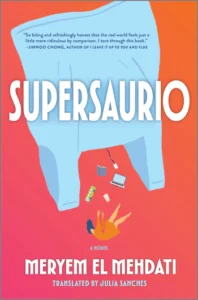
[Hanover Square Press; 2025]
Tr. from the Spanish by Julia Sanches
Imagine that a young Muslim woman living in the Canary Islands who is really funny on Twitter and whose fanfiction account has a large following is encouraged by a well-established author to write a traditional book. This, according to Meryem El Mehdati, is Supersaurio’s origin story. Published in Spanish by a Barcelona-based independent press in 2022, the novel was translated into English by Julia Sanches, who is responsible for the English-language translations of several of Eva Baltasar’s novels. El Mehdati’s autofictional debut is more anchored in character than in plot, and while it contains elements of coming-of-age, office satire, and romance, it also offers observational humor accumulated from a decade of funny tweets and a very online perspective. For those who like The Office-style corporate satire and workplace fictions like Such a Fun Age or Yellowface, Supersaurio is well worth picking up.
Meryem starts the novel as a twenty-five-year-old intern who has given up dreams of using her languages degree to become a translator at the UN in exchange for an internship at Supersaurio, the Canary Islands’ largest supermarket chain. Meryem is no check-out girl; she works on the floors above the flagship store in Gran Canaria as an administrative assistant for the company Compliance team. She commutes by bus three hours a day to get from her family’s home in Puerto Rico to Las Palmas.
Meryem is sharply attuned to Supersaurio’s abundant corporate cringe. One of its most visible absurdities is the company mascot (a blue, ten-foot dinosaur wearing a Supersaurio t-shirt) kept in a supermarket storage room where Meryem sometimes goes to cry. She mocks the company’s incessant virtue signaling, which is accompanied by even more extensive microaggressions from her colleagues. “Our HR department has a list of nationalities that it trots out at every opportunity,” Meryem quips, “as if each new hire were a Pokémon Go match and the company’s goal were to collect one from every single country on Earth.” One of her colleagues insists repeatedly that her name must “mean something” because she is Arab. Another makes a gaffe in trying to wish her a happy Ramadan, and almost no one at the company bothers to learn how to spell or pronounce her name correctly. Her colleagues never remember that she doesn’t drink alcohol. When she attends not-technically-required-but-basically-required after-work happy hours, one person after another tries to press drinks on her. There is a tweet-like quality to her takes on the ways her workaday life resembles The Office sitcom—and Meryem is full of takes.
Her armor of humor, though, is inadequate protection from Yolanda, the woman Meryem is assigned to work for at the beginning of her internship. Yolanda quickly decides that she doesn’t like Meryem and bullies her with tedious assignments, ever-shifting directions, and intentional omissions from important emails. Yolanda, with heels that go “click clack” on the office floor and her hair in a tight bun, is responsible for many of the tears the Meryem sheds in the embrace of the moldy blue dinosaur.
So it’s useful that, in addition to being very funny on Twitter, Meryem also has great facility with fanfiction, a form that allows her to take some narrative control of situations that might otherwise overwhelm her. As a teenager, she got her start writing Harry Potter fics, eventually moving to the big leagues of fanfiction.net. Working at Supersaurio doesn’t leave her much time to write, but she occasionally posts stories about her colleagues, imagining what they are like in private, or, in one case, taking Yolanda through a kind of revenge fantasy in which she has to babysit their boss Matiqui’s spoiled preteen who drinks endless quantities of soda in the supermarket. These bits give us another angle into Meryem’s character, not only funny at the expense of her colleagues, but also curious and compassionate in quieter ways.
The daily drama of failing to satisfy Yolanda’s demands is soon overshadowed by Omar, the head of the Quality Control department who starts hanging around Meryem’s desk, then messaging her on the company Skype with invitations to join him whenever he takes his smoke breaks on the roof. Meryem is attracted to him despite his being more than a decade older than her and his having a slouchy, “cool boss” persona. Once she is hired to work for Compliance full-time, she moves to Las Palmas and is increasingly subsumed by work and her mystifying relationship with Omar.
Meryem’s fanfiction provides a layer of commentary on the genre of this novel, which seems to shift along with Meryem’s own sense of her life. She most often tags her workplace fanfictions as “general,” but occasionally “horror” or “romance” come into play. One reviewer sees the book as negatively “disjointed,” but the variety of forms seemed to me to be an engaging representation of how young adulthood can be accompanied by radical changes in one’s sense of identity from day to day. On Tuesday, life feels like a triumphant coming-of-age narrative; on Wednesday, a family drama; and on Thursday, a tragic romance. The book mashes up an impressive range of forms, making it difficult to categorize as a novel, but folds in various online media to create what was for me a distinctive and enjoyable reading experience.
When Meryem finds herself increasingly attached to Omar, the novel stylistically shifts, sinking the reader into a frenetic present-tense stream-of-consciousness. Despite knowing that indulging in time with Omar is a terrible decision she would advise any friend against, Meryem loses some of her critical distance from her workplace. She describes losing herself in hours on Tik-Tok, Instagram, and Twitter to cope with the overwhelming uncertainty of this relationship, and her commentary can arrive at what feels like the speed of thought,
All I can do these days is react to visual stimuli. This thing looks cool, that thing makes me laugh: re-tweet, like. This thing pisses me off, that thing offends me: report, block. If one of my posts doesn’t get a certain number of likes, I beat myself up for hours, wondering where I went wrong. I compare myself to the people I follow and to the people I read. There are days when doing this makes me feel pretty terrible about myself, but that doesn’t stop me. My focus is scattered across nothing and everything at the same time, hanging off a thousand different bits of content that I’m not interested in or that are bad for me, and yet there I am, scrolling.
I found these moments—when the narrative takes its form from a brain consuming Instagram reels or Twitter threads, when El Mehdati drifts away from representing her heroine’s creative drafting of tweets and fiction— the most difficult to stay engaged with.
In scenes that involve Meryem’s friends and immediate family, the narration does not read as tethered to online forms, and her cynical humor takes a back seat. Her parents can do no wrong and are treated with reverent love. Her friends are perfectly supportive, funny, and helpful. This fierce loyalty is an endearing counterpoint to Meryem’s mercilessly satirical approach to nearly all other aspects of her life, making her, in my experience, an easier character to spend time with than if she operated solely in her critical mode. These carefully protected areas of her life also reinforced for me the sense of the novel as a performance; Meryem surely must harbor more complex relationships to the important people in her life than we see on the page. El Mehdati is only willing to reveal so much about her protagonist’s internal world, and those limits felt most visible to me in the representations of her closest relationships, even though—or maybe because—she writes about them with a less-obviously-stylized prose style than she does in the workplace sections.
Another more sincere aspect of Meryem’s first-person perspective—her Muslim faith—informed some of my favorite parts of the novel. She incorporates both earnestness and her trademark self-deprecating humor in narrating how her beliefs about God shape how she thinks about making decisions. When she is being onboarded for the full-time position, the woman taking her information mangles her name and asks where it’s from. Meryem fibs that “‘It’s Italian’ and means ‘Love, life, and levity.’” In reflecting on this deception, she thinks, “One good deed translates into several good deeds, while one evil deed is only ever equal to one,” and muses that “if I walk outside after this is over and give the first panhandler I see five Euros, I’ll be awarded several good deeds (I’m not sure exactly how many, I’m not an expert or an imam). One of those good deeds will cancel out my evil deed.” It’s a calculation that gets her (and the readers) through a painfully dehumanizing hiring process.
Meryem’s fierce determination to retain her identity while performing a soul-crushing office job made this book work. It read to me like the photographic negative of another Spanish workplace satire out in translation this fall—Discontent by Beatriz Serrano, translated by Maya Faye Lethem—whose protagonist has so sold out for her work that her entire personality consists of consuming massive quantities of random content on YouTube and telling funny stories about what she saw to her attractive neighbor. Meryem, in contrast, uses writing to maintain a subversive sense of humor about her awful colleagues; about the absurd insensitivity of much of the world to differences in religion, class, race, and gender; and about the incompetence of people in corporate jobs who nevertheless take home shockingly high salaries. The voice in Supersaurio is distinctive and maintains a sense of how accents and the occasional use of English characterize Meryem’s coworkers. Unlike with Discontent, I never forgot that this was a novel written in Spanish and set in Spain.
Supersaurio celebrates the potential of online forms of writing for subversive joy. As the novel progresses, Meryem more often uses her fanfiction to critique the structural issues she sees at her company by taking on the perspectives of its less privileged workers. An underpaid stocker spends twenty minutes mopping vomit off the dairy aisle floor. Another store employee anticipating mass layoffs has another employee stand guard while she hangs up a poster advertising her union. And she mocks the macho attitude of one of her male coworkers, imagining him admiring himself in the mirror and spouting corporate nonsense to pump himself up: “‘You have a commanding presence,’ he reminded himself, his reflection glowing in the white, fluorescent bathroom light. ‘You optimize your team’s skills. You help your employees shine.’” (That story is titled “Madrileñan Psycho.”) El Mehdati has managed to stretch the novel form to incorporate the biting humor, the syrupy empathy, and the elevated, fast-paced emotional appeal of so much online content. While the book’s frenetic energy may not be for everyone, Supersaurio delivers line after line with charm and skill, and I’m eager to see what El Mehdati’s future experiments show us about what literature can do.
Nicole Schrag is an English professor and freelance book critic based in Tampa, Florida. You can find more of her work at nicoleschrag.com.
This post may contain affiliate links.