


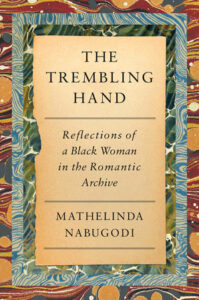
[Knopf; 2025]
“The pair of opposites painfully joined together.” This is how Mathelinda Nabugodi describes the project that animates The Trembling Hand: enslavement and poetry, bound not metaphorically but in the literal textures of the archive. Romanticism’s luminaries produced verses that aspired toward transcendence, while their families, friends, and benefactors participated in a global economy dependent on the extraction of Black life. Nabugodi’s book refuses to let these worlds drift apart. She writes, with surgical directness, “it was time to stop talking about Romanticism without the racial violence that it coincided with. That it was complicit with.” Nothing in the book softens that sentence. Nothing in the book wants to.
At a moment when both the archive and the canon are under renewed scrutiny, her intervention arrives not as correction but as provocation. A demand to read Romanticism within the structures of racial capitalism that sustained it. Nabugodi, a Lecturer in Comparative Literature at University College London, has written widely on Romanticism, translation, and the politics of the archive. The Trembling Hand is her first full-length work of nonfiction, and it formalizes the embodied, historically self-conscious method that animates her poetry and criticism alike.
The book unfolds object by object—teacup, hair, rattle, death mask—each encounter staging a meditation on the racial and archival forces sedimented in Romantic material culture. Nabugodi’s hand literally trembles. This is not a conceit. It is an epistemology. Her body registers the knowledge that the archive still tries to repress. Nabugodi frames her archival method through Sankofa, a return for what was effaced or displaced, an ethic that structures not only her research but her refusal to let Romanticism float free of the racial histories that enabled it. Her research moves between museums and manuscript collections across Britain, where domestic artifacts and plantation documents often sit only rooms apart. Nabugodi writes within the Anglo-British Romantic tradition—Wordsworth, Coleridge, Byron, the so-called founders of lyric inwardness—whose work has long been insulated from the imperial economy that sustained their era.
The Trembling Hand is structured around moments of contact: a hand reaching toward a manuscript, a page turning, the sudden encounter with a plantation ledger whose tidy columns pretend to be mere administration. As Nabugodi describes her reaction to touching the ledger, “bile ris[ing] in [her] throat; [her] knees…ready to fold,” the prose stays flat, almost cool. The tremor is a fact, like the ink or the paper or the history itself. Nabugodi resists both melodrama and academic neutrality. Her approach is closer to a physics of feeling, a record of the body’s reactions to forces it cannot absorb but cannot avoid.
The Wordsworth family’s involvement in the slave economy is no revelation, but Nabugodi insists on following the line of association all the way down to the objects that have been carefully curated into cultural innocence. Wordsworth’s teacup sits under museum glass, a testament to domesticity. The plantation papers sit in the archive, a testament to something else. “His teacup and the plantation papers…are two relics of the same history.” The remark lands with the force of a proof: artefact + artefact = system. In its blend of memoir, archival criticism, and political history, The Trembling Hand joins a growing body of contemporary nonfiction that treats the archive not as a neutral storehouse but as a site of encounter, where touch becomes theory and proximity refuses innocence.
This is a book uninterested in abstraction for abstraction’s sake. When Nabugodi writes about sugar, she begins with the simplest possible statement—“Sugar is made from the juice squeezed from sugar cane”—and then follows the implication through heat, injury, and the constant possibility of death. “Letting your attention slip for a second might mean getting pulled into the mill-rollers.” There is no sentimental identification here. She refuses to analogize, refuses to convert suffering into metaphor. She simply lets the proximity speak. “Consuming sugar brought white digestive systems into dangerous proximity to the Black hands that grew, cut and processed the sugar cane.” The book does not request that we recoil, but that we pay attention to the links that history has tried to render unfeelable. Attention is the book’s conceptual gravity. Not empathy, not outrage, not restitution. Attention. Nabugodi describes herself entering the archive “to see for myself,” aware that “in looking at that page I will catch their line of sight.” The phrase “catch their line of sight” is astonishing. The past looks back, but indirectly, as if deflected through the point of contact. And the contact is always partial. The archive is gaps and silences, but also its violent distortions.
Nabugodi gives an example that is almost unbearable in its clarity. A transcription of a conversation between two enslaved children, Sibell and Ashy, appears in a distorted form, the transcription riddled with racist caricature. “The deliberate misspellings exaggerate non-standard pronunciation…driven by the lure of the foreign and exotic,” she explains. The violence is not only what is said but how it was captured. “We come away with nothing but their names, a mere sliver more than nothing at all.” A sliver. More than nothing. Not nearly enough.
Much of Nabugodi’s research unfolds in British archives—manuscript rooms, plantation ledgers, estate papers—where the bureaucratic traces of slavery sit alongside the literary remains of Romanticism. In this, Nabugodi’s practice recalls Saidiya Hartman’s refusal, in “Venus in Two Acts” and Lose Your Mother, to convert archival violence into narrative plenitude; like Hartman, she treats the gap as a site of ethical constraint rather than imaginative license.
Nabugodi never pretends that scholarship can redeem these losses. She does not resurrect Sibell and Ashy. She does not attempt to imagine their consciousnesses into narrative fullness. Instead, she dwells with the absence, allowing the tremor to mark the limit of what the archive, and therefore the scholar, can claim to know.
This restraint is part of the book’s rigor. Nabugodi distrusts both the archive’s authority and the scholar’s impulse to fix its omissions. What she trusts is the pressure of the encounter, the vertigo that follows when one recognizes that “every single one” of the poets she studies “had friends and family members who were actively involved in the slave economy.” Silence becomes legible as an act. “Their silence was a political statement, even if it might have been an unconscious one.”
Her own positionality enters not as credential but as friction. “Engaging with this history made me confront my own sense of identity as a Black woman with dual heritage,” she writes, before untangling the multiple migrations and inheritances that shape her presence in the archive. She has “come to see Blackness as a heritage that is rooted not in biology or nativist exclusivity but in survival through solidarity.” What she encounters in the archive is not only the history of Romanticism, but the history that Romanticism could not fully look at—and that she cannot look away from. Nabugodi’s own positionality, as a Black woman of mixed heritage, trained inside the British academy but not fully claimed by it, becomes not confession but method. The tremor is not sentiment but instrument.
The tremor is a method because it is a limit. It tells her where interpretation must pause, where certainty collapses into the knowledge that the page—any page—is both contact and severance. This is not a memoir disguised as criticism. It is criticism sharpened, distressed, and clarified by the memoiristic trace.
To call The Trembling Hand timely is almost beside the point. It is not a book that answers a disciplinary need so much as one that interrupts disciplinary reflexes. It does not steady the canonical past; it touches it until it shakes. Nabugodi writes, at one point, that she is “here to see for myself,” a sentence that lands as both declaration and warning. The Romantic archive has long invited readers to look at it from a safe distance. This book abolishes that distance. In the end, Nabugodi’s contribution is not a revision of Romanticism but a revision of relation: critic to text, body to history, hand to page. In insisting that the past be felt rather than merely studied, she offers not only a new way of reading Romanticism but a new understanding of what an ethical encounter with history requires. The tremble is where thought begins.
Holly Coleman lives in Jacksonville, Florida. Her work has appeared in Anthropocene Poetry Journal, On The Rag, Tough Poets Review, and other places. She teaches writing at the University of North Florida and is a Ph.D. student at Old Dominion University, where she studies British Romanticism and the rhetoric of art and activism. Find her @hollycaroline
This post may contain affiliate links.