


[unnamed press; 2025]
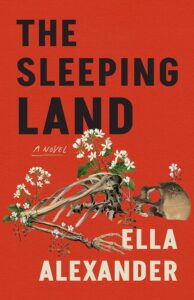
While the internet does not yield an official consensus, most sources, including Britannica, state that Siberia’s name is derived from the Tatar term for “sleeping land.” This is the title of Ella Alexander’s debut novel, The Sleeping Land, set in Siberia, 1994. The story follows three archaeology students and their advisor, George Auberon, as they travel to a cave in northern Yakutia for a field excavation. George, brilliant and egotistical, has a clandestine and possibly sinister motive for bringing his students to the site. They have no idea what they may uncover, but what George suspects is there could dramatically shift their perception of human history.
Upon first glance, The Sleeping Land promises the same dark academia coziness and cheeky intellectual tone as Donna Tartt’s The Secret History. An ensemble of students follows a charismatic, slightly mad leader. Not an evil genius, but an academic teetering on the precipice. The students (Valerie, Kit, and Mark) accept George’s invitation without knowing why he is drawn to this remote cave. Petroglyphs have been documented miles away, and locals have found flint tools in nearby riverbeds, but nothing particularly significant. It isn’t until the team arrives in Russia that George mentions that the Sakha, the region’s indigenous people, consider the valley haunted. Now, this team from the University of Toronto is to be left alone there, deep in the wilderness, for weeks.
The novel is driven by the mystery surrounding George and the cave, and by the dynamic between the archaeologists. The perspective shifts from one student to another, revealing their unique points of view. However, these shifts are not immediately obvious because it is all written in third person with a consistent tone. Through this quiet passing-of-the-mic, Alexander reminds us of the narrative’s subjectivity. She also omits George’s perspective, shrouding him in further mystery. I found myself dying for Alexander to reveal George’s thoughts, but when I realized she never would, it made me double-down: I had to find out what he was hiding.
Valerie, who goes by Val, is the only woman in the group. She’s short-haired, smart and strong minded. But she’s also messy, sometimes reckless, and woefully behind on her thesis. From the onset, Alexander reveals that Val is drawn to archaeology because it grounds her: “[Archaeology] seemed like enough to offset a lack of practical and spiritual connection with the natural world.” For Val, excavations become a way of seeking the connection, stability, and roots she lacks.
Still, Val’s feeling of detachment aren’t limited to the natural world. The same distance shapes her relationships, and her connection with George reflects this dynamic. She greatly admires him, amplifying the inherent power imbalance between a senior academic and a female graduate student. Yet, she is aware of how her gender and age allow her to maintain a certain remoteness, something she finds comfort in. She reflects:
But George wouldn’t like her as a man. She couldn’t tell whether she would challenge him like Kit did, or fawn like Mark, but either way it would be awful. As a woman, she could say almost anything to him, and both mean it and not mean it at the same time.
Through this subtle dance, Val becomes the closest to George, while maintaining a wall between them. Val recognizes that George’s detachment and selfishness enable him to focus on work, but these traits prove costly as the story progresses. While the archaeologists dig through layers of the past for meaning, the novel ultimately suggests that the most gratifying connections are found in the present.
Val recalls a powerful moment from her freshman year archaeology class with George, in which, passing ancient pottery sherds around the room, he told his students to run their hands along the clay. “These were made, he said, by fingerprints, by the unique marks in the skin of people who lived thousands of years ago. And now you’re touching them, running over these grooves with your own fingerprints. A direct link through time.”
In the English language, we refer to time as something linear and quantifiable: it’s numbers on a clock, it’s money, it’s seconds and minutes and hours past. We take time, and we run out of it. Despite these terms, we cannot hold time, and our mortality serves as a reminder. And how do we grapple with memento mori? The Sleeping Land seems to propose that connecting with humans is the answer, because these relationships ground us and give us purpose. As Val concludes, “To love mutually, giving good things and getting them in return.” This understanding of connection, temporal and personal, extends beyond the character’s relationships. The Sleeping Land is peppered with archaeological anecdotes and, even when it is not being directly discussed, Alexander often writes the settings with an awareness of the past. For instance, this description of their train to Yakutia:
The interior had been refurbished in plastics and polyfibers sometime in the 1970s, though these were now scratched and stained […] Val could still see the attempt at a bright, clean, modern decorating scheme. The imagined future of a hopeful past.
This image raises questions about the future the people of the past envisioned. Would reality disappoint them? By encouraging the reader to consider the point of view of people from the past, Alexander reminds us that the human experience is bound to a rich history, and not just a matter of individual experience.
This novel could have delivered a stronger colonial and political critique, especially given its setting in the Sakha Republic (Yakutia) in the early 1990s. The premise of a Western research group venturing into indigenous land and uncovering ancestral histories that are not their own raises questions about power, sovereignty, and exploitation. To what end does this “discovery” serve?
The Sakha Republic’s history gives this novel a weighty backdrop. Yakutia was incorporated into the Russian Empire in the seventeenth century as a resource colony, primarily for fur, and early Sakha uprisings were violently suppressed. By the nineteenth century, the Sakha were officially classified as “nomadic aliens,” and imperial policy focused on “civilizing missions.” In response, organizations were formed to raise ethnic-Sakha consciousness. During the Soviet era, the Yakut Autonomous Soviet Socialist Republic was created, granting cultural recognition but still tightly controlling indigenous people. After the Soviet collapse in 1991, the Sakha Republic declared sovereignty, but the legacy of resource extraction and colonial marginalization remain. Because indigenous land use continues to face immense pressure, it feels like a missed opportunity that The Sleeping Land did not engage more with these tensions of land, identity, resource power, and post-Soviet autonomy. More overt political interrogation could have settled the story in real historical and ongoing colonial dynamics.
Readers interested in more political depictions of indigenous Siberian life might turn to Sakha writers such as Platon Oyunsky, one of the founders of Yakut literature, known for recording Olonkho, a Yakut hero epic that was traditionally shared orally. There’s also Sofron Danilov, Yakut writer whose work often center on shamanism, land, and survival, as well as the cost of Soviet modernization on traditional ways of life. These works directly engage with the cultural tensions that The Sleeping Land gestures toward, but don’t fully confront.
Still, The Sleeping Land was fun and resonant. I devoured it in a weekend and at 230 pages, it left me wanting more. And it left me with questions. Why are we here? What marks will we leave? Archaeologists dig through earth that is settled: sleeping land. They enter an environment as disruptors, searching for clues about the past, attempting to go back in time. The Sleeping Land reflects the beauty and the risk of such work: what (or who) will you agitate if you bring up the past? What are the political and ethical implications? How can the work help us understand the present? With these questions swirling around my head, I would say that if Alexander released a sequel, I would pick it up.
Julia Steiner is a Content Specialist at 3Dnatives based in Paris, France. In her free time, she reads and writes about books. A recent graduate of Tufts University, Julia studied international literary and visual studies with a concentration in French. She is also a member of the Phi Beta Kappa Honors Society and has contributed articles to their Key Reporter magazine.
This post may contain affiliate links.