


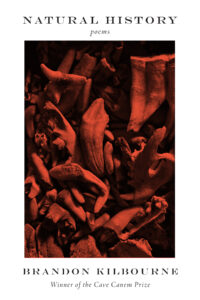
[Graywolf Press; 2025]
The relationship between relics and living things and between history and the present are throughlines of Brandon Kilbourne’s first poetry collection, Natural History. With dense layers of archeological and site-specific detail, Kilbourne has created a space where ecology grounds a layered examination of evolution, colonization, the slave trade, and extinction, as seen through the eyes of a scientist-poet whose training as an evolutionary biologist has been honed by years of experience teaching dead bones to speak. Natural History reaches into museum dioramas and behind-the-scenes collections to challenge a scientific record rooted in the observations of largely white, Western men whose discoveries often rested on the routes of slave ships and on the degradation of native Africans under colonial rule.
Natural History opens and ends reflecting on often unconsidered contradictions within the scientific field of natural history, which studies our planet and its past and present inhabitants and considers how living things change and adapt over time. Chief among those contradictions is how the field’s extractive means relied heavily upon the subjugation of native populations, as seen in “The Giraffe Titan (I),” the collection’s opening poem, where Kilbourne questions whether this gigantic Jurassic predator could conceive in its dying moments a time:
in which twenty men in Berlin would carve
its continent into plantations, mines, and ivory-
hunting groups, their talons manifest in
massacres charring within burning villages,
famine’s gaunt ribs slowly quelling rebellions,
black skin in the mouths of ravenous empires?
The correlation between predators living “hundreds of thousands of millennia” ago and humanity’s collective predation, of nature and of those deemed as lesser, finds expression in many of the poems in Natural History. “Natural History, the Curious Institution” weaves the imagined voices of slave traders and their newly enslaved “cargo” with those of European naturalists who benefited from being able to catalog new specimens brought to Europe in the emptied holds of slave ships, such as a bats, nests, minerals, rhinoceroses, and feathers, to devastating and eye-opening effect:
…Having delivered
your slaves to port, I trust bringing these and other
articles back to Liverpool shall not burden you.
Kilbourne’s own work as a Black scientist at natural history museums around the world deepens the poet’s dissection of his chosen field of study. In the multi-sectioned “Dioramic Idylls,” Kilbourne contrasts dioramas as “pockets of Earth escaped” with the act of building or viewing a diorama, which requires pretending “we haven’t devoured the Earth.” This insistence on seeing the self-serving attributes of natural history as ongoing powerfully grounds this collection in the present, and Kilbourne’s expertise gives credence to his claim, in “The Giraffe Titan (II),” that:
…I tell you these horrors
alongside the bones showcased here
so you can recognize as truththat sheer rapacity apt for
a dinosaur can masqueradeas something human.
Many poems in Natural History exemplify how greed, heedlessness, and prejudice are utterly human attributes, traits handed down generation after generation. Is it any wonder that in Natural History’s final poem, “Blindfold Wonder,” Kilbourne must deaden his eyes to a noted scholar’s seminar insinuation that “Black people / are not as smart as White people” or to a curator who ignores his visitor badge to question why a Black man might be among a museum’s skeleton collections? As much as Kilbourne “would like to think that with the dead / I have found my place,” he recognizes with each measurement of the length of a tibia or an ulna, he also is measuring the history of genocides that allowed each specimen to be collected, as well as the history of exclusion that left brown people not amid scientific archives and tools for study, but in a “background invisibility, its trappings / of brooms pushed down hallways, flashlights to patrol / after hours, the ladles serving museum visitors.”
The inner sections of Natural History continue Kilbourne’s technique of compressing scientific details and historical information into tight layers, but these poems are assembled from more personal memories, too. We meet Kilbourne’s mother and father, visit a market and cook moqueca, share intimate moments with a German lover. And we go on location with Kilbourne to Ellesmere Island to participate in a dig on a mostly desolate, far-north landscape. In the search for Tiktaalik and other Denovian fish specimens, Kilbourne also finds small tundra plants to collect for his beloved, a small fox, a plover nest among the rocks. From such simplicities, Kilbourne discovers, in “North of the Treeline,” that:
an appreciation sprouts out of the tundra,
a seedling I hope to take south of the treeline
and rear to twine about unnoticed trunks,
a transplant among the backdropping green.
As much as natural history is a history of disappearances and extinctions, it is also a repository of evolutions and potentials. Or, as Kilbourne posits in “Our Gilled Forebear,” might all parents not wish for their children “lives redefining what can even be / imagined”?
Kilbourne’s training as a naturalist can be seen in his poems’ many lists, where flurries of details pack on top of each other to build scene and scope. In “The Giraffe Titan (II),” such listing allows Kilbourne to compare the Mesozoic creature’s “hunger incarnate” with the maw of humanity, which:
without end tried in vain to cram
itself full, stuffing its mouth withdiamonds and sapphires, rubber’s sap,
gold and copper, clear-cut timber,medicinal herbs, ivory
and hides, animals bound for zoos,fossils destined for museums,
plantation-grown cocoa and cane,coffee, sisal, and palm’s red oil,
despoiled rivers and vistas, landsfertile, grasses for cattle, men
yoked faceless for brute hard labor.
In this way, Natural History can be read as keenly observed field notes, given over to poetry through individual poems’ wider range of subjects and thoughts and Kilbourne’s interest in sound, how consonance and assonance resonate amid the bones. Take, for instance, in “Our Gilled Forebear,” the research team that:
…come[s] to the outcrop,
set about the sweat-beading business
of shoveling away overburden,
combing the hillside’s scree
for the telltale hue and texture
betraying weathered-out bone…
Here, the harsh t, c, and b sounds are interspersed with the softer s sounds in its own scraping of layers.
The sparseness of Kilbourne’s Ellesmere poems contrast with the density of other sections, creating an unanticipated gentleness in an otherwise unforgiving landscape. “Among these vales, / where for days we’ve seen nothing stir…” resonates not only in “Muskox Memory,” but the other poems in this section. Kilbourne’s wonder and exhilaration of being somewhere others are typically not is infectious; however, his examination of extinction within the same set of poems reads more pressing today than perhaps even when the poems were written. Given his eye for detail and his expansive search for a better future through studying the past, I can easily imagine Kilbourne turning to essays to give even more flesh to his inquiries. Funding priorities may have shifted, but climate impacts on our natural environment have not gone away, and we still require voices raising the necessary questions that will help humanity avoid our own extinction. Natural History seems but a stepping off point for Kilbourne, and the collection’s readers will be fortunate to participate in the start of Kilbourne’s creative endeavors.
Lisa Higgs is associate editor of RockPaperPoem. She has published three chapbooks, most recently Earthen Bound (Red Bird). A recipient of a 2022 Minnesota State Arts Board grant, her reviews and interviews can be found online at the Poetry Foundation, Kenyon Review, Adroit Journal, Full Stop, and Colorado Review.
This post may contain affiliate links.