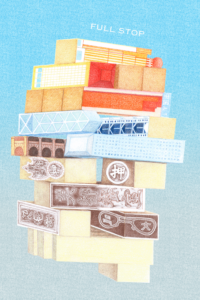




[Seven Stories Press; 2025]
Tr. from the French by Alison L. Strayer
The Other Girl is the latest work by Nobel Prize-winning author Annie Ernaux to be translated into English by frequent collaborator Alison L. Strayer, and it tells the story of the author’s deceased sister who died at the age of six in 1938, two years before Annie’s birth. This subject matter is something of a departure for Ernaux, the great artist of memory. Rather than recounting a biography, Ernaux is writing into a silence. She has never known her sister; her parents have never even spoken the other girl’s name. Early on in her memoir, she describes her sister’s legacy as “A story now sealed, definitive and unalterable, in which you live and die like a saint–like Thérèse de Lisieux, whose enormous photo under glass has pride of place on the bedroom wall.” And although throughout the book, Ernaux continues to address her absent sibling in the second person, she also makes it clear she’s well aware that her dead sister will not actually be reading it. “It is others who’ll receive it,” Ernaux writes on the final page, “readers who, when I’m writing, are as invisible as you.” In writing this long missive, Ernaux is up to something different than apostrophe. She’s attempting to bring her sister out of the cold vitrine of her family’s idealized remembrance, and into the sin, the subtlety, and the imperfection of Annie’s own story of her–into something more like life.
It’s 1950 when Annie learns of the sister who preceded her, when she is ten years old. The details of Ernaux’s early life will be familiar to anyone who has encountered her work: her parents were shopkeepers of a café-grocery outside of Le Havre, in an impoverished area of Northern France. On a Sunday afternoon, Annie overhears her mother chatting with a holidaymaker, and hears the fateful words: “She says they had another daughter who died of diphtheria at age six, before the war, in Lillebonne. She describes the membranes in the throat, the suffocation. She says: She died like a little saint… In the end, she says of you, she was nicer than the other one.” Ernaux writes: “The other one is me.” This eavesdropped confession establishes the narrative surrounding Ernaux’s dead sister that goes on to preoccupy her throughout her childhood and into her adult life. Between the two girls, a dichotomy is established. Annie, the living child, feels that she is by nature of her very endurance a burden and a disappointment. Ginette, the “other girl,” by nature of her absence, can remain in the memory of her parents forever an angel. “You, the good girl, the little saint, were not saved,” writes Ernaux in a later passage, “and I, the demon, survived.” Through the sheer act of living, Annie will drain her parents’ financial resources, make mistakes, lash out in anger and rebellion. How could she ever compete with the ghost of a girl whose last words were, according to her mother, and, frankly, unbelievably, “I am going to see the Blessed Virgin and the Good Lord Jesus?”
The rigid sanctity of this image will never be relieved through conversation with her mother or her father. For the length of their lives, Ernaux’s parents never mention their first daughter to their second, and Ernaux herself never inquires. The intensity of this repression at times verges on the absurd, to the extent that, when Annie and her mother bury her father in 1967, his grave is dug next to Ginette’s, and neither of the women says a word. But there are other signs of the other girl: a hand-me-down schoolbag, a rosewood cot, and two photographs, hidden in a drawer in her mother’s wardrobe.
A basic requirement for approaching Ernaux’s oeuvre is recognizing that although they’re famed for their clear, intimate prose, and their apparent bracing honesty, her books are more than mere diary entries. Each of the author’s works is a carefully crafted meditation on the power of writing and the functions of art. In The Other Girl, Ernaux’s letter to her departed sister is mediated by her reflections on photography and the experience of encountering the dead only through their photographs, as well as the ways in which writing, too, can act as a kind of preservation, albeit one that is, like life, more durational, more expansive, and more susceptible to the animus of human feeling.
The Other Girl opens with the author regarding one of the photos of her sister, and moves from a description of the picture (“It is a sepia photo, oval-shaped, glued inside a yellowed cardboard folder, showing a baby posed in three-quarter scalloped cushions”) to the second-person address (“When I was little, I believed—I must have been told—that the baby was me. It isn’t me, it’s you”). This shift from the descriptive to the personal establishes from the first pages of the book the almost Manichean dualism Ernaux creates between her sister and herself, through the additional dyad created between the photo and the word. Like the departed Ginette it depicts, the photograph is fixed, unchanging, while the written address is, like Annie, fallible and particular. Ernaux has elsewhere explored this affinity between photography and death. For instance, in The Use of Photography, released in English in 2024, she and her lover use words and images to document their life during Ernaux’s treatment for cancer. In that book, she writes, “Photos cannot capture a span of time. They lock you into the moment,” and, later, looking at a photo of herself, “Before this photo, I feel nothing. Here there is no more life or time. Here I am dead.” The motif works the same way in The Other Girl. Of her memories of overhearing her mother first mention her dead sister, Ernaux observes, “The scene of the story hasn’t budged, no more than a photo would.” Photography, like death, traps a person forever as they are at the moment of their capture. Ginette belongs to the world of the sacred, the sealed glass, the photo, and Annie belongs to the world of life and language, two forces that enable her to do almost anything. She isn’t sure exactly how she wants to use that power.
“Am I writing to resurrect you and then kill you again?” Ernaux asks, after wondering if she had in fact learned of Ginette’s existence earlier in her life, and somehow repressed it. Later, in a passage that is a striking metaphor for the writing process, she again muses, “Is it from my writing that you have been reborn, from my descent with every book into something I can’t know ahead of time, as now, when I feel as if I’m pulling back curtains that continue to multiply in an endless corridor?” For Ernaux, writing is a way of forging life, and of pulling her sister out of the dead image of her that persisted for the entirety of Annie’s childhood. But there’s an ambivalence here. Writing may wrest Ginette out from her saintly storyhood, but it fixes in her a different way–this time, in a narrative of Ernaux’s own. Language is the medium through which Ernaux has discovered herself, and putting her departed sister down on paper, especially with so little evidence to go on, can only ever be done on Ernaux’s own terms. It’s a trap she herself acknowledges, saying, “You have no existence except through the mark you left on mine.” The entire letter, although directed to Ginette, is an exercise in self-authorship. Bitterly, Ernaux writes: “Perhaps I wanted to repay an imaginary debt by giving you, in turn, the existence your death gave me. Or to make you live and die again, so I could call it quits with you, get out from under your shadow. Get away from you. Fight against the long, long life of the dead.”
It might always have been a selfish thing, to pull a little girl out of heaven into the cold light of the world. Although hell in this case are the sparse clean paragraphs of an eighty-six-page memoir, there were times while reading The Other Girl when I was reminded of nothing so much as Paradise Lost, in the central place given to the so-called sinner, in its insistence on the fall. If that makes Ernaux the devil, if it makes a devil of all authors, I wonder if it’s a comparison that Ernaux herself would find sound. Her willingness to excavate and excoriate herself in A Woman’s Story, in Simple Passion, in all her books, and here in The Other Girl, is a major reason why her writing so compels.
Griffin Reed is a writer originally from St. Louis and currently living in Chicago. She’s the Managing Editor of Boulevard.
This post may contain affiliate links.