


In 2018 I stopped into the Two Dollar Radio Headquarters in Columbus, Ohio, looking for something to read. I was twenty-six years old and on tour with my band, with time to kill before our set that evening. The store co-owner, Eric Obenauf (who also runs the press Two Dollar Radio with his wife Eliza Wood-Obenauf), walked up to me and asked if he could help me find anything. I was looking for something to grip me, to keep me engaged on the long drives between shows. I wanted something to reflect the reality of my life, the exhaustion and vulnerability of being a young woman in public—traveling, performing on stage, often viewed as an object instead of an artist. I told Eric I was looking for “intensely personal writing.” He beelined toward Chelsea Hodson’s essay collection Tonight I’m Someone Else.
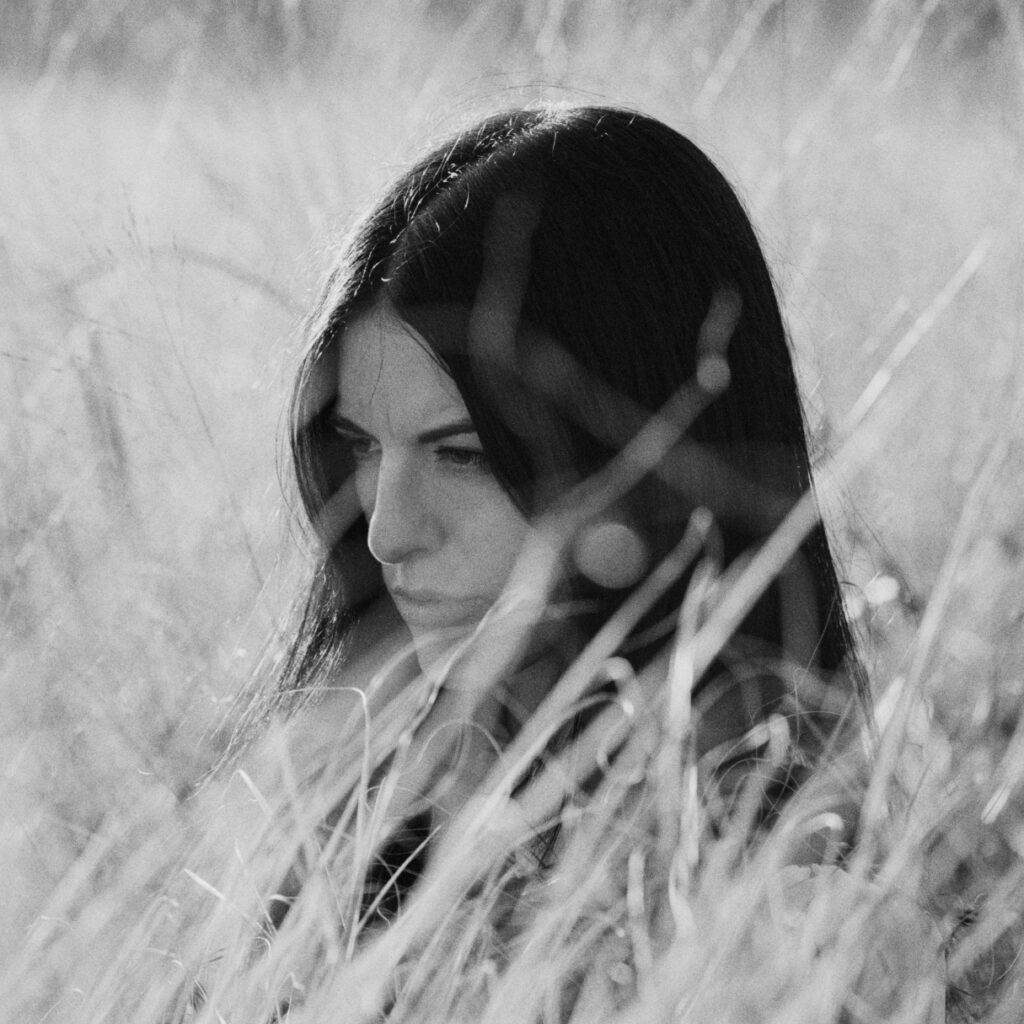
Chelsea’s essays excited me, energized me, and made me sick with envy. I could conceal myself through songwriting, I could lean into rhyme and, sometimes, affect. But Chelsea, who wasn’t much older than me, had managed to write openly and honestly about desire, sexuality, money, and power. I wanted to be so bold. And now Chelsea’s released her first singles as a musician. “Belong to Nobody” is an atmospheric and sexy treatise on the meaning of love, while “Sleepwalker” explores unhealthy habituated patterns and is a song you can blast in your car on a night out. Both songs are in conversation with her essay collection and reflect her attunement to philosophy, grief, and the importance of remaining reckless in artmaking.
In addition to being a musician and a writer, Chelsea runs the press Rose Books, works as an editor and a writing coach, and runs Morning Writing Club, where she helps writers maintain a regular writing practice and develop their work. I talked to Chelsea about her new music, recording while pregnant, and re-acclimating to making art after giving birth.
Katie Bennett: Hi Chelsea, congrats on “Belong to Nobody” and “Sleepwalker”! It’s exciting to access your interiority from another angle. I’d like to start by asking you something that’s top of mind for me as a new mom, with limited time and energy and everything else that entails—what did it look like for you to start a new creative project while mothering your young daughter?
Chelsea Hodson: Music has always been a really big part of my life. As a teenager I didn’t write much, what I really loved was music—going to shows and learning about bands and just kind of being a part of things. I never started my own band, but I always played guitar by myself and played the piano here and there. There was a part of me that thought, “Well, maybe I could make music myself someday.” And for whatever reason I decided to more clearly focus on writing and my dream of publishing a book.
I think in some ways that was a decision based on my discomfort with being seen. I thought I couldn’t be in a band, or I couldn’t be a singer-songwriter, because I didn’t really want to be on stage. What I really wanted was to be left alone and to hibernate and write.
So I thought I’d just focus on writing a book, which takes a long time. I found myself on the path to becoming a writer and that became my identity. When I got pregnant with my now-almost-two-year-old, I told my husband, “I feel like if I don’t record music now I’ll never do it.” So while facing a totally unknown new phase of my life, I had a feeling that I should push making music. I didn’t know what would happen and I didn’t have many songs written, but I wanted to try.
I asked my oldest friend Adam Lee, who’s an engineer at Jackpot! Studios in Portland, Oregon, “What do you think about us recording together?” He was really supportive. So I went to the studio with a vision of the album having a really quiet, singer-songwriter, girl-in-her-bedroom type vibe. We ended up doing four sessions in total, while I was pregnant, and I felt pretty bad physically. There were times at the studio in which I’d be laying down and falling asleep in between takes. The recording process wasn’t easy, but I was on this path where I was like, “I need to push this just to see what happens.”
I wasn’t sharing on social media that I was recording music, so I recorded the songs in a kind of quiet hibernation mode, which helped. It felt safe to experiment and explore.
Adam helped me reimagine some of these songs and helped them become more multi-dimensional. If I wrote a song on piano, he suggested maybe adding guitar or drums, which wasn’t something I was in the mode of considering. The process of recording the songs became quite collaborative in a way I needed, because it helped me build my confidence.
I finished all the recording while I was pregnant, and then on and off for the past two years we’ve been mixing and having conversations about the sound as I put a plan into motion to release the songs myself. I had a phase where I wondered if I needed a label to release the songs to validate them because, like most people, I have imposter syndrome when I do something new. I take my music really seriously and I want people to take it seriously, too. But in today’s day and age I don’t think it’s a requirement to have a label to put out music. I think it can still resonate with listeners when an artist releases something themselves. I’ve certainly seen the power of that with books and running my own press.
Since becoming a mom I’ve turned back toward songwriting because I often find the form more accessible than prose writing when I have limited time and energy. Has songwriting seemed especially attractive to you postpartum for similar reasons?
I struggle to have enough time to focus in the ways that I did before becoming a mother. Because, as you know, even when you have the time set aside for a creative project, your mind is often elsewhere. So I haven’t been as prolific about songwriting, but just in the last couple months, I was able to start writing and recording again.
A couple months ago, I went to Los Angeles to record with Adam and my friend Josh Klinghoffer. With my husband’s support and help at home, I was able to go into this other headspace as well as this other physical space and only worry about writing and recording again. It was a really generative and transformative week for me, and it was good to feel that I was building momentum toward a second album.
I’m finding that, in being a mother, pockets of time aren’t as generative as setting aside several days to really enter the dream of the music or the book I’m working on. I don’t want to portray myself as someone who’s “doing it all” easily because it’s extremely difficult for me, but also necessary I think. When my daughter grows up, I want her to be able to say, “It’s really cool my mom was able to continue to do all this stuff and to express herself in all these ways.” For me it’s really special that my daughter was technically with me while I recorded my first album. I’ve asked her, now that she can talk, “Do you remember hearing me sing?” She’ll nod and kind of say, “Mmm.” I’m not sure if she’s saying yes, but for me she’s really a part of those songs.
This is all really helpful to hear. From the outside it seems like you’re doing so much so effortlessly but of course it’s incredibly hard, and it all takes effort and planning.
Yes, and my album has been in progress for three years at this point.
How do you choose when to explore a feeling or thought through songwriting or prose writing?
The processes are totally different for me. I will often write a song in less than an hour. I’ll feel sort of reckless about it, in a good way. I’ll think, “That’s what it was meant to be,” instead of obsessing over it, like I do at the sentence level with my novel. When I was in LA, I was recording on my friend Josh’s piano. He had asked me if I’d like the piano tuned beforehand and I was like, “No, I like it a little out of tune.” I’m not aiming for perfection.
I’ll sit down and think, “What am I feeling today, what’s a cool line?” and I’ll try to follow my impulses in a more fluid way than when I’m working on my novel, a process which has sometimes felt quite laborious.
With songs, I still feel the freedom of being an amateur. And I like the challenge of learning something new—that’s part of the reason why I started my own press. I don’t want to just write another book of essays, because I feel like I know how to do that. The challenge was part of the appeal of motherhood, too.
Right. For me, the past six months of becoming a mother have been incredibly challenging, but they’ve also attuned me to the world in new ways and helped me access new depths of feeling. I’ve found the experience generative, creatively.
Totally. I’ve felt that way—broken open in all these interesting artistic ways, but it’s frustrating to notice that and not be able to write another book in the middle of the experience. It takes a while to put those feelings on the page, for me at least.
How do you balance the work you do for money—editing, being a publisher, etc—with creative work that is more amorphous and which may or may not bring in money?
I try to block off time throughout each week for creative ventures, and if I can’t do that, then I try to write or be creative in some way before I do things like writing coaching, or editing for hire. This ethos is how I started my Morning Writing Club—I was looking for my own sense of accountability to make sure I was writing before doing anything else, because that’s always what’s worked best for me. Now that I’m a mother, I have to be more flexible, because my sleep and my schedule always seems to be evolving.
I find my editing work to be its own creative act and sometimes I let it take over in a way I don’t intend. I have to be really intentional with my time and say, “Ok, today I’m going to play a cover song as a way to get back to playing music. Or re-read a few pages of my novel to get back into it.” Each project I do demands a different level of focus and time, even each book I publish by other people requires a different set of skills. What I preach in Morning Writing Club is being flexible with your life and trying to always get back to creating. Most of us have to fight to be creative. Most of us don’t have endless time and money, we have to be doing multiple things.
In your songwriting, like in your prose writing, you’re interested in forms of love that are expansive and mysterious and undefinable. In “Sleepwalker” you write love letters that are indirect and “in between” and love “belongs to nobody” in your eponymous song. When you wrote those songs were you thinking about love within certain contexts—marriage, motherhood, friendship, etc?
With “Belong to Nobody” I was thinking aphoristically and wondering if I could write a song that conjures the feeling I get when I read philosophy. As with a lot of my songs, I wrote the lyrics in response to the music I wrote. I think that process can make the lyrics come out of a more subconscious place for me. “Belong to Nobody” was written in the studio—I didn’t prepare anything beforehand. The process of writing it wasn’t as intellectual as when I write an essay. It’s mysterious how it came about. I was wondering what love is, and thinking about it as this thing that you maybe want to hold onto but that refuses to be held. It comes and goes without warning, whether through loss of a relationship or a death. Thinking about losing people in whatever capacity informed that song. My really close friend Giancarlo DiTrapano died while I was writing the first drafts of some of my songs, so he was definitely on my mind. One of my other songs is explicitly about him.
With “Sleepwalker,” the structure of the song informed the lyrics. To me the structure is like a loop that occurs twice, and it made me think of a cycle you can’t get out of—love, addiction, a bad habit, whatever. That’s where the lyric “I swore I wouldn’t do this again” came in.
Your friend Adam Lee produced the album but I’m sure you had ideas for how you wanted the songs to sound—did you bring him songs for inspiration?
The sound came together through our collaboration more than it did any sources of inspiration I brought to him. “Belong to Nobody” was born out of a year of conversations about where the drums should go, where the electric guitar should come in, and what the sound would be. I did bring in sources of inspiration but we actually veered from them. One of my biggest inspirations and holy grail albums is Grouper’s Ruins. You can hear frogs in the background of it and it’s very atmospheric but that’s not where I ended at all. And Adam was working with his own influences. Some of the songs are just me and piano, some are just me and an acoustic guitar, others are much more built out and collaborative.
It’s fortunate that Adam is your good friend and you had space and time to experiment with him because most musicians are only able to afford a few days of studio time and that’s it. Recording time can feel really pressurized and restrictive.
Totally. Adam is what really made recording songs possible for me. He created a safe space in which I could explore. I had major imposter syndrome when I got to the studio for the first time. And I remember almost crying—I was pregnant so had pregnancy hormones too—the first time I heard my clean vocals through headphones. I was like, “This is horrible.” I wasn’t singing confidently, I was scared. I asked Adam, “Is this bad? This is bad, right?” And he was like, “No, no, everyone just hates how they sound in their headphones. Trust me, we’ll mix it and it’ll sound good.” If I were at a studio with a stranger, I wouldn’t have been able to say that. I would have been freaking out and trying to perform well.
Adam’s brain works totally differently than mine. I really want to control and intellectualize everything and Adam is like, “Just let it happen,” but he’s also an expert in a way that I’m not. So we were perfect collaborators. When I would get anxious he would be there to buffer it. He didn’t always tell me things sounded good but he’d be there to help it sound better. He was honest and encouraging.
I hear you naming what makes a good collaborator—someone you trust and who makes you comfortable.
And someone who has another perspective than you. I couldn’t have recorded my songs with a version of myself, it would have been horrible. I really needed Adam to offset whatever negativity I was feeling and vice versa. We could each hear different things we wanted to change. Part of the reason I’m a writer is that I like doing things myself, I like having control. But with Adam I thought, “This is actually working, this is the beauty of collaborating on a song, this is how these things become magic.”
What are your hopes and ambitions for your music? Do you plan to tour? Keep writing songs and see where the process takes you?
Mainly I want to keep writing and releasing songs. I’m pretty realistic about my circumstances. I don’t live in a big city and I’m brand new at this so really I’m just trying to present my music seriously and release it in a meaningful way. And I’ll put out a vinyl next year. I’m not sure to what degree I can tour because my band lives in Portland so it’s not like we can practice easily. We’ll try to do some sort of tour at some point but that’s a bit ambiguous. The most important thing for me is to continue writing and making music in addition to books.
Katie Bennett is a writer based in West Philadelphia who is interested in time, motherhood, power, and desire. Her first book, She Was Wild Grass, will be released by Brink Books fall 2026. She’s published work in Lit Hub, swamp pink, and Salmagundi and received fellowships from Yaddo, Hedgebrook, and Monson Arts. She’s a contributing editor for Zona Motel and she runs the reading series Personal Velocity.
This post may contain affiliate links.