


[Open Letter Books; 2025]
tr. from the Spanish by Helen R. Lane
When an intellectual with self-proclaimed “gifts” is mercilessly exposed as a fraud, he flees to another continent, where he will build a hut in a desolate region and plot his roaring revenge. Because the local demand for his intellectual work is next to none, he needs to get creative in how he will fund his research. Being wily and practical enough, he can quite easily get rich in a local venture—selling wire fencing to ranchers, for example—that leaves him with sufficient time to stand around and think. Of course, he can’t be expected to do it all alone: he will need a wife, who will also serve as his ever-loyal research assistant. He will also need at least one friend and business partner to help with the fences. Unfortunately, he may begin to suspect that this friend and his wife are sleeping together, even sharing cigars when he isn’t around, and the paranoia might get to him. It might even derail his work and quite possibly drive him insane.
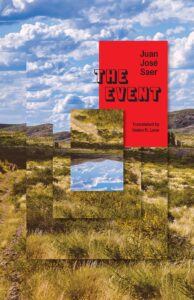
The Event by Argentinian writer Juan José Saer (1937–2005) is the story of this intellectual: Bianco, a man of murky identity and dubious talents. Originally published in Spanish in 1988, it’s Saer’s eighth novel, winning him the prestigious Premio Nadal literary prize, and was translated into English by Helen R. Lane, a prominent translator of Spanish, Portuguese, French, and Italian literature who has won both the PEN Translation Prize and the National Book Award. The novel takes an ironic look at the life of the mind, blending it with a more earnest examination of alienation, identity, and self-imposed exile. These themes must have been close to Saer, who was born in Argentina to a Syrian-Lebanese family and spent the final decades of his life in France. His protagonist, Bianco, has a similarly transnational identity. Like a character in a Bolaño novel, he crosses borders until he doesn’t seem to belong to any one place, moving around Europe before leaving for Argentina in the 1870s. But Bianco is different from the Italian or other immigrants sailing for the Americas. His background is never revealed, and we’re reminded several times throughout the novel of the curious fact that he speaks every language, even his mother tongue, with the same strange accent. Estranged from the world, he is never at home in any country or language. Maybe he has no identity at all. He wants to make something of himself out of these obscure origins, even if what he creates is a fake; he is like a non-homicidal Tom Ripley.
At the beginning of the novel, Saer presents the Argentinian landscape as being similarly murky, a non-place to Bianco in his colonialist position (the Italian government hires him to convince peasants to immigrate to Argentina):
The flat expanse, with no surface irregularities, that surrounds him, as gray as the sky at the end of August, represents better than any other place the uniform emptiness, the space devoid of the phosphorescence of ill-assorted colors that the senses emit, that translucent no man’s land inside his head where strict, silent, and clear syllogisms concatenate.
The pampas is flat, monotonous, and gray, with a sense of unreality. Bianco is drawn to its lack, finding in it the perfect location to think, as if mining its apparent emptiness for his philosophic proofs. But it isn’t really a void. It’s the dusty, hypnotic landscape of a western, a genre Saer is clearly playing with, and it begins to exert power over Bianco. By the end of the novel, the world around him gradually becomes awash in the “ill-sorted colors” that he has tried so hard to evade. His senses overwhelmed, Bianco begins to go mad. The pampas reminded me quite a bit of the South American landscapes in Werner Herzog’s films Aguirre, the Wrath of God and Fitzcarraldo, in the way they entice their European protagonists while eventually overseeing their destruction.
Bianco abandons Europe because of a philosophical obsession that gets mixed with a desire for revenge. It’s an intellectual squabble taken to a parodic extreme. Specifically, he wants to refute the despised positivists, the “cabal” of nineteenth-century philosophers who held that all true knowledge is derived from physical experience and experimentation. Bianco hates the material world of the senses, which throughout the novel is given various histrionic epithets such as “the material magma that poisons him” or “the adverse matter that prisons him.” He places mind above matter, going so far as to claim powers of telekinesis and telepathy, which, if they exist, would immediately dismantle the positivists’ position. The positivists see him more as a joke than a threat, cruelly exposing him as a fake during a public demonstration in Paris, after which Bianco flees the country. Bianco’s subsequent research never goes anywhere, and the novel leaves the true nature of his powers unclear. While it seems that he is a fake, we never definitively learn that he has no powers. He is a quixotic failure.
He fits into a line of modernist overthinkers, like the narrator of Fernando Pessoa’s The Book of Disquiet, with their obsessive tendency to doubt reality and see themselves as only a mask. Bianco’s distrust alienates him from everyone around him, including his wife, Gina. When Gina becomes pregnant, Bianco suspects without any real proof that Garay López, his friend and business partner, is the father, and his initial suspicion grows into an increasingly feverish paranoia:
Bianco has already formed an opinion about Gina, and often he imagines her, not only in the company of Garay López, but in that of all the men in the immediate vicinity; he is convinced that she is not only victim of that matter beyond measure that he detests, but that she also secretes it, and that, like those female insects which eroticize the branch of the tree they land on, Gina contaminates whatever she touches, and leaves a voluptuous trail wherever she passes.
Bianco sees Gina as a dangerous and enigmatic force. His growing distrust of her and Garay López mixes with his distaste for matter, rising to a disastrous extreme in which Bianco becomes separated from those around him. It’s a cliché, how someone’s intellectual or creative obsession distances them from other people, but Saer depicts it with such intensity that I felt completely drawn in, especially by the end of the novel, which has the nightmarish, surreal quality of a Poe story or a post-apocalyptic science fiction novel.
In Bianco, intellectual conviction slips into conspiracy. No one asks him to refute the positivists; no one else even seems to care. He takes it on himself and won’t let it go, becoming increasing paranoid and plagued by thoughts of persecution by the positivists. He fails in his mission to refute them, and his failure destroys him, as he comes to realize that “the possibility of knowing is escaping him, slipping down the endless corridor of the past toward the inconceivable place where frustrated hopes and secrets rust, disintegrate and are reduced to dust.” For all its ironic and satiric elements, the novel presents an unsettling vision of ash and dust. In the dismantling of Bianco’s fragile reality, the novel leaves us with a landscape as barren and inhospitable as the far-flung reaches of the pampas.
Noah Slaughter writes fiction and essays, translates from German, and works in scholarly publishing. He lives in St. Louis.
This post may contain affiliate links.