


The Buddha learned to extinguish desire. For [Debré’s] narrator, desire appears as liberation, what the rigid world of shitless boredom kept from her.

In the course of living, are we acting? In the act of remembering, are we editing life? And when we first began to watch movies, did the act of watching films become the way we experienced our memories?

The Singularity – Balsam Karam
Karam has written a surprising work of horror, embedded in two motherhood plots that briefly connect in an unnamed harbor town half-recovered from a violent conflict.

Capitalist modernity renders mothers and daughters as autonomy-desiring “units”; SALT reveals the ache of this separation.
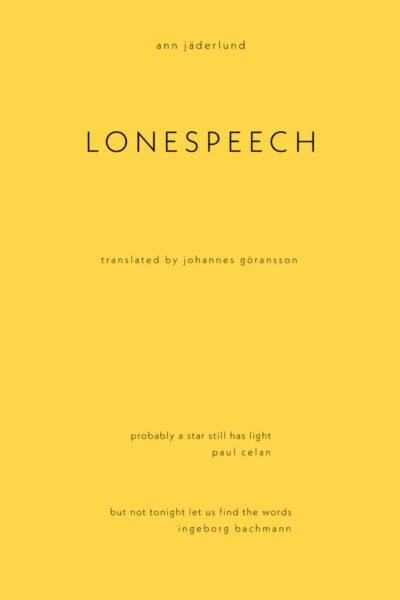
Lonespeech is a dialogue edited down to a poem, its minimalism acknowledging the blank space around its “cut-out” phrases.

I think of [the Russian soul] as acknowledging our suffering, our collective suffering. I think of it as a connection point with other people. Exquisite pain. I think there’s also a perverse enjoyment of suffering. It’s like, there’s something kinky about it.

A hypnotic novel, itself seemingly hypnotized by bodily fluids.

A Small Apocalypse – Laura Chow Reeve
Reeve’s imagined worlds are not habitable alternatives but critical comments on this one. Her idea of a refuge is not the infinite expanse of the interior self, but the tight-knit, embattled queer family in a hostile world.

The Literary Life of Connie Converse
On her own, Converse created great and complex work, but what might the canon look like today if she found an audience in her lifetime? If she created in communion with other great art?

Like a Sky Inside – Jakuta Alikavazovic
Alikavazovic’s writing is contemplative and digressive, roving like the insatiable gaze of a consummate museum goer.